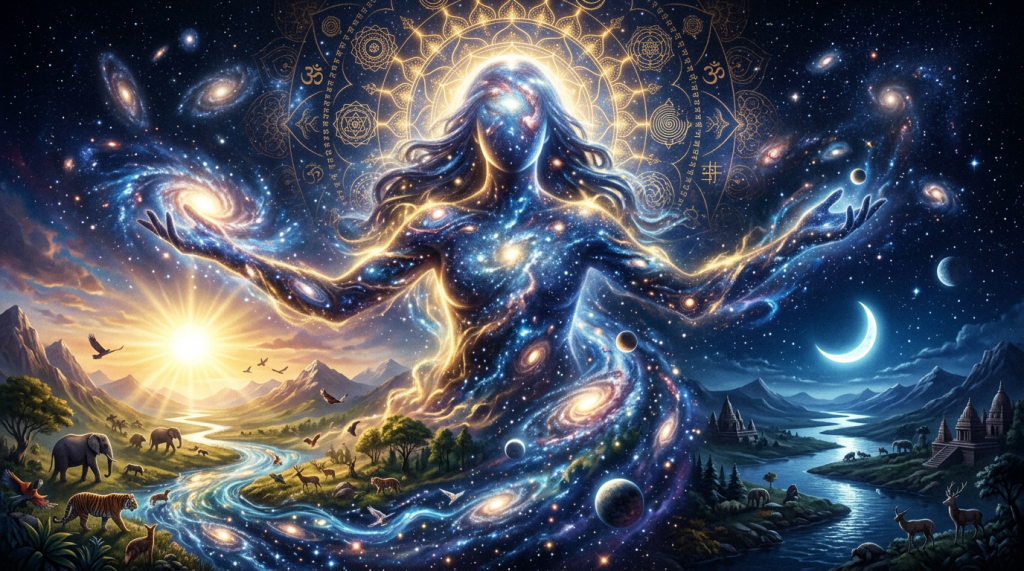
There is in the Rig Veda a hymn that has been more misread, more mistranslated, more misused than any other. Hymn 10.90 — the Puruṣasūkta, « the hymn of the cosmic Being » — has become over the centuries the founding text of the caste hierarchy, the religious justification for a social inequality that its authors had probably never imagined.
This hymn must be read differently. It must be read as it is.
The Puruṣa: the total cosmic Being
The hymn opens with a vision of vertiginous scope:
10.90.1 — The Purusha has a thousand heads, a thousand eyes, a thousand feet. Having covered the Earth on all sides, he extended it by ten fingers.
10.90.2 — The Purusha is the Whole: what has been born and what will be born. And he is master of immortality when he rises beyond here, through nourishment.
10.90.3 — His greatness is truly great, but the Purusha is even greater. One quarter of him is composed of all living beings; three quarters of this immortal are in Heaven.
The Puruṣa — from Sanskrit pur, « city, » uṣa, « the one who inhabits » — is the Being who inhabits everything, who is everything. A thousand heads, a thousand eyes, a thousand feet: the totality of consciousnesses, the totality of gazes, the totality of paths. This is not a personal god. It is the cosmic consciousness in its total manifestation.
And this cosmic consciousness is both immanent — « one quarter of him is composed of all living beings » — and transcendent — « three quarters of this immortal are in Heaven. » The visible cosmos is only one quarter of the Puruṣa. The rest is beyond what the senses can perceive.
The cosmic sacrifice: a cosmogony, not a social prescription
The heart of the hymn is a cosmic sacrifice — not a human sacrifice, but the sacrifice of the cosmic Being by itself to give birth to the world:
10.90.6 — When the gods received the offering through the Purusha, they extended the sacrifice. Spring was its clarified butter, summer its kindling wood, autumn its offering.
10.90.9 — From this sacrifice, entirely offered, the shlokas and songs were born. From them, the rejoicings were born. From them, veneration was born.
The world is born from a sacrifice. Creation is a cosmic self-gift. This is not a political metaphor. It is a cosmogony — a description of how the One multiplies into the All.
Verse 12: a functional description, not a hierarchy
It is verse 12 that has been — deliberately or through ignorance — transformed into the theological foundation of the caste hierarchy:
10.90.11 — When they fixed the Purusha, into how many parts did they condition him? Who was his face? Who were his two arms? Who were his thighs? Who were his feet? Tell us!
10.90.12 — The Brahmins were the face. The Rājanya s were made from his two arms. As for his thighs, these were the Vaishyas. The Shūdras were born as feet.
To read this verse as a justification for the caste system is to commit a fundamental reading error — and a historical context error.
First: in the 7 Rivers civilization at the time these hymns were composed, there is no archaeological evidence of a rigid social stratification. The excavations of Mohenjo-Daro, Harappa and Rakhigarhi reveal a society without outsized palaces, without royal tombs overflowing with gold, without spatial segregation between rich and poor. It is a civilization in which — as I document in The Civilization of the 7 Rivers — even the houses of the most modest had a bathroom and access to the sewage network.
Second: the image of the body is a metaphor of integration, not of hierarchy. The face speaks and thinks — that is the function of the brahmin, the guardian of knowledge. The arms protect and act — that is the function of the rājanya, the king-administrator. The thighs support and nourish — that is the function of the vaishya, the farmer-merchant. The feet carry and root — that is the function of the shūdra, the employee.
In a human body, the feet are not inferior to the head. They are indispensable. A body without feet goes nowhere. And the head that despises its feet falls.
Third: the text speaks of varṇa — a term meaning « colour, » « character, » « quality » — not jāti, the term that designates the hereditary castes of classical and modern India. The confusion between varṇa and jāti is one of the greatest falsifications in the religious history of India.
The description of a peaceful, functional society
In the original Vedic vision, the four varṇas are four complementary functions of a social body — like the four seasons, like the four directions, like the four forms of speech that Vāc describes in hymn 1.164.45.
What characterizes a healthy society is not the absence of functional differentiation. It is the harmonious integration of all functions. A body where the face despises the feet is a sick body. A society where the guardians of knowledge cut themselves off from craftsmen and farmers is a society that loses contact with its own reality.
The cosmos as social model
10.90.13 — The Moon was born from his mind. From his eye was born the Sun. From his face were born Indra and Agni. From his breath was born Vāyu.
10.90.14 — From his navel was the intermediate world. From his head, Heaven spread out; from his feet, the Earth; and from his ears, the directions. They organized the worlds in this way.
The Sun is born from the Puruṣa’s eye. The Earth from his feet. Vāyu from his breath. The entire cosmos is the body of the cosmic Being, and every element of this cosmos is indispensable to all the others.
The Puruṣasūkta is the hymn of humanity because it says that all of humanity — in the full diversity of its functions and talents — is the visible body of the Puruṣa, the cosmic Being who is all. No part of this body is inferior to the others. All are necessary. All participate in the divine.
This is the reading the text supports. The rest is politics.


Laisser un commentaire