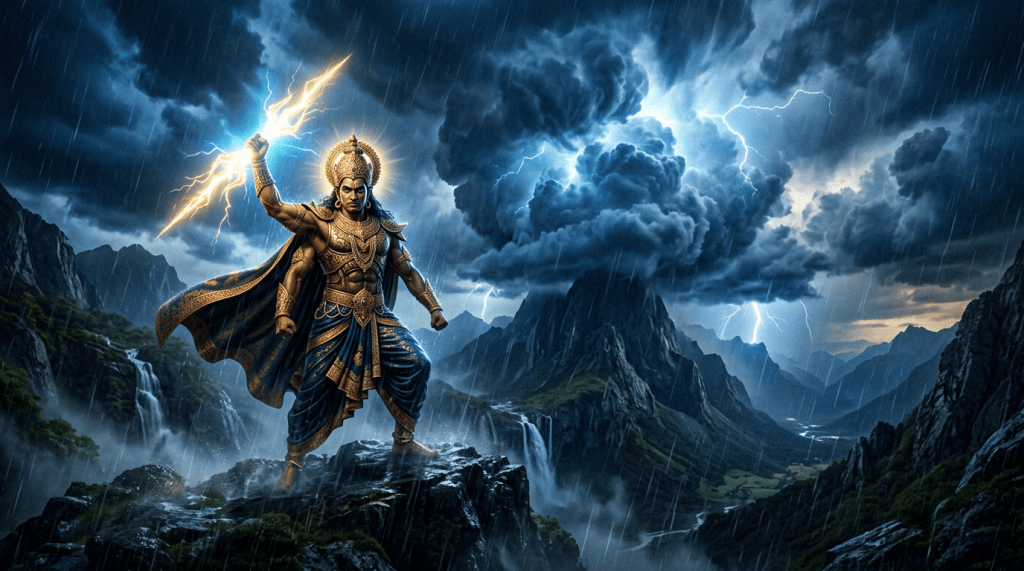
In the Rig Veda, no god is invoked more often than Indra. Of the one thousand and twenty-eight hymns in the text, more than two hundred and fifty are entirely devoted to him — a quarter of the entire work. And yet Indra is perhaps the most misunderstood Vedic god in Western academic tradition, which has wanted to see in him a barbarian warrior brandishing his thunderbolt against human enemies.
In The Civilization of the 7 Rivers, I formulate it clearly: when Indra is asked to give strength and kill enemies, it is about spiritual strength, spiritual energy. Today’s Indians call it by different names depending on the current they follow: kundalini, shakti are the most common.
Indra is not a god of war. He is strength and spiritual energy deified.
Who is Indra? The glossary definition
In the glossary of The Civilization of the 7 Rivers, the definition of Indra is precise and multidimensional: « He who is powerful » is the warrior god. He is also linked to the senses, and in particular to the intellect, which is a sense in India. He is the storm, his weapon is lightning. His power is revealed through the soma, which he loves. He conquers for man wealth (the Brahman), the Cow (the Light) and the Horse (strength).
Three conquests. Not territories, not material riches. The Brahman — absolute consciousness. The Light — direct knowledge of Reality. And Strength — the vital energy that allows one to reach them.
And his weapon — the Thunderbolt — is defined thus in the glossary: « Indra’s weapon that kills ignorance to make way for Light. »
The thunderbolt that kills ignorance. This is not poetic metaphor. It is a precise description of an inner process: the sudden, thunderbolt-like irruption of clear consciousness that dissolves the illusions of the Ego.
Hymn 2.12: « This powerful one is Indra »
Hymn 2.12, composed by the rishi Gṛtsamada Bhārgava Śaunaka, is the most repetitive and hypnotic portrait of Indra in the entire Rig Veda. Fifteen verses, each ending with the same refrain: « O people, this powerful one, it is Indra. »
This structure is deliberate. The hammered refrain — fifteen times — creates an accumulation effect that eventually overflows rational understanding to reach something deeper. It is a mantra. And like all mantras, it acts not only through its meaning, but through its rhythmic recurrence.
2.12.1 — The one who was born, the god first and most wise, has embellished the gods with his motivation. The Sky and the Earth trembled before the power of the Sun, O people, this powerful one, it is Indra.
2.12.2 — The one who has strengthened the disturbed Earth and calmed the angry mountains, who has measured the vast Intermediate World, who has sustained the Sky, O people, this powerful one, it is Indra.
2.12.3 — The one who killed Ahi, who freed the seven Rivers and brought the Cows out of the Cave, who created fire between two stones and totally triumphed in battles, O people, this powerful one, it is Indra.
In these three opening verses, all of Indra’s cosmology is established. He sustains the Sky and the Earth — he is the structuring force of the cosmos. He frees the seven Rivers — he liberates blocked energy flows. He creates fire between two stones — he is the force from which consciousness springs.
And the Cow brought out of the Cave — in the Vedic double reading — is the Light of knowledge freed from the darkness of ignorance.
« Does Indra exist? »: doubt in the text
One of the most extraordinary aspects of hymn 2.12 is verse 5, which anticipates the most radical philosophical questioning:
2.12.5 — They have asked: is this venerable, yes, or is it not him? He comes, bringing all the Riches and destroys the one who is like someone fleeing, according to his aspirations. Believe in him, O people, this powerful one, it is Indra.
« Is this venerable, yes, or is it not him? » — the rishi himself reports that some doubted the existence of Indra. And his answer is not dogmatic — it is « believe in him » because he comes bringing riches. The proof of Indra is experiential, not doctrinal.
This doubt within the sacred text itself is typical of the Vedic intellectual honesty — the same honesty that produces the conclusion of the Nāsadīya Sūkta: « And if he did not know? »
Indra and soma: strength revealed through experience
In the glossary of The Civilization of the 7 Rivers, it is said that Indra’s power is revealed through the soma, which he loves. This formulation is essential.
Indra drunk on soma is not an image of divine debauchery. It is the description of a particular state of consciousness — the state in which the raw spiritual energy that ordinary consciousness cannot perceive becomes visible and operative.
2.12.13 — Even the Sky and the Earth bow before him. Before his flame, the mountains are afraid. The one known as a soma drinker, carrying the Thunderbolt, brandishing the Thunderbolt, O people, this powerful one, it is Indra.
Indra « known as a soma drinker » — this is his most constant characteristic. His relationship to soma is not incidental. It is the condition of his power. The tryptamine of soma triggers in Indra’s consciousness — and in that of the rishi who invokes him while drinking soma — the pure spiritual energy: the kundalini, the shakti, the force that breaks inner obstacles and liberates the Light.
Indra, the Maruts and collective energy
Indra does not act alone. He is always accompanied by the Maruts — the troop of unleashed winds, his companions and amplifiers.
Their combination says something essential about the nature of spiritual energy in the Vedic vision: it is not solitary. It is collective, communal, amplified by the resonance between several consciousnesses. The Vedic sacrifice is not a solitary practice. It is a collective practice — several rishis reciting together, several participants drinking soma together, the consciousness of each amplified by the presence of the others.
What Indra says to our time
In our contemporary world, « strength » is almost always understood in its most literal and external sense: military strength, economic strength, political strength. We have almost entirely lost the Vedic meaning of strength — as inner energy, as spiritual vitality, as the capacity to see clearly in the darkness of the Ego.
Today’s Indians call it kundalini or shakti. Buddhists call it chi or prāṇa. Western contemplative traditions call it « grace » or « vital impulse. » But whatever name one gives it, it is the same reality that the Rig Veda deified under the name of Indra: the force that liberates, that illuminates, that breaks obstructions and lets the Light flow.
2.12.15 — You reveal the Truth in the pressing of soma, with your Strength, you crush and restrain the Enemies, you are this Hero. Therefore, forever, we are your friends, O Indra, we can proclaim it in the assembly with the good Heroes.
« We are your friends. » Not his servants, not his subjects. His friends. The relationship with deified spiritual energy is a relationship of friendship — of reciprocity, trust, mutual growth.


Laisser un commentaire