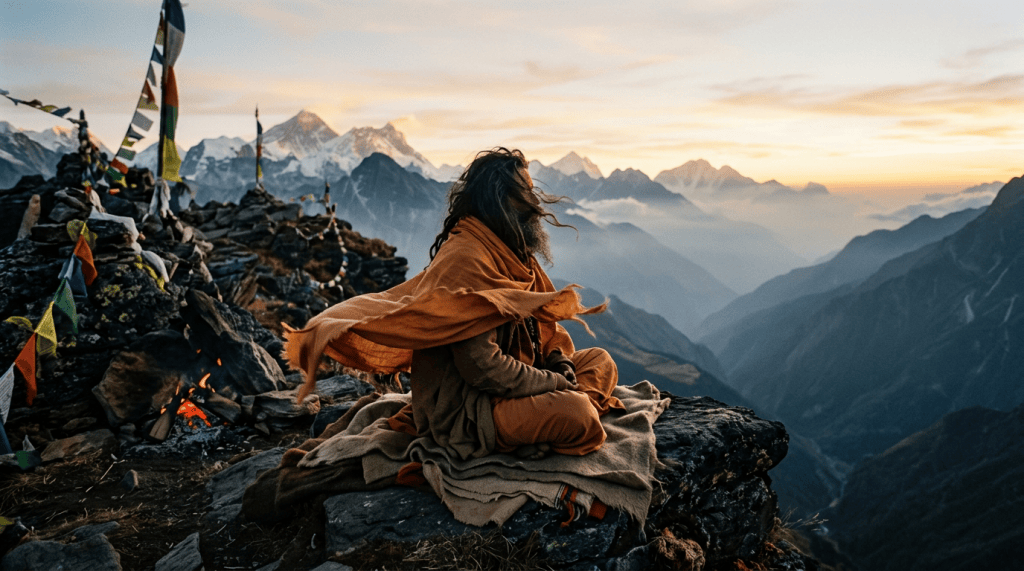
There is a received idea about Vedic meditation that must be dispelled from the outset: meditation is not absent from the Rig Veda because the word dhyāna — which will designate meditation in later traditions — does not yet appear there as a technical term. Meditation is present in the Rig Veda in multiple forms, in different words, in different practices — and it is, along with sacrifice and soma, one of its three fundamental pillars.
In the introduction to my translation, I formulate it clearly: one can only understand Reality (the Brahman) if one’s intellect falls silent. And this condition — the silence of the intellect — is precisely the definition of meditation in the Vedic tradition.
The Rig Veda as meditation support
The first thing to understand about the relationship between the Rig Veda and meditation is formulated in my introduction: each verse is a support for meditation. Therefore, there is no need to « devour » the Rig Veda.
This is not a figure of speech. The Rig Veda is not a text to be read quickly to extract information. Each verse — each mantra — is designed to be recited slowly, several times, in a state of concentration that borders on the meditative state. The rhythm of the metre, the recurrence of sounds, the semantic depth of the words — all converge to induce a modified state of consciousness through language alone.
In my introduction, I describe the sacrificial context: the sacrificer concentrated on the sound, the rhythm and the meaning of the mantra. This triple concentration — sound, rhythm, meaning — is precisely what all later meditative traditions will call samādhi: the total absorption of consciousness in a single object.
Hymn 10.136: the Keśins, meditative ascetics
Hymn 10.136 is one of the most extraordinary texts in the Rig Veda — and one of the most direct about meditative experience. It is devoted to the Keśins — « the long-haired ones » — wandering ascetics who practise a radical form of renunciation and contemplation.
In my translation:
10.136.1 — The long-haired one carries the fire. The long-haired one carries what acts quickly. The long-haired one carries the Sky and the Earth. The long-haired one carries the Sun that all see. The long-haired one is called Light.
10.136.2 — The ascetics, girdled with wind, dress themselves in ash, they follow the Force of the wind when the gods have entered into them.
10.136.3 — « Driven into an ecstatic state, we ride the winds. You mortals, you see only our bodies. »
10.136.4 — He flies in the intermediate world, seeing all forms. The ascetic has been established as a friend of every god for his spirituality.
« You mortals, you see only our bodies » — the Keśins speak in the first person of an out-of-body experience. Their consciousness is elsewhere — in the Intermediate World, flying with the wind, seeing all forms. Their body is there, in the camp, around the fire. But they — their consciousness — are elsewhere.
This is the most precise description of the deep meditative state that the Rig Veda has left us. Not meditation as relaxation or concentration, but meditation as a journey of consciousness beyond the ordinary limits of bodily perception.
And the long-haired one « carries the Sky and the Earth » — he carries within him the totality of the worlds. Deep meditation does not narrow consciousness. It widens it to contain the universal.
Meditations as path toward the Light
Throughout the Rig Veda, meditation appears as the path par excellence toward the Light — toward direct knowledge of the Brahman:
7.87.7 — Meditation leads to Union. — A half-verse that says everything. No elaboration. Meditation leads to Union — with the Brahman, with Truth, with what is.
9.63.21 — The swift bull is active through thoughts. This is the flow of truth. The sages have been completely illuminated by the meditations. — « Completely illuminated by the meditations » — not partially, not temporarily. Completely. Enlightenment is the destination of Vedic meditation.
9.85.3 — The sages through their meditation savour the brilliant sap of this couple, in the eternal posture of the Gandharva. — « The eternal posture of the Gandharva » — the stable meditative posture, the one the seals of Mohenjo-Daro depict in the Baddha Koṇāsana posture. Eternal because perfect, balanced between tension and release.
Māyā, Brahman and the silence of the intellect
The meditative theory of the Rig Veda rests on a precise vision of reality. In my introduction, I formulate it thus: Māyā — generally translated as « illusion » — is the perception that our senses give us of the world around us. The reality is the Brahman. Our eyes cannot see everything. Our ears cannot hear everything. One can only understand Reality if one’s intellect falls silent.
This phrase — « if one’s intellect falls silent » — is the Vedic definition of meditation. Not the suppression of consciousness, but the suppression of the discursive activity of the intellect. That continuous noise of thoughts, evaluations, inner commentaries that occupies ordinary mental space and prevents direct perception of the real.
Vedic meditation is therefore a practice of silence — not the silence of sounds, but the silence of the mind. And in that silence, what remains is pure consciousness — the Brahman, Reality without veil.
Yoga before the word yoga
In my introduction, I specify it: yoga already existed at the time of the Vedic hymns, even if this word does not exist to designate a specific discipline in the Rig Veda. Renouncing ascetics already existed. The seals of Mohenjo-Daro prove it.
What we call « yoga » today — the discipline of the body and breath as preparation for meditation — was already there, without that name. The Keśins of hymn 10.136 are its most direct demonstration: ascetics who « gird themselves with wind » (pranayama), dress in ash (renunciation of the body), and fly in the Intermediate World (deep meditative state).
The tryptamine we naturally generate in our brain is « triggered » by yoga, meditation and especially pranayama. Stanislav Grof demonstrated it through holotropic breathing. The Vedic rishis knew it without needing Grof to confirm it.
What Vedic meditation says to our time
Contemporary meditation — popularized by Jon Kabat-Zinn, Matthieu Ricard, Yuval Noah Harari — has become a global market. Mobile applications, paying retreats, corporate courses. A decontextualized meditation, often reduced to a stress management technique.
The Vedic tradition proposes a radically different vision: meditation is not a tool for individual well-being. It is a communal, ritualized, structured practice aimed not at stress reduction but at the direct knowledge of Reality. And this direct knowledge — Enlightenment, Union with the Brahman — is not a spiritual luxury. It is the condition of just governance, generous sacrifice, and society without oversized Ego.
10.136.1 — The long-haired one is called Light.
The meditating ascetic is the Light. Not because he holds it. But because in the silence of the intellect, he can no longer be anything else.


Laisser un commentaire