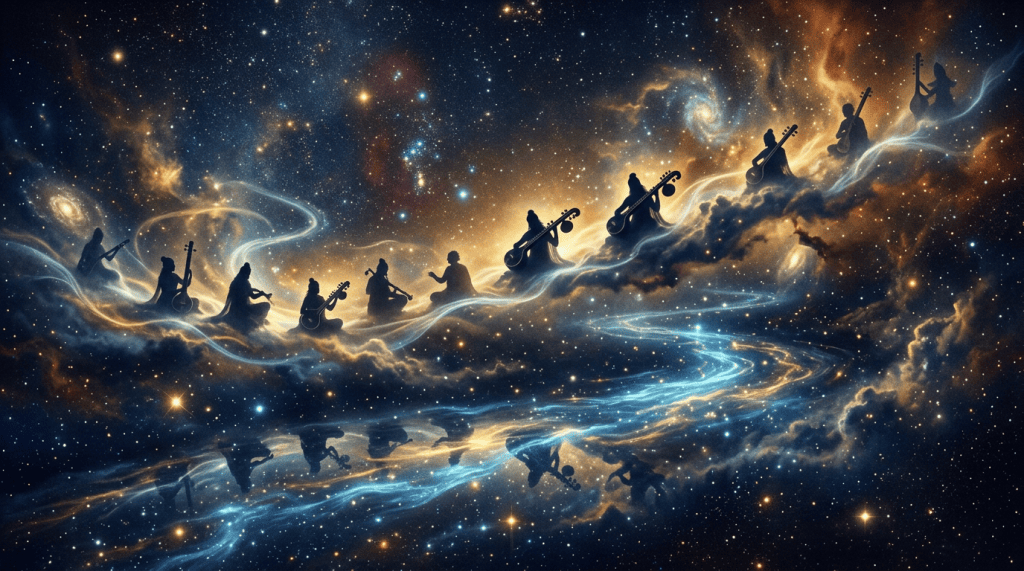
In the Vedic pantheon, the Gandharvas occupy a singular place — neither quite gods, nor humans, nor demons. They inhabit the Intermediate World — that space between the Earth and the Sky where « all paranormal events occur, » as I define it in The Civilization of the 7 Rivers.
They are the musicians of the cosmos. The guardians of soma in the Sky. The transmitters of speech between worlds. And in a way that is not metaphorical, they are also the first musical algorithms that human thought ever formulated.
Who are the Gandharvas in the Rig Veda?
In the Rig Veda, the Gandharvas appear in several hymns with precise and distinct functions.
In hymn 1.163 on the horse sacrifice, the Gandharva appears as the one who seized the cord of the first celestial horse:
1.163.2 — Given by Yama, harnessed by Trita, it is he who was first ridden by Indra. The Gandharva seized his rope, O Vasus, from the Sun you fashioned the Horse.
In hymn 3.38.6, the rishi Viśvāmitra describes a mystical vision in which he sees the Gandharvas themselves:
3.38.6 — Coming here through my mind, I even saw the Gandharvas, their hair in the wind.
And in hymn 10.139, the Gandharva Viśvāvasu is described as the one who measures the Intermediate World and stimulates thought:
10.139.4 — The Waters, O Soma, saw Vishvavasu, the Gandharva. They flowed, by the Truth.
10.139.5 — May Vishvavasu sing it to us, he who is the divine Gandharva, whether we know it or not, measures the Intermediate World. Stimulating our thoughts, he makes us understand that he can help us.
« He measures the Intermediate World. Stimulating our thoughts. » — this is the fundamental function of the Gandharva: to measure, and through that measure, to stimulate thought. This is precisely what a musical algorithm does.
And in hymn 10.177.2, the connection between the Gandharva, speech and the transmission of knowledge is explicit:
10.177.2 — The bird brings the word, through its mind. The Gandharva said it to the germ. The sages protect the sounds of the brilliant minds on the path of Truth.
The Gandharva is the one who says the word to the germ — who transmits knowledge before the form even exists. This is the fundamental idea behind every generative program: a rule (the Gandharva) that produces a form (the music, the speech) before that form is decided.
The Gandharva as principle of measure
What defines the Gandharvas in the Rig Veda is their relationship to measure. And in the context of Vedic music — which is precisely a music of metres, cycles, numerical proportions — this measure is not metaphorical.
Vedic music is a music of rules — precise metres (Gāyatrī: 3×8, Triṣṭubh: 4×11, Jagatī: 4×12), cycles that repeat and transform, numerical proportions between different parts of the sacrifice. These rules are not constraints imposed from outside. They are generative structures — algorithms, in the most literal sense of the word.
An algorithm is a series of rules that, applied to an initial state, produces a result. A Vedic metre is precisely this: a series of rhythmic rules that, applied to a content (the mantra text), produces a musical form.
And the Gandharva is the entity that « measures » — that applies these rules to the Intermediate World, that produces the music of the cosmos from numerical proportions.
Contemporary algorithmic music: what the Gandharva anticipates
Algorithmic music — also called generative or procedural music — is a field of contemporary musical composition in which rules or mathematical processes automatically generate music, without each note being manually decided by a composer.
Its first academic manifestations in the contemporary West date back to Iannis Xenakis (1950s) and John Cage, but it has developed explosively with computer algorithms. Today, systems like Google’s Magenta, OpenAI’s MuseNet, or AI music generation tools produce continuous music from rules and probabilistic models — without human intervention at each musical decision.
The principle is exactly what the Gandharvas embody in the Rig Veda: an entity that « measures » — that applies rules to an intermediate space (here, the space between training data and musical output) to produce a form.
Vedic metres as algorithms
The connection between Vedic thought and algorithmic music is not only metaphorical. The metres of the Rig Veda — the Gāyatrī, Triṣṭubh, Jagatī, Uṣṇik, Anuṣṭubh metres — are precise generative systems.
Each metre is defined by a number of syllables per verse and a pattern of accents. This pattern is not fixed for every syllable — there are constraints on certain positions, and freedom on others. A simple algorithm: fixed rules on some positions, controlled randomness on others.
This is exactly the principle of constraint-based algorithmic music — fixed rules that define certain parameters, and stochastic randomness managing the free parameters. The result: music that is both structured (recognizable as belonging to a style or metre) and infinitely varied in its concrete realizations.
The rishis who composed in the Gāyatrī metre did not decide each syllable at random. They followed the rules of the metre — and within those rules, they improvised, composed, created. This is the same relationship between constraint and freedom that defines a good musical algorithm: enough structure for the result to be coherent, enough freedom for it to be alive.
What the meeting between the Rig Veda and musical AI opens
Contemporary algorithmic music — whether produced by mathematical rules or by artificial intelligence models — poses a question that the Vedic tradition had already encountered: what is the share of human intention in musical creation?
For the rishis, the answer was clear: the rishi does not invent the mantra. They receive it. Śruti — « what is heard » — designates the entire body of revealed texts. The human composer is a receiver, a channel, a Gandharva in a sense — the one who « measures » and « transmits » what comes from a source that surpasses the individual.
Music generated by AI poses the same question in a new form: who is the author of music that nobody composed note by note? The Vedic answer would be: the Gandharva. The rule. The algorithm. The measure of the Intermediate World.
This is not the answer to all the questions that algorithmic music raises. But it is perhaps the oldest human attempt to formulate them.
10.139.5 — May Vishvavasu sing it to us, he who is the divine Gandharva… Stimulating our thoughts, he makes us understand that he can help us.
The Gandharva stimulates our thoughts. Four thousand years before AI music, someone had named the principle that underlies it.
 Le Rig Veda
Laisser un commentaire