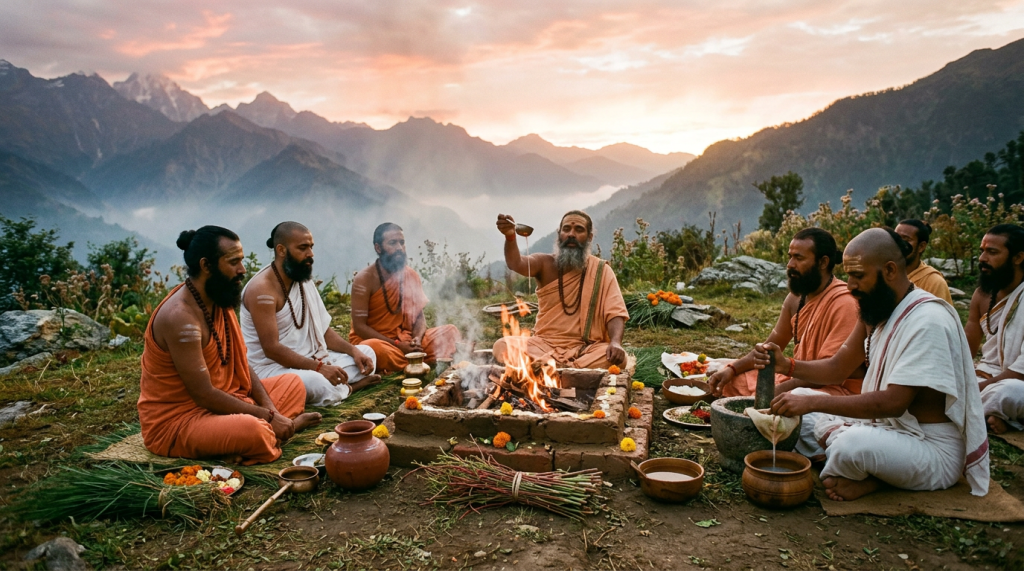
The ninth mandala of the Rig Veda is unique in all the sacred literature of humanity. One hundred and fourteen hymns. One subject. No Indra, no Agni, no Varuṇa. Nothing but Soma — his purification, his pressing, his effects, his divine nature.
This concentration is itself a message. In a text of one thousand and twenty-eight hymns that embraces the entire Vedic cosmos, devoting a whole mandala to a single substance — and to what it produces in human consciousness — says something essential about the place of this substance in the civilization of the 7 Rivers.
Soma was not a ritual condiment. He was at the centre of everything.
Soma in the introduction to the Rig Veda
In the introduction to my translation of the Rig Veda, I state it plainly: soma is an entheogenic plant. The ninth mandala is entirely devoted to him — it is the only mandala devoted to a single god. In all its descriptions, there is never any mention of leaves, seeds, fruits or flowers. Only fibres — amshu.
And there is remarkable archaeological evidence: in 2009, Russian archaeologists found in Mongolia a tapestry in a tomb dating from the first century CE, woven in Palestine or Syria and embroidered in the cities of the Indus. The motif depicts priests of Zoroastrianism — the Iranian religion, a daughter of Vedism — venerating a mushroom identified as an Indian variety of the genus Psilocybe, that is, a mushroom containing psilocybin.
Now Zoroastrianism used the same drink as Vedism — called haoma in Avestan, soma in Sanskrit. These are the same words, the same plant, the same ritual in two branches issuing from the same source.
What mandala 9 says about soma
The entire mandala 9 revolves around a key word: pavamāna — « the purified one, » « the one who purifies himself. » Soma is not simply pressed and drunk. He is purified — through the woollen filter, through the mantras, through the intention of the officiants.
The opening hymns set the framework:
9.1.1 — O Soma, purify your sweetest, most intoxicating flow for Indra, so that he may drink the juice.
9.2.1 — Purify yourself, O Soma, quickly, through the filter that pleases the gods, O Indu, come to the powerful one and penetrate Indra.
9.2.8 — We go to you for a vigorous intoxication, you who have created the worlds. The great proclamations are yours.
9.3.1 — This immortal god flies, as if borne on wings, toward the cups to sit.
« This immortal god flies toward the cups » — soma himself is a god. Not the container, not the ritual, but the substance itself, in its deepest nature. And when it flows into the cup, it brings with it something of immortality.
The effects described: hymn 9.113
Hymn 9.113, composed by the rishi Kaśyapa Mārīca, is the most explicit in the mandala about what soma produces in consciousness. It concludes with a litany of verses — each followed by the refrain « Flow around, for Indra, O Indu » — describing states of remarkable precision:
9.113.7 — There, where eternal Light resides, in that world the Sun has been placed. Place me, O Purified One, in that immortal and imperishable world. Flow around, for Indra, O Indu.
9.113.9 — There, where one can receive from the Sky, at will, for three days and three nights, there, the worlds are illuminated — there, make me immortal. Flow around, for Indra, O Indu.
9.113.10 — There where desires and pleasures are, there where the reddish Sky is, there where comfort and satisfaction lie — there, make me immortal. Flow around, for Indra, O Indu.
9.113.11 — There where bliss, plenitude, jubilation, Happiness reside — he sits there. There where one attains the delights of desire — make me immortal. Flow around, for Indra, O Indu.
Bliss, plenitude, jubilation, immortality — these terms are not poetic metaphors. They describe an experience. A precise, repeatable, structured experience. And the request « make me immortal » is not a request for eternal life in the literal sense. It is the request for the experience of what transcends death — of what, in human consciousness, is prior and subsequent to individual death.
These are exactly the terms that all contemplative traditions and contemporary research on psychedelics use to describe experiences of ego dissolution and access to expanded states of consciousness.
The molecule and contemporary tradition
In the introduction to my translation, I document this precisely: the soma plants contained a tryptamine — from the same family as the dimethyltryptamine (DMT) that our brain naturally generates, notably through yoga, meditation and pranayama.
Stanislav Grof, a Czech psychiatrist, treated patients for more than ten years with LSD in a clinical context — obtaining remarkable results on severe trauma and treatment-resistant depression. Following political and administrative pressures in the 1970s, he developed with yogis the technique of holotropic breathing — a technique of intense, sustained breathing that produces the same states without any substance. He obtained the same results.
Contemporary research confirms these observations:
Expansion of consciousness — psychedelics provoke an expansion allowing individuals to feel a deeper connection with the universe or nature, described as mystical unity. (Griffiths et al., 2006)
Reduction of the ego — they temporarily diminish the sense of self, allowing individuals to feel more in harmony with others and the environment. (Carhart-Harris et al., 2016)
Experience of transcendence — users describe experiences where they feel they have surpassed the limits of ordinary reality and entered a higher state of consciousness. (Pahnke, 1963)
These are not trivial effects. This is why, in The Civilization of the 7 Rivers, I insist: the soma experience was not recreational. It was ritualized, structured, prepared over several days — through fasting, purification, recitation of mantras, in a precise communal context.
Soma and the regulation of the Ego
The entire life of the 7 Rivers civilization revolved around the sacrifices. The Agnistoma — the praise of fire, of Light, of Enlightenment — took place at least once a year in spring. All those responsible for society participated and drank the soma.
This point is of capital importance: leaders had the obligation to undergo this experience. A person who possesses things but regularly undergoes an experience that relativizes their possession cannot durably confuse what they have with what they are.
This may be the deep reason why the civilization of the 7 Rivers had no kings, no palaces, no wars — for fifteen centuries. The regulation of the Ego was institutionalized in the ritual itself.
And when soma disappeared — after the great drought of 2200 BCE that weakened the production zones — the substitutes (ephedra, cannabis) produced less profound effects. The experience lost its power. The Ego gradually reasserted its rights. And with it came the castes, the wars, the conquests.
9.2.10 — O Indu, you are the one who procures Cows, men, Horses and energy — you are the ancient soul of the sacrifice.
The ancient soul of the sacrifice. When it vanished, something essential vanished with it.


Votre commentaire