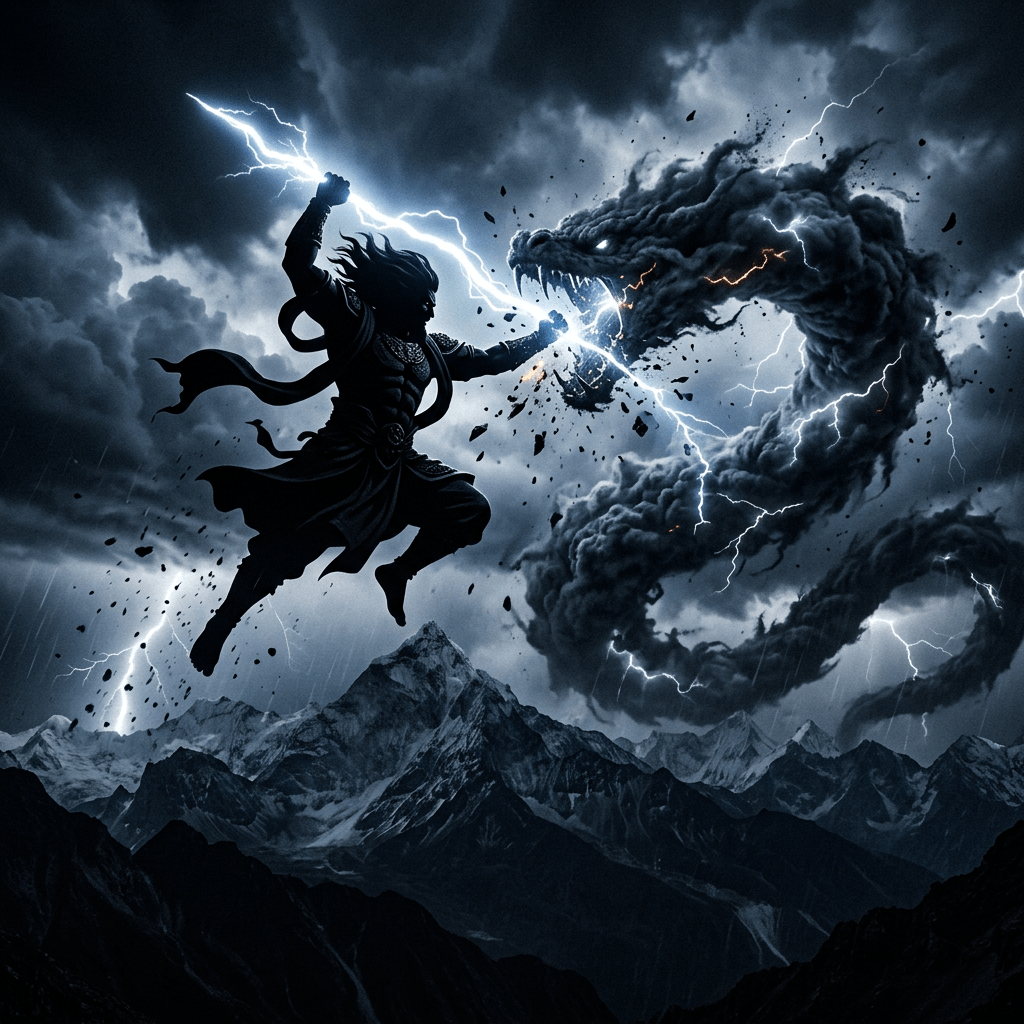
The most celebrated hymn to Indra in the Rig Veda is not a hymn of military conquest. It is a hymn to the liberation of waters.
1.32.1 — I tell the ancient exploits of Indra that he performed with the Thunderbolt: he struck the serpent of the Sky and freed the Waters, he pierced the mountains so that the rivers would flow.
A serpent holding back the waters in a cave. A thunderbolt that destroys it. The rivers flowing again toward the ocean. This is the heart of the Vritra myth — the most repeated, most central, most charged myth in the entire Rig Veda. And it is also, on several simultaneous levels of reading, one of the most useful texts for understanding the civilization of the 7 Rivers.
Vritra: the one who covers, the one who obstructs
The name Vritra comes from a Sanskrit root meaning: to hide, to cover, to obstruct. In the glossary I establish in The Civilization of the 7 Rivers, Vritra is the serpent, the darkness, the gloom — the force that prevents the human being from reaching Enlightenment. He must die, through Indra.
But before being a spiritual metaphor, Vritra is also, in the oldest hymns of the Rig Veda, a very concrete physical reality: something — or someone — that blocks the waters.
1.32.11 — The wives of Dāsa, having the serpent as their guardian, were besieged, like the Cows by the Panis. The Waters had been placed in a cavern, the slayer of Vritra freed them.
1.52.2 — Like a mountain firm on its base, immovable, having a thousand protectors, he has increased his Forces. When Indra slew Vritra who oppressed the ascending Rivers, he made the Waves stand up against the Darkness.
1.54.10 — Darkness reigned, the Waters were held in the belly of Vritra, like a mountain trembling on its base, Indra struck the Rivers and sent them all away into the mountains.
1.56.5 — When, with force, you firmly fixed that which was hidden in every quarter of the Sky, through the Intermediate Space, then O Indra, in the constant excitement of intoxication, you struck Vritra and released the Waters into the Ocean.
Waters blocked in a cave. Rivers oppressed. Darkness that reigns when water does not flow. And Indra, armed with his thunderbolt and drunk on soma, who strikes and liberates.
What is Vritra, really?
The three levels of reading
In The Civilization of the 7 Rivers, I note it: at first glance, Vritra seems to be a cloud that prevents rain from falling. But why make this a founding myth, repeated in dozens of hymns across all the mandalas, if it is merely an ordinary meteorological metaphor?
The first level is indeed climatic. The water blocked in a cave — this is drought. The Thunderbolt of Indra that frees the waters — this is the monsoon storm that breaks the dry season, brings down rain, fills the rivers and reservoirs. For a civilization whose entire prosperity depends on the monsoon, this liberation is literally cosmic.
But there is a second level — historical this time — that the rishis encode in these metaphors. In The Civilization of the 7 Rivers, I devote a long analysis to it: the great drought of 6200 BCE, accompanied by a brutal cooling of the entire northern hemisphere, caused considerable population movements. This cosmic Vritra — this obstruction of the waters for generations — marked the collective memory so profoundly that it entered mythology.
And the great drought of 2200 BCE — which would progressively dry up the Sarasvatī and weaken the entire 7 Rivers civilization — could be the second Vritra, the one that the most recent mandalas evoke with growing anguish.
The third level is spiritual — and it is the one I defend as the deepest. Vritra is what obstructs the path toward Enlightenment. The blocked waters are the inner Light that the Ego holds captive. The thunderbolt of Indra is the force of consciousness that shatters this obstruction. And the rivers flowing again toward the ocean — that is the Light pouring toward the Brahman.
Shushna: drought deified
Alongside Vritra, the Rig Veda stages a second enemy of the waters: Shushna. His name means: torrid, arid. Indian Sanskritists define him as the symbol of drought.
1.51.11 — When Indra was inspired by the zealous hymns, he mounted his chariot drawn by his two Horses which went as fast as possible. The Mighty One poured water into the dry riverbed and destroyed the fortified city of Shushna.
8.40.10 — Sharpen him with good living hymns, him the impetuous one who must be celebrated with verses, and now let him break the testicles of Shushna by his strength, and gain the celestial waters.
Shushna does not block waters like Vritra blocks a watercourse. Shushna desiccates — he empties riverbeds, makes fields barren, turns pastures arid. He is structural drought, the kind that lasts entire seasons.
And Indra breaks it — by spreading water into the dried-up beds, by destroying the obstacles to fertility, by releasing « the celestial waters. »
The theft of the Cows by the Panis: an eclipse and its metaphors
The third great myth linked to the water wars is that of the theft of the Cows by the Panis. Pani means: miser, greedy, money-grubber. The Panis have stolen the Cows — that is, the Light — and hidden them in a cave in the mountain.
In The Civilization of the 7 Rivers, I identify this myth with the total solar eclipse of February 19, 3929 BCE — the oldest eclipse of which humanity has retained a written memory. The Light of the Sun suddenly disappears in broad daylight — « stolen » by an obscure force. It is Brihaspati who, passing before the cave, hears the Cows lowing through the rocks, breaks open the cave and liberates the Light.
10.68.5 — By his Light he drove away the darkness of the intermediate world, as the wind drives away water. Brihaspati touched the skin of the cave, as the wind touches the clouds, and brought out the Cows.
10.68.9 — This one found the Dawn, the Sky, Agni. He drove away darkness with Light. Brihaspati extracted the cattle from the cave, like the marrow of the bones from the joints.
But the theft of the Cows by the Panis is not only an eclipse. It is also, at a more immediate level, a metaphor for the cupidity that monopolizes common resources — that retains wealth in caves rather than letting it circulate. The Panis are the misers, those who hoard. And in a civilization whose fundamental principle is the circulation of wealth — like the wheels of the chariot that turn from one to another — the Panis are the enemy par excellence.
Indra: the inner force that liberates
What unites all these myths — Vritra, Shushna, the Panis — is the role of Indra. In my glossary from The Civilization of the 7 Rivers: Indra means « he who is powerful. » He is linked to the senses, and in particular to the intellect — which is a sense in India. His power is revealed through the soma he loves. He conquers for the human being wealth (the Brahman), the Cow (the Light) and the Horse (strength).
Indra drunk on soma who breaks Vritra with his thunderbolt — this is consciousness illuminated by the entheogen, shattering inner obstructions and liberating the Light. This is not a military battle. It is an inner transformation.
And the Waters that flow again after the death of Vritra — these are the vital energies released, the rivers of Enlightenment pouring toward the Ocean of the Brahman.
1.32.12 — You were like the tail of the Horse, O God Indra, you struck that individual with your thunderbolt. You gained the Light, you gained the Soma, O Hero, you freed the seven Rivers that flow downwards.
What these myths say to our time
The water wars are no longer myths. They have become a geopolitical reality. According to experts, conflicts linked to access to fresh water will be one of the main causes of tensions and wars in the coming decades — in South Asia, the Middle East, sub-Saharan Africa.
And the contemporary « Vritras » exist. They are the dams that divert entire rivers, depriving downstream populations of their resources. They are the overexploited aquifers that are drying up without recharging. They are the Himalayan glaciers melting, threatening the hydrological regimes of the seven rivers themselves — the rivers of the Punjab that the Rig Veda sang as the heart of the world.
The rishis who described Vritra blocking the waters in a cave were encoding in their mythology a profound truth about the nature of life: when the waters do not flow, everything dies. When wealth does not circulate, society disintegrates. When the Light is held in a cave, darkness reigns.
Freeing the waters — physically, politically, spiritually — was the primary meaning of Indra. It may be the meaning we need most urgently today.


Laisser un commentaire