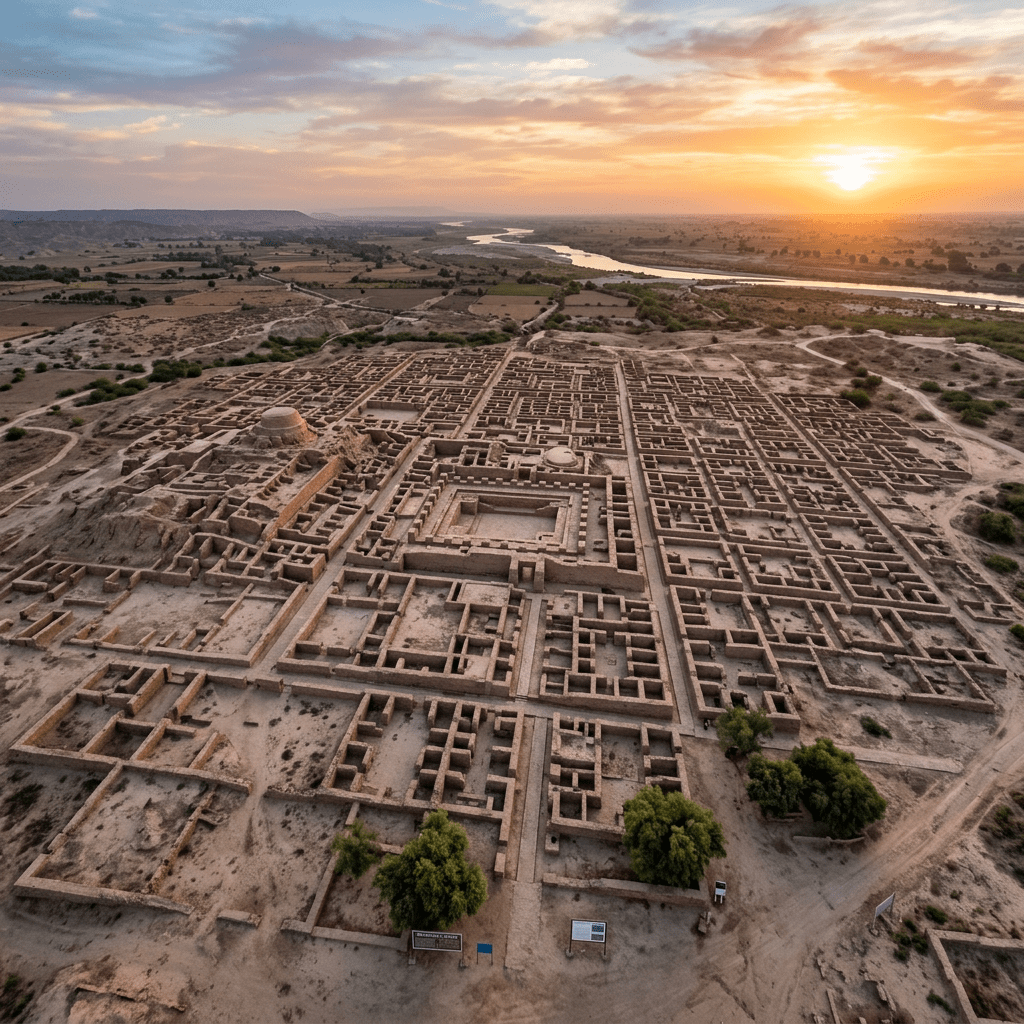
Mohenjo-Daro. The name means « the mound of the dead » in Sindhi — a name given by those who discovered the site, not by those who built it. Its inhabitants may have called it something else. We do not know: their writing has not yet been deciphered.
What we do know is what archaeologists have uncovered since John Marshall’s first excavations in 1927: a city of thirty to forty thousand inhabitants, built with a precision and sophistication unmatched in the world of its time. And a city that speaks, through its very architecture, of something essential about the civilization that built it.
The « Manhattan of prehistory »
In The Civilization of the 7 Rivers, I note it: Mohenjo-Daro has been nicknamed the « Manhattan of prehistory. » The avenues run north-south. The streets cross them east-west. The plan is a grid — rational, geometric, deliberate. This is not a city that grew randomly around a palace or a temple. It is a planned city.
And planned for whom? For its inhabitants. All of them.
Every house — even the most modest — had an interior courtyard around which the rooms were organized. Every house had a bathroom. Every house was connected to the sewage network — which carried waste water outside the city walls, preventing any contamination of the wells. Wells found at every crossroads, some dug to thirty metres deep, lined with trapezoidal bricks of remarkable solidity.
Meanwhile, in Mesopotamia and Egypt, people drank beer to avoid diseases caused by contaminated water. In Mohenjo-Daro, they drank clean water.
John Marshall, director of the excavations, summarized what he observed: « The Indus civilization represents a very perfect adjustment of human life to a specific environment which can only result from years of patient trials and accumulated experiences. »
What is absent — and what that says
The first thing archaeologists sought at Mohenjo-Daro was what they found in all great ancient cities: a royal palace. A great temple. Statues of sovereigns. Bas-reliefs of military victories. Lavish tombs.
They found none of it.
No palace. No temple in the institutional sense — no structure dedicated to the worship of a state god. No statue glorifying a king or warrior. No depiction of battles, chained prisoners, executions. No royal tomb. No slavery visible in the architectural structures.
In The Civilization of the 7 Rivers, I insist on this point that astonishes archaeologists: no trace of glorification of the individual Ego. The architecture of Mohenjo-Daro celebrates no one in particular. It serves everyone in general.
What one finds instead of the palace, in the elevated part of the city that 19th-century archaeologists called « the citadel » — for lack of a better word — is a large open-air common room, a community granary, and what excavations revealed to be a large ritual purification pool.
The Great Bath: collective spirituality
The Great Bath of Mohenjo-Daro is one of the most remarkable structures in world archaeology. It is a pool-shaped basin — twelve metres long, seven wide, two and a half deep — surrounded by small individual rooms and accessible by brick staircases.
Archaeologists established that this basin was watertight — it was coated with a bituminous sealant — and that it was supplied and drained by carefully designed hydraulic systems. This was not a running water reservoir. It was a place of ritual purification.
Around the basin: small rooms, probably for undressing or individual preparatory rites. Staircases to descend into the water. An architecture designed for the act of collective purification — the same logic as the ritual baths of Hindu and Jewish traditions, Islamic ablutions, Christian baptism.
At Lothal and Kalibangan, archaeologist B. B. Lal discovered altars with one or more hearths — the fires of the Vedic sacrifice. The spirituality of the 7 Rivers civilization did not need a cathedral. It needed water, fire, and a shared space.
The seals of Mohenjo-Daro: yoga and interiority
Among the thousands of artefacts discovered at Mohenjo-Daro and other sites, the steatite seals are particularly revealing. Some depict figures in meditation posture — legs crossed, spine straight, hands on knees — in what any yoga practitioner immediately recognises as a meditative posture.
In The Civilization of the 7 Rivers, I note this explicitly: yoga already existed, as these seals found at Mohenjo-Daro and elsewhere demonstrate. The word « yoga » does not appear in the Rig Veda — but the practice is visible in stone.
This is not incidental. A city without a state temple, but with a collective purification pool, sacrificial fire altars, and meditation figures on its seals — this city says something precise: spirituality here is an interior and collective affair, not institutional and vertical. One does not go to the temple to honour a state god who legitimizes the king’s power. One purifies oneself, meditates, offers the sacrifice — and these acts are accessible to all.
Mohenjo-Daro and the Rig Veda
The Rig Veda was composed in this world — or its direct continuation. Its hymns describe a society that resembles what archaeology reveals: no rigid castes in the oldest mandalas, no god-king, women composing hymns, a spirituality accessible to all masters of the household.
Mandalas 8 and 9 — the most linked to the urban period — were probably composed between 3500 and 3000 BCE, at the time of the mature urban phase of the civilization. It is in this context that soma was pressed in household courtyards, that fires were lit in domestic hearths, that mantras resonated in the north-south oriented streets.
Mohenjo-Daro is not an archaeological backdrop. It is the brick-and-mortar proof that the ṛta — the Truth, the just order of things — could be embodied in a city. And that this city could last for over a thousand years.


Votre commentaire