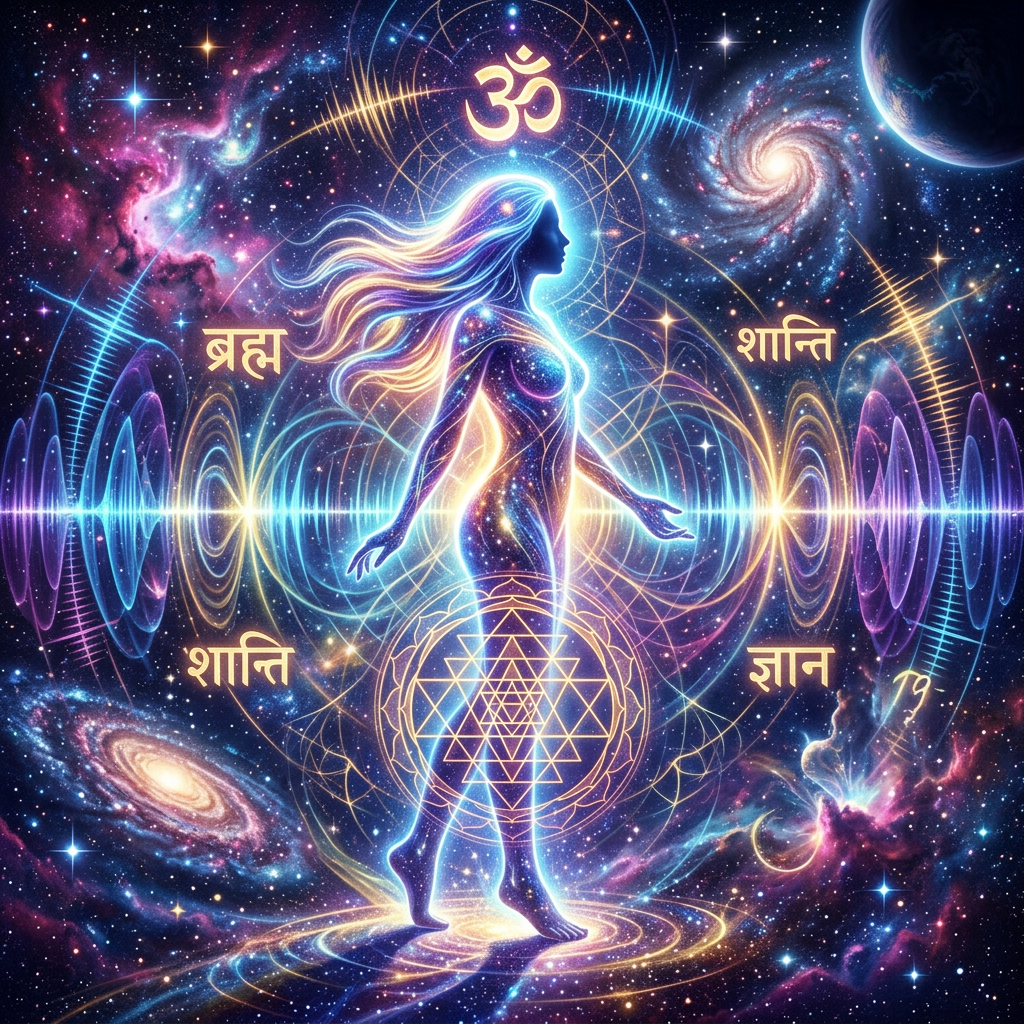
In the Vedic tradition, the Word is not a tool of communication. It is a cosmic force. It pre-exists the gods. It sustains them. It traverses the worlds. And it is personified — as a rishi, as a goddess — in one of the most extraordinary hymns of the Rig Veda: hymn 10.125.
This hymn is signed vāc āmbhṛṇī — « Vāc, daughter of Ambhṛṇa. » Vāc speaks herself. She is both the subject and the author of the hymn. This is unique in all ancient literature.
Vāc describes herself
In my translation:
10.125.1 — I go with the Rudras, with the Vasus. I go with the Ādityas and with all the gods. I sustain the couple Mitra and Varuṇa. I sustain the couple Indra and Agni. I sustain the two Ashvins.
10.125.3 — I am the queen who assembles the Riches, the first to observe those who deserve the sacrifices. I have the gods placed in many places, in many abodes. I have many homes.
10.125.4 — Through me, he eats food, he sees, he breathes, he hears my song. Ignoring me, they dwell near me. Listen, you who hear — what I say is credible.
10.125.6 — I stretch the bow and arrow for Rudra to kill those who are hostile to the mantra. I create intoxication for the people. I penetrate the Sky and the Earth.
10.125.7 — I stimulate the head of the father. My womb is in the waters of the ocean. Then I stand in all the worlds, and I touch the high Sky.
10.125.8 — I, surely, blow like the wind, seizing all the worlds, beyond the Sky, beyond the Earth, so vast. I become just as vast.
Every verse begins with aham — « I. » This is not arrogance. It is an ontological declaration: I am the force that precedes everything. I am that without which nothing can exist — not the gods, not the sacrifice, not life itself.
« Through me, he eats food, he sees, he breathes, he hears my song. » This verse says something vertiginous: all perception, all biological life, passes through the Word. Not that words are necessary to see or breathe — but that the Word as cosmic force is constitutive of every act of consciousness. Without Vāc, no subject that perceives. No world that manifests.
The four levels of the Word
Hymn 1.164 — one of the most mysterious in the Rig Veda — specifies this vision in a verse that is perhaps the most quoted in the entire text:
1.164.45 — The Word has been divided into four parts. The brahmins who are sages know them. Three of them are as if placed in a cave. People say they know only the fourth.
Four levels. The later Vedic tradition names them: Parā, Paśyantī, Madhyamā, Vaikharī.
Vaikharī — the articulated Word — is what we all know: the sounds of language, the spoken words, the written text. It is the most external, most superficial level.
Madhyamā — the intermediate Word — is thought formulated internally, the inner dialogue, the level of discursive mind.
Paśyantī — the seen Word — is the level of pure vision, prior to mental formulation. What some traditions call direct intuition, or what the meditator experiences when discursive thought stops and an understanding arises — whole, instantaneous, without words.
Parā — the Word beyond — is the level of the cosmic Word itself, prior to all manifestation. It is the level Vāc speaks of in hymn 10.125 when she says: « my womb is in the waters of the ocean. »
A Vedic mantra operates on all four levels simultaneously. This is why the sonic form is inseparable from the meaning — and why reciting a mantra without understanding its functioning is less effective than reciting it with awareness of its four dimensions.
Vāc in hymn 8.100
Hymn 8.100 adds a fundamental dimension. In a dialogue between Indra, Vāyu and the singer, the Word is described as fundamentally ambivalent — at once revealed and concealed:
8.100.10 — When the word has favourable speech, she is the queen of the gods. Sitting comfortably, I milk the four powerful juices.
8.100.11 — The gods engendered the goddess Word. Animals of all forms speak her. Milking the powerful refreshment for us — may the good hymn go toward the Cow, toward the Word, toward us.
« Animals of all forms speak her » — the song of the bird, the roar of the lion, the buzzing of the bee are all forms of Vāc. The Word is not specifically human. It is the vibration through which every living creature manifests in the world.
Vāc and creation
This Vedic vision of the Word as creative force is not isolated in the history of human spiritualities. We find it in the prologue of the Gospel of John: « In the beginning was the Word, and the Word was God. » We find it in the Hebrew tradition — the creation of the world by the divine Word: « God said: let there be light. » We find it in the later Hindu concept of Aum — the primordial sound from which all creation emanates.
But in the Rig Veda, Vāc is something more precise than the Johannine « Logos » or the « fiat lux » of Genesis. She is not merely the means by which a god creates — she is herself the creative force, personified, self-aware, sovereign. She does not serve the gods — she sustains them. And she is composed by a woman.
In The Civilization of the 7 Rivers, I define the Vedic Word — the mantra — as « the mantra that brings Enlightenment. » And the River, in the same glossary, as « the flow of speech, of Enlightenment. » Vāc and the Sarasvatī — the great river goddess — are forms of the same principle: what flows, what carries, what nourishes, what awakens.
The Word is not in the dictionary. It is in the flow.
 Le Rig Veda
Laisser un commentaire