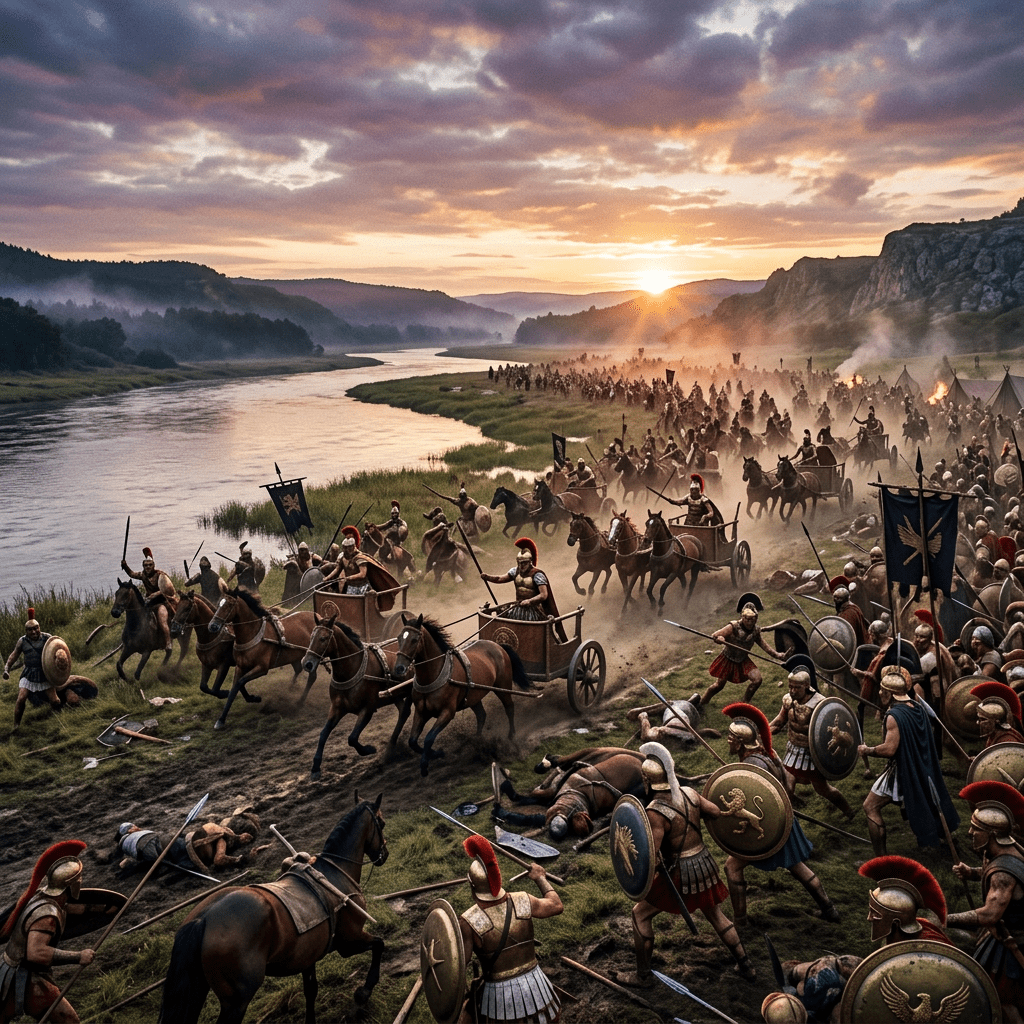
The Rig Veda is a spiritual text. But it is also, woven into its hymns, a historical document. And one of the most striking episodes in that history — the rivalry between two of the greatest rishis of the Vedic tradition, Vasiṣṭha and Viśvāmitra — runs as an undercurrent through several mandalas, culminating in what tradition calls the first war of which humanity has retained a precise memory: the War of the Ten Kings.
Two men, two mandalas, two visions
The seventh mandala is the mandala of Vasiṣṭha. Almost all its hundred and four hymns bear his name as rishi, or that of his sons. It is a mandala of deep contemplative depth — hymns to Varuṇa, to forgiveness, to Truth, to the inner light. Vasiṣṭha is the Brahmarishi par excellence: born, according to tradition, from Mitra and Varuṇa themselves, he embodies stability, devotion, fidelity to the ṛta.
The third mandala belongs to Viśvāmitra. A hundred and sixty hymns, most signed viśvāmitra gāthina — Viśvāmitra son of Gāthina. Viśvāmitra is a different figure: a king who became a rishi, a warrior who chose the spiritual path, a man of action whose hymns breathe energy, conquest, the crossing of obstacles. It is he who composes the Gāyatrī — the most sacred metre in the entire Vedic tradition, and perhaps the most recited mantra in the Hindu world today.
These two men did not belong to the same world. Vasiṣṭha was the purohita — the royal chaplain — of King Sudās, grandson of Divodāsa. Viśvāmitra had held that position before him. And it is this succession that triggers the first historically documented war.
The War of the Ten Kings: when rivalry becomes history
In The Civilization of the 7 Rivers, I recount this precisely: King Sudās had first Viśvāmitra as his purohita. He replaced him with Vasiṣṭha. Viśvāmitra, refusing to accept this dismissal, is said to have united five Vedic peoples — the Pūru, Yadu, Turvashas, Anu and Druhyu — joined by five non-Vedic peoples, to fight the Bharatas of Sudās.
This is the Dāśarājña — the Battle of the Ten Kings — the first war in human history of which we know the protagonists, the locations and the names of the main dead. It took place in two battles: one on the banks of the Paruṣṇī, the other on the Yamunā.
Vasiṣṭha, remaining faithful to Sudās, composed the hymns that accompanied this war. Hymn 7.33, in my translation, is unambiguous:
7.33.3 — Now, surely it is with them that they crossed the Indus. Now, surely it is with them that he killed Bedha. Now, surely it is by your mantras that Indra favoured Sudās against the ten kings, O Vasishthas.
7.33.5 — Like thirsty men looking toward the Sky, supplicating, they chose to find themselves in the battle of the ten kings. Indra heard Vasishta, who honoured him, and extended a vast world for the Tritsus.
7.33.6 — Like sticks for driving cattle, the small Bharatas were surrounded. Vasishta became their chief. Then the people of the Tritsus spread.
And hymn 7.83, composed in the heat of battle:
7.83.6 — These two you call in battles, Indra and Varuna, to bring Riches. There you protected Sudāsa, allied to the Tritsus, when he was in difficulty against the ten kings.
7.83.7 — The ten kings who do not sacrifice, all united, did not defeat Sudāsa, O Indra and Varuna. The praise of men, which draws together, was realised. At the divine call, his gods sat down to eat.
7.83.8 — Indra and Varuna, you helped Sudāsa who was surrounded on all sides by the ten kings who wanted to be powerful.
Sudās won. Vasiṣṭha was on the right side. Viśvāmitra had lost.
Viśvāmitra and the rivers: another form of power
But Viśvāmitra is not only the man who lost the War of the Ten Kings. In mandala 3, he is also the author of a unique hymn — hymn 3.33 — which recounts his dialogue with two rivers: Vipāsa and Śutudrī, the modern Beas and Sutlej of the Punjab.
The rishi arrives with the Bharatas. He must cross. The rivers in flood refuse to stop. He speaks to them directly, in a first-person dialogue that is one of the most vivid passages in the entire Rig Veda:
3.33.5 — (The rishi speaks) Stop in your course, for a moment, at my word, at the word of the soma-offerer, guardian of Truth. Desiring help, I have called, through deep meditation, the Indus, the child of Kushika.
3.33.9 — (The Rishi speaks) Listen well, O Sisters, to the Craftsman who has come from afar with an imposing chariot. Lower your flow, be easy to cross, keep your waves under our axles.
3.33.10 — (The Rivers speak) Yes, we hear your words, O Craftsman, you have come from afar with an imposing chariot, as the nursing woman bows before you, as the young girl opens to the man for you.
The rivers obey. The Bharatas cross. It is Viśvāmitra who has guided them. His power here is not military. It is that of the rishi — the one whose word, rooted in the ṛta, can bend the course of waters.
What the rivalry reveals
The great Vedic rivalry between Vasiṣṭha and Viśvāmitra is not a personal quarrel. It embodies two ways of being a rishi — two relationships to spiritual power.
Vasiṣṭha is the rishi of continuity, devotion, transmission. Born of the gods according to tradition, he is the guardian of the Vedic order. His hymns to Varuṇa — god of justice and forgiveness — are among the most beautiful in the Rig Veda. He does not seek victory. He seeks the Truth.
Viśvāmitra is the rishi of transformation. A king who became a sage through tapas — intense asceticism. A man of action who conquered knowledge as he had conquered territories. Composer of the Gāyatrī — that mantra which, recited three times at sunrise and sunset, encapsulates in itself the entire Vedic quest: may the divine Light illuminate our intellect.
These two figures coexist in the same text. Their mandalas face each other. Their rivalry produced, in passing, the first historically documented war — and after that war, according to tradition, there were no more for generations.
Perhaps because both rishis, each in their own way, had understood the same thing: that the true victory is not on a battlefield.


Votre commentaire