The Rig Veda is not only a spiritual text. Encoded within its metaphors, it is also a record of astronomical observations of remarkable precision. The rishis watched the sky. They knew it intimately. And what they saw, they transmitted — in the form of gods, hymns, myths — across the centuries.
Two astronomical realities stand out from the text with particular clarity: the Ashvins, twin gods who personify two specific stars, and a total solar eclipse dated by supercomputers to one of the earliest precisely known dates in all of human history.
The Ashvins: Castor and Pollux, the guides of dawn
The Ashvins — « those who resemble the Horse » — are the twin gods most invoked in the Rig Veda after Indra and Agni. They are the brothers of the Dawn. They arrive before sunrise, on their swift chariot, bringing light, healing, rescue to those in peril.
In The Civilization of the 7 Rivers, I state this clearly: the Ashvins also represent two twin stars that appear before dawn — Castor and Pollux, the Gemini. For a civilization of navigators — one that exported by sea to Mesopotamia, Bahrain, Iran — these two bright stars, visible just before sunrise, were essential navigational markers. They guided sailors through the darkness, announced the dawn, made orientation possible.
But the Ashvins are also, and above all, the physicians of the gods. The hymns dedicated to them — dozens throughout the Rig Veda — build an extraordinary catalogue of medical interventions and maritime rescues. Hymn 1.112, in my translation, attests to this:
1.112.5 — With these, you brought Rebha and Vandana out of the waters, who had been imprisoned and bound, to see the Sky.
1.112.8 — What aids did you give to Paravrij, O Powerful Ones, with which the lame and the blind could see and walk?
1.112.15 — When, in the hour of danger, the leg of the wife of Khela was cut off like the wing of a bird, at that same moment, you gave a metal leg to Vishpalī so that she could move.
A metal leg for an amputated woman. This is the first mention of a prosthesis in world literature. And this text dates to at least 3500 BCE.
Hymn 1.116 goes further still: the Ashvins rescue the shipwrecked Bhujyu in the middle of the ocean, for three days and three nights, with a hundred-oared boat. In my translation:
1.116.3 — Truly, O Ashvins, as a dead man leaves his Wealth, Tugra abandoned Bhujyu in the cloud of the Waters. You brought him back on your animated boats that float above the Waters, above the intermediate world.
1.116.4 — For three days and three nights you brought back Bhujyu with migratory birds, O Nāsatyas, from the wet desert to the coast of the Ocean, with three chariots, a hundred wheels and six Horses.
1.116.5 — You accomplished this feat in the Ocean that offers no support, nothing to cling to, nothing to stand on. When, O Ashvins, did you bring Bhujyu home in a hundred-oared boat?
These hymns are not decorative mythology. They are accounts of navigation, medicine and maritime rescue — encoded in the metaphorical language of an oral tradition that had to transmit them intact across the centuries.
The eclipse of 3929 BCE: the oldest astronomical memory of humanity
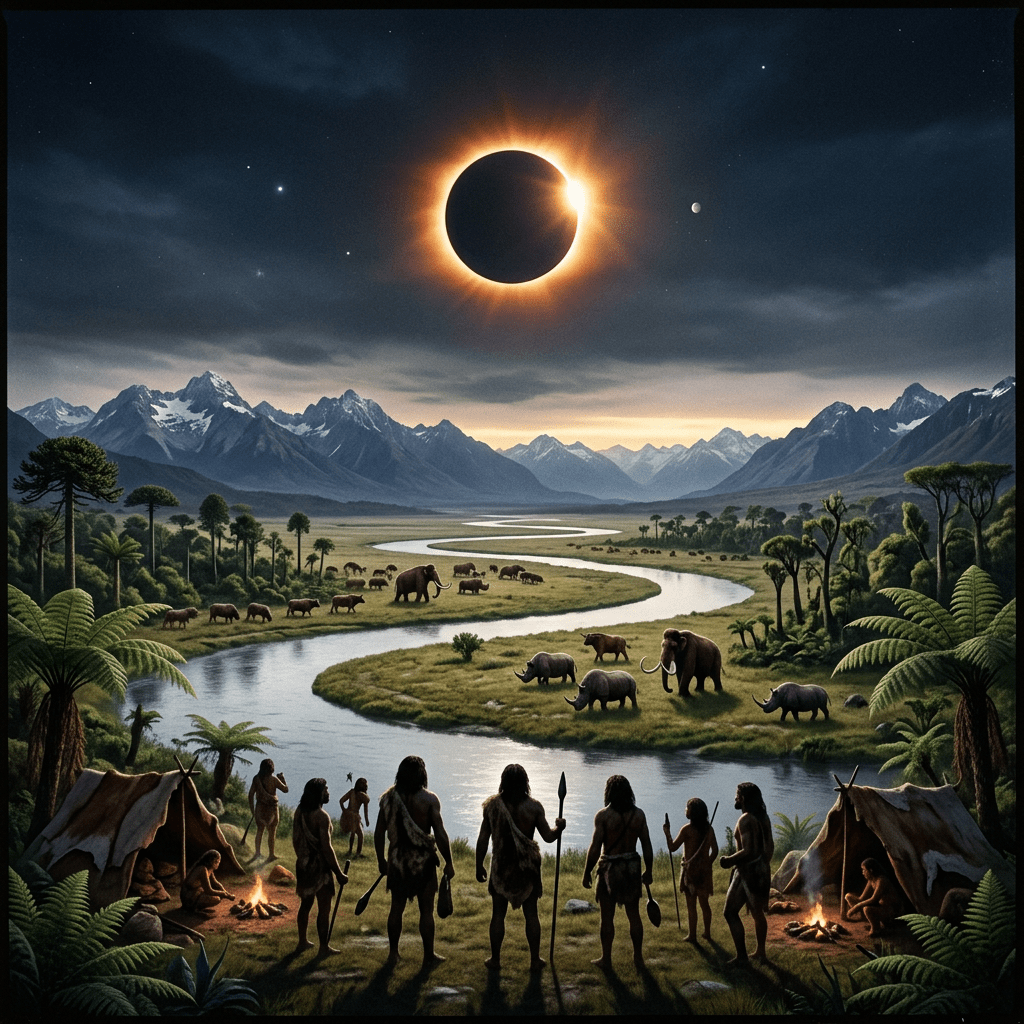
Hymn 5.40 of the Rig Veda describes a terrifying cosmic event: the Sun is « pierced by darkness » by a demon named Svarbhānu. Living beings « remain bewildered. » The rishi Atri intervenes with his hymns to « replace the eye of Sūrya in the Sky. » In my translation:
5.40.5 — When, O Sun, Svarbhānu Āsura pierced you with darkness, living beings remained perplexed, not knowing the obscurity.
5.40.6 — When, O Indra, you understood the magic of Svarbhānu falling from the Sky, Atri with her four hymns discovered the Sun, hidden by darkness, by the impious.
5.40.8 — The mantra having united the stones, worshipping the gods by homage, and fulfilling it. Atri placed the eye of Sūrya in the Sky and hid the magics of Svarbhānu.
5.40.9 — This is the Sun with which Svarbhānu Āsura pierced the darkness, the one that the Atris found — no one else could do it.
This is a total solar eclipse. The description is precise — sudden darkness at midday, the terror of living beings, the return of light. Other hymns allude to it as well, notably 10.27.20 which mentions explicitly the eclipse that « hides the Sun which reappears. »
Specialists in ancient astronomy submitted these data to supercomputers. The eclipse’s path had to cross the territory of the 7 Rivers; the date had to correspond to spring — the season of the sacrifices. The answer is unambiguous: this is the total solar eclipse of February 19, 3929 BCE. The path travels up the Indus and peaks in Ladakh. In Harappa on that day, in the middle of the afternoon, it was pitch black.
This is the oldest solar eclipse of which humanity has retained a written memory. It is mentioned in the oldest book in the world. And it gives us, with a precision of a few years, the beginning of the civilization of the 7 Rivers — around 4000 BCE.
(The Indian calculation gives 3928; the one-year discrepancy is explained by the difference between the Christian and Indian calendars, the Christian calendar having been adjusted in the time of Julius Caesar to correct a small imprecision in the calculation of the year’s length.)
What this reveals about the rishis
The rishis were not inspired poets singing at random. They were scholars. Rigorous observers of the sky, its cycles, its anomalies. Their astronomical knowledge served the sacrifice — the dates of the full moons, the solstices, the equinoxes determined the calendar of the rituals. In The Civilization of the 7 Rivers, I note that soma doses had to be prepared on dates fixed by the astronomers.
But their observation went beyond the ritual calendar. They had mapped the stars, named the constellations, identified the planets, predicted eclipses — or at least memorized and transmitted them with sufficient precision that, six thousand years later, supercomputers could date them to within a few years.
The Rig Veda is not only a spiritual archive. It is also the oldest astronomical archive humanity possesses.
https://www.rigveda.blog/rishis-astronomy-ashvins-eclipse-3929
 Le Rig Veda
Laisser un commentaire