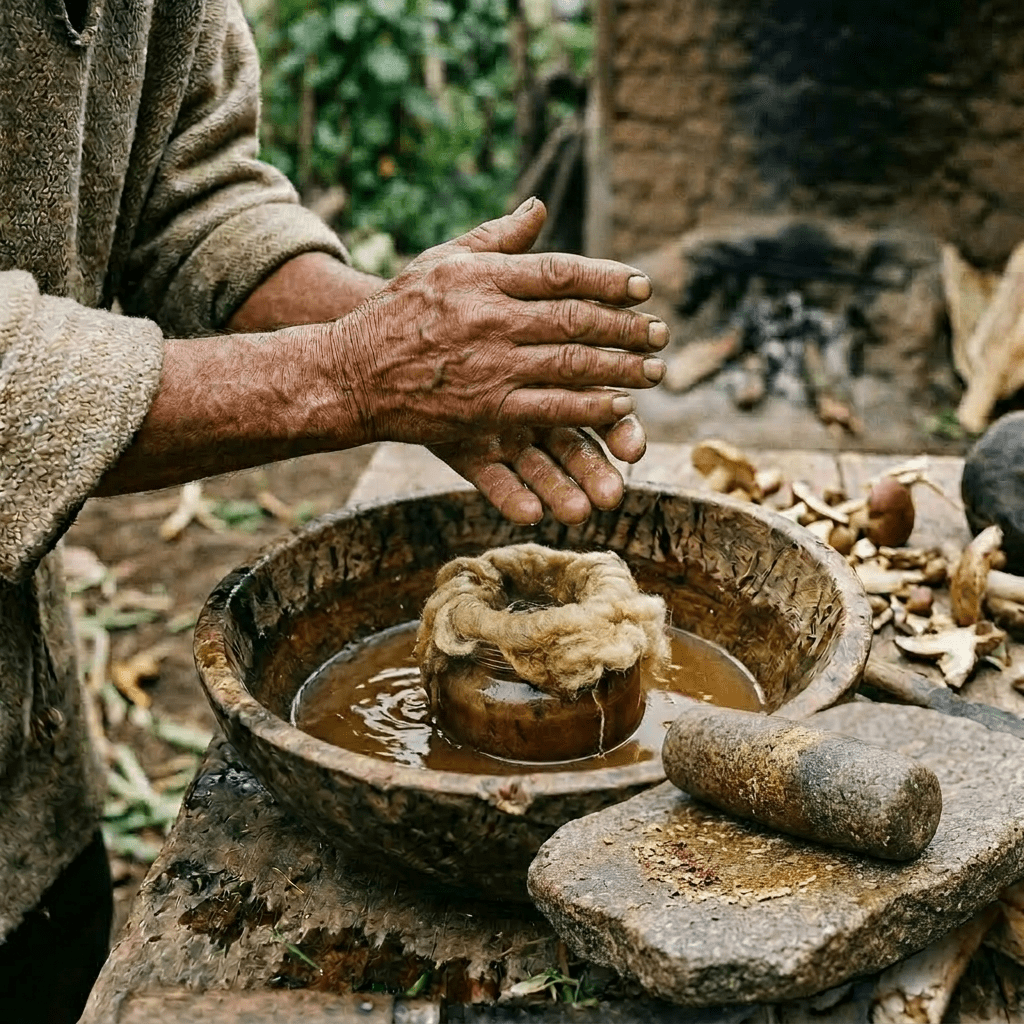
The ninth mandala of the Rig Veda is unique in all the sacred literature of humanity. It is the only mandala entirely devoted to a single god — Soma. One hundred and fourteen hymns. One subject. No battles, no genealogies, no invocations to Indra or Agni for victory or prosperity. Nothing but Soma — his purification, his pressing, his effects, his divine nature.
This is not a liturgical quirk. It is the signature of a civilization whose entire spiritual and social life revolved around a central ritual: the Agnistoma.
The Agnistoma: the praise of fire
The Agnistoma — literally « the praise of fire, of Light, of Enlightenment » — was the typical sacrifice of the 7 Rivers civilization. It took place at least once a year, at one of the full moons of spring. All Masters of the House — that is, all propertied families, therefore all those who held social responsibility — participated. They were required to drink soma at least once a year.
This point deserves to be dwelt upon. In this civilization, those who held power were obligated to undergo a deep, structured, ritual psychedelic experience at least once a year. A person who possesses things but has never had the experience that relativizes possession will eventually confuse what they have with what they are — and defend their wealth as though defending their life. The Vedic rishis understood this four thousand years ago. None of our modern societies has yet understood it.
Five days of preparation
The classic sacrifice lasted five days. The first four were devoted to preparing the minds of the sacrificers — a preparation considered essential for the experience to be positive.
On the first day: the man and his wife were washed and purified. The man was shaved of all body and head hair. The woman was purified by a priest. The sacrificial area was negotiated and demarcated. Huts were built — one for the man, one for the woman, one for the priests, one for the cart that had transported the soma. Quantities of rites and mantras from the Rig Veda punctuated each stage. During these four days, the sacrificers ate only yogurt. Physical abstinence and purification prepared the mind’s receptivity.
On the second day: the soma plants were purchased, dried, in exchange for a cow — soma had considerable value.
On the third day: the plants were sorted and measured, laid out on a black antelope skin. For eighteen people — sixteen priests plus the two sacrificers — the dose was measured in spans: one span, plus one span minus one finger, plus one span minus two fingers, plus one span minus three fingers. In total, a line of plants roughly one cubit long.
On the fourth day: the soma plants were left to « swell » overnight in a container of water. The night before the consumption, the sacrificers and priests did not sleep. They spent the night playing dice to stay awake.
The fifth day: the pressing
At dawn on the fifth day, the priests lit the fires. Half the plants were taken for the morning pressing. The remainder was divided in two — for the midday and evening pressings.
Before sunrise, the soma was pressed and drunk, facing East. Everything proceeded with mantras from the Rig Veda — sung, murmured, chanted according to very precise rules. Among the priests, the Brahman supervised the whole ceremony and corrected any errors made by his colleagues.
Mantras and rites followed one another until noon. At the zenith, the juice of the second pressing was drunk. At sunset, the third. The total experience lasted eighteen hours. Long — but necessary for everything to succeed.
The ninth mandala is the sonic manual of this ritual. Each hymn accompanied a phase of the pressing, an invocation to Soma as he flowed through the woollen filter, thundered in the cups, purified himself to be worthy of Indra — the inner force par excellence.
What the ninth mandala says
Here are some representative verses, in my translation:
9.1.1 — O Soma, purify your sweetest, most intoxicating flow for Indra, so that he may drink the juice.
9.2.1 — Purify yourself, O Soma, quickly, through the filter that pleases the gods, O Indu, come to the powerful one and penetrate Indra.
9.4.1 — Conquer and win great glory, since you are purified, and thus make us better.
The word that returns like a breath throughout the mandala is pavamāna — « the purified one », « he who purifies himself. » Soma is not simply pressed: he is purified. The physical preparation — the woollen filter, the pressing stones, the water in which the plants swelled — is inseparable from the ritual preparation. The mantras are not decorative accompaniments. They are part of the purification process itself.
Hymn 9.113 — one of the most beautiful in the mandala — describes what the experience produces:
9.113.7 — There, where eternal Light resides, in that world the Sun has been placed. Place me, O Purified One, in that immortal and imperishable world. Flow around, for Indra, O Indu.
9.113.10 — There where desires and pleasures are, there where the reddish Sky is, there where comfort and satisfaction lie — there, make me immortal. Flow around, for Indra, O Indu.
9.113.11 — There where bliss, plenitude, jubilation, Happiness reside — he sits there. There where one attains the delights of desire — make me immortal. Flow around, for Indra, O Indu.
This is not the description of a religious ceremony. It is the description of an experience — precise, repeatable, structured — of ego dissolution and access to a non-ordinary state of consciousness. « Bliss », « plenitude », « immortality »: these are the terms that all contemplative traditions in the world, and contemporary psychedelic research, use to describe the same states.
Which plant?
The first European Indologists long searched for what soma actually was. Some proposed alcohol — absurd given the effects described. Others proposed ephedra, a plant whose active molecule belongs to the amphetamine family. But amphetamines do not produce non-duality. And the Rig Veda never mentions leaves, flowers, seeds or fruit — only fibres, filaments: amshu.
Albert Hofmann, the discoverer of LSD, consumed Psilocybe mushrooms in the course of his research. He reports that in a five-gram dose he had forty-two dried mushrooms — very fine, very long. Filaments. Mushrooms of the Psilocybe genus are composed of soluble fibres and contain up to 90% water. When dried, they correspond perfectly to amshu. And their active molecule is a tryptamine — like DMT, like 5-MeO-DMT — the family that produces non-duality.
In 2009, Russian archaeologists discovered in Mongolia a tapestry dating from the first century CE, woven in Palestine or Syria and embroidered in the cities of the Indus. The motif depicts priests of Zoroastrianism — a religion descended from Vedism — venerating a mushroom identified as an Indian variety of Psilocybe cubensis.
The dossier is far from closed. But the evidence converges.
What happened next
Around 2200 BCE, a great drought struck the region. The Sarasvatî began to decline. Soma production — whatever the plant — dropped dramatically. The tenth and final mandala reflects this shortage: hymns begin asking Soma not to deliver the sacrificer to death — an anxiety absent from all earlier mandalas.
Without soma, the Agnistoma continued with substitutes — ephedra mixed with cannabis, as in the neighbouring civilizations of the Oxus and Karakum. The effect was impressive, but did not produce non-duality. Duality returned. And with it, progressively, the castes, the wars, the epics of conquest.
The ninth mandala is therefore the beating heart of a civilization at its apex. Its gradual disappearance from living ritual marks, symbolically, the end of that civilization — and the beginning of another, our own, that has forgotten how to regulate its ego.


Votre commentaire