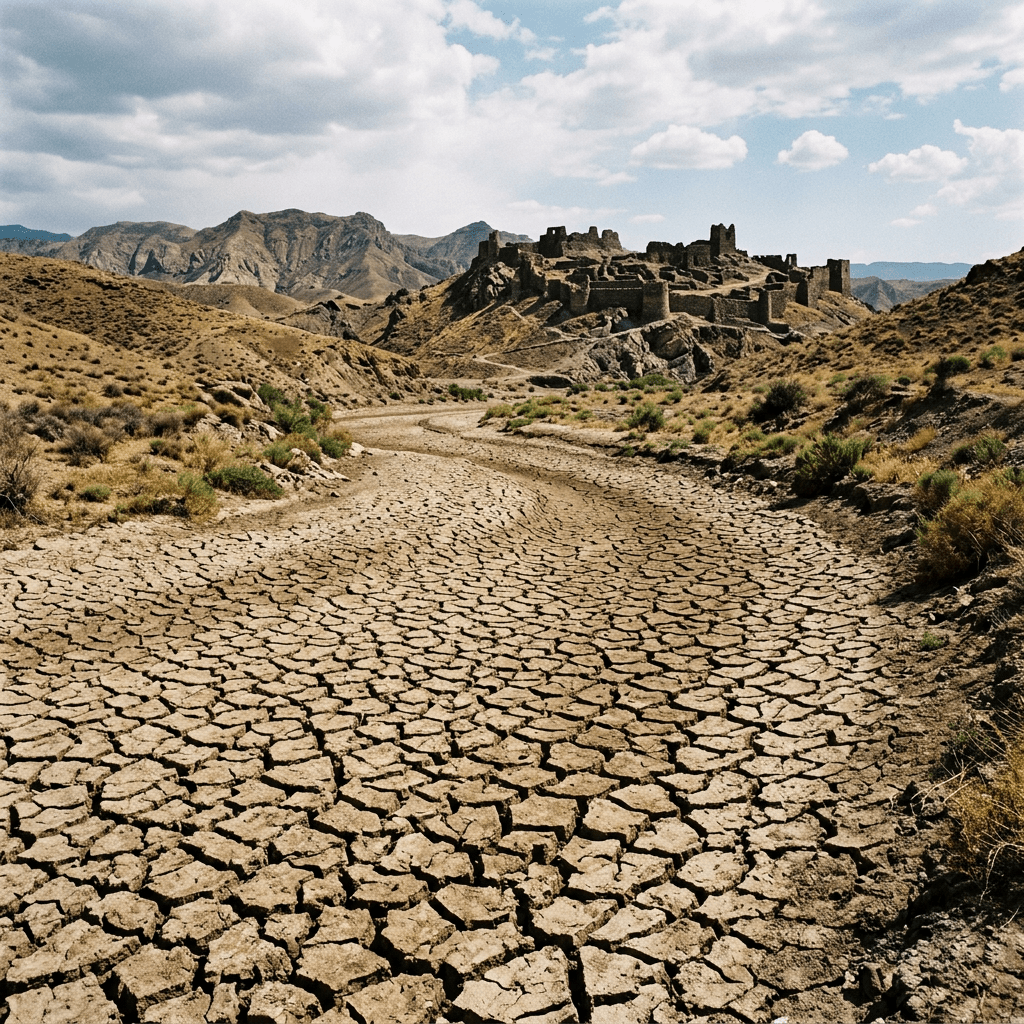
4,200 years ago, the world changed. Not gradually, not over centuries — quickly. A drought of unprecedented violence struck the entire intertropical zone and much of the northern hemisphere. Within a few decades, three of the great civilizations of the age were shaken or swept away: the Egyptian Old Kingdom, the Akkadian civilization in Mesopotamia, and the 7 Rivers Civilization in what is now Pakistan and northwestern India.
Climatologists call it the 4200 BP event. In the Rig Veda, we may find its traces in hymns that speak of drought, of rivers running dry, of rains that no longer come.
What Archaeology Tells Us
The 7 Rivers Civilization, at the moment this drought strikes, is at its peak. It covers more than a million square kilometres — twice the area of France. It has roughly a thousand towns and villages, and the largest of them — Mohenjo-daro, Harappa, Rakhi Garhi — are among the most important cities of their time. Houses have bathrooms. Streets have sewers. Urban planning reaches a standard Europe would not match for millennia.
And then the rains diminish. Harvests do not fail immediately — archaeologists have found no evidence of famine in the early period of this crisis. But hydraulic stress sets in, slowly at first, then with increasing force. This drought may have lasted anywhere from twenty years to a century, depending on the study. It also completed the desertification of the Sahara, already weakened by an earlier episode several millennia before.
The Sarasvatī — the River That Dies
To understand what happened in the 7 Rivers Civilization, one must understand the role of the Sarasvatī. It is the central river, the one around which the greatest cities of the eastern part of the civilization are built: Rakhi Garhi, Banawali, Kalibangan, Ganweriwala. In the Rig Veda, it is deified, celebrated as the widest of rivers, the flow of divine speech. In hymn 7.95.1 of my translation:
She surges forth, swelling, refreshing, this Sarasvatī clad in gleaming armour. She moves like a chariot rushing forward, surpassing all other rivers in her waters.
And in hymn 1.164.49:
Your breast, source of joy, ever abundant, with which you make precious things prosper, giver of Wealth, granting the Treasure, generous, bestowing munificence — here, Sarasvatī, you are the primordial element.
This abundant, sacred, life-giving river — today the Ghaggar, which flows only briefly during the monsoon — dried up around 1900 BCE. A combination of prolonged drought and earthquakes in the Himalaya diverted the watercourses that fed it. One of them, the Yamuna, was deflected at a place geologists still call the Yamuna tear.
A Migration Without Violence
What is remarkable about the decline of the 7 Rivers Civilization is the way it unfolded. Archaeological excavations have revealed no trace of violence whatsoever. No fires, no massacres, no deliberate destruction. The cities were abandoned gradually, in an orderly fashion.
The majority of the population living on the banks of the Sarasvatī first moved to the Indus valley. But the Indus cities, already densely populated, were quickly overwhelmed. The evacuation continued, moving primarily toward the Ganges plain. Those living in Afghanistan moved toward what is now Tajikistan and Uzbekistan. Others migrated into Iran, and from there into Anatolia.
It may be one of the largest peaceful migrations in ancient human history.
The Soma Shortage — an Inner Rupture
The drought did not only dry up the rivers. It caused something else — less visible but equally heavy with consequences: the disappearance of soma.
Soma — very likely a psilocybin-containing mushroom to which the entire ninth maṇḍala of the Rig Veda is devoted — requires abundant moisture to grow. When the rains stop, soma disappears. Around 2100 BCE, the first signs of this shortage are already visible in the text. Certain hymns show that soma is becoming scarce and that part of the population is being deprived of it.
The priests tried to replace it with other plants — blue lotus, ephedra mixed with cannabis. But these substitutes do not produce the same effects. The experience of ego dissolution that soma made accessible was no longer available in the same way.
And it is precisely in the tenth maṇḍala — the most recent, added after the shortage — that the caste system appears for the first time. This is probably not a coincidence. A society in which all those in positions of responsibility regularly dissolve their egos in expansive states of consciousness functions differently from one in which egos are free to assert themselves unchecked. Deep spirituality gradually gives way to religion. The ego returns. Hierarchy follows.
What the Rig Veda Keeps in Memory
In hymn 4.25.7, a rishi says this of Indra — the god symbolizing intellectual energy and spiritual force:
Indra is friend neither to the rich, nor to the miserly, nor to those who do not prepare the soma. He loves the soma-drinkers. He presses to obtain knowledge, and destroys drought.
This verse directly associates soma and drought. Indra destroys drought — and he is also the one who enables the attainment of knowledge, that is to say illumination. The outer drought and the inner drought seem linked in the minds of the rishis.
What This Tells Us About Ourselves
We tend to see the civilizational collapses of Antiquity as distant, almost abstract events. The 7 Rivers Civilization disappears, Akkad collapses, the Egyptian Old Kingdom falters — and then humanity bounces back, as it always has.
But look more closely. This civilization lasted nearly two thousand years. It survived droughts, earthquakes, climate shifts. It adapted its crops, diversified its agriculture, organized its migrations. It did not vanish in a year — it declined over three centuries.
And all that time, the rishis kept singing. The Rig Veda itself is the testimony of a civilization that, facing the most severe climate crisis in its history, preserved its memory, its spirituality, and its capacity to transmit.
That is not nothing.
In a world where climate disruption is accelerating, where rivers are running dry, where climate migrations are beginning to redraw the human map, the great drought of 2200 BCE is not merely an object of historical study. It is a mirror.


Laisser un commentaire