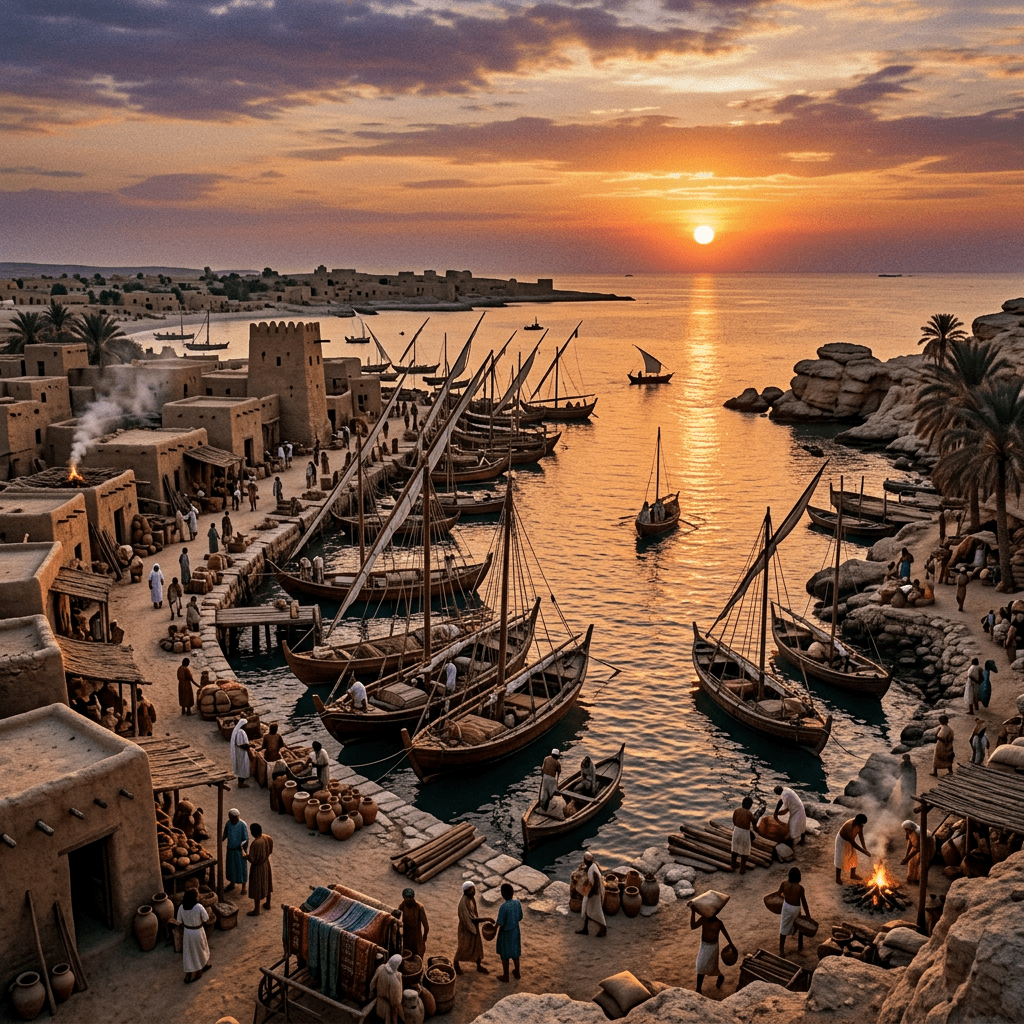
In the middle of the Persian Gulf, a small archipelago of low-lying islands has played a role for five thousand years that its size would never suggest. Bahrain — the ancient Dilmun of cuneiform texts — was for centuries one of the most active commercial hubs of the ancient world. And among its most consistent trading partners was the civilization of the Sapta Sindhu, the land of the Seven Rivers.
Dilmun in the texts
The earliest mentions of Dilmun appear in Sumerian tablets dating from the third millennium BCE. In these texts, Dilmun is described as a pure, sacred, abundant land — an earthly paradise where illness does not exist and fresh water springs miraculously from the sea.
This mythological dimension should not obscure the economic reality: Dilmun is above all mentioned in accounting texts as an indispensable commercial intermediary. Merchants from Mesopotamia purchased copper, ivory, precious stones, timber, and textiles there — goods that came, in large part, from the Indus civilization.
Geography as destiny
Bahrain’s position in the Gulf is not a geographically neutral coincidence. The island lies exactly halfway between the mouths of the Tigris and Euphrates to the northwest, and the coasts of Gujarat and Sindh to the southeast. For an ancient merchant vessel, it was the natural stopover, the break-of-bulk point between two worlds.
Archaeologists have uncovered at Bahrain warehouses, Indus seals, and pottery characteristic of the Sapta Sindhu civilization — proof that this stopover was not merely theoretical. Merchants from the Indus lived at Dilmun, stored their goods there, and built lasting commercial relationships.
Pearls as universal currency
Bahrain was also — and this is one of its singularities — one of the great pearl-producing centers of the ancient world. The shallow waters of the Gulf, rich in pearl oysters, made the archipelago a source of natural pearls coveted by the elites of Mesopotamia, Egypt, and the Indus civilization.
The pearl of Dilmun appears in commercial texts as a luxury good of the first order. It circulated along the same routes as lapis lazuli from Afghanistan, carnelian from Gujarat, and copper from Oman — forming a prestige network that connected civilizations separated by thousands of kilometers.
What this trade reveals
The existence of this commercial network between the Sapta Sindhu, Dilmun, and Mesopotamia is rich in lessons. It demonstrates first that the civilization of the Seven Rivers was not turned inward — it was deeply connected to the world of its time, capable of organizing maritime exchanges over considerable distances.
It also reveals a form of ancient internationalism: merchants of different cultures, speaking different languages, venerating different deities, capable of coexisting, cooperating, and exchanging for centuries without these differences constituting an insurmountable obstacle.
In Vedic thought, the merchant — the vanik — is not a secondary figure. He is the weaver of bonds between peoples, the one who transforms diversity into shared wealth. The trade of Dilmun may be its oldest illustration.
The end of a world
Around 1900 BCE, trade between the Sapta Sindhu and Mesopotamia via Dilmun abruptly disappears from cuneiform archives. The reasons remain debated: climate change, shifting trade routes, political transformations in Mesopotamia, the gradual decline of the Indus cities.
This silence in the archives is itself eloquent. It reminds us that commercial networks, however solid they appear, are fragile. That a civilization can flourish for centuries and vanish from the texts within a few generations. And that Bahrain, the pearl of the Gulf, was the silent witness to that disappearance.
rigveda.blog/trade-bahrain-dilmun-pearl-gulf-crossroads-civilizations


Votre commentaire