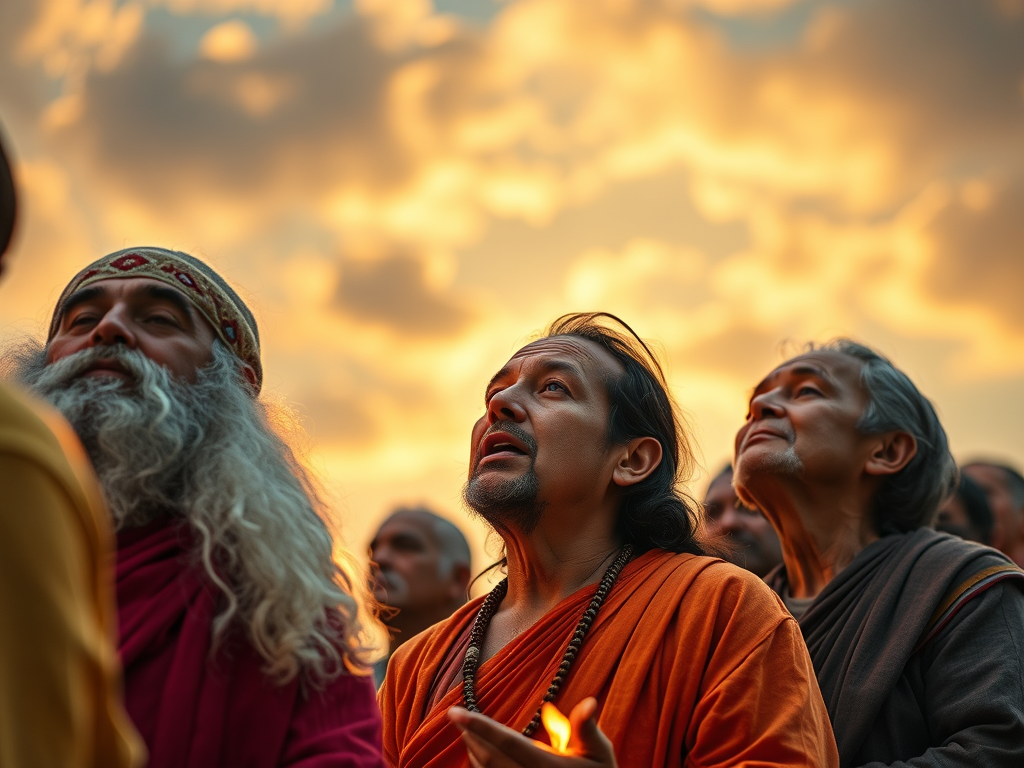
There is a persistent misconception about ancient sacred texts: that they are cold, solemn, distant, written in a ceremonial language that keeps human emotions at bay the better to express the divine. The Rig Veda contradicts this idea with a force and a consistency that end up being striking. The Vedic hymns are texts of remarkable emotional intensity. In them one finds joy, wonder, fear, gratitude, desire, impatience, sadness, exaltation, sometimes anger and even humour. These emotions are not rhetorical ornaments nor human weaknesses that the sacred text tolerates despite itself. They are constitutive of the relationship between the rishis and the divine forces they invoke, and they play a precise functional role in the effectiveness of the sacrifice.
To understand why, one must return to the nature of the Vedic sacrifice and to what the rishis meant by prayer. In the Vedic tradition, prayer is not an intellectual undertaking. It is not a formulation of thoughts addressed to a superior entity in the hope of being heard. It is an act of coming into resonance, a way of vibrating at the same frequency as the force one invokes in order to attract its presence and energy. And this coming into resonance necessarily passes through emotion, because emotion is the register in which human consciousness vibrates with the greatest intensity. A hymn recited without emotion, with only the technical precision of a memorised recitation, does not reach what it aims at. It has the correct form but not the life that gives it its effectiveness.
Joy is without doubt the most omnipresent emotion in the hymns. It is not the tranquil and measured joy of a successful meditation. It is an exuberant, overflowing joy, sometimes almost childlike in its intensity. The gods are invited to come with joy, to drink soma with joy, to accept the offerings with joy. The sacrificer expresses his own joy in performing the sacrifice, his joy at seeing the fire ignite, his joy at hearing the hymns resonate. This joy is not performative. It is the mark of an authentic relationship, of real contact with something greater than oneself that inevitably produces that particular quality of exaltation that we all recognise, even when we do not always have the words to name it. In the eighth mandala, one can read hymns in which the jubilation of the sacrificer who has drunk soma is palpable across the centuries — a jubilation that speaks at once of physical intoxication and spiritual exaltation, inseparable in the Vedic experience.
Wonder is another fundamental emotion of the hymns. The rishis do not look at natural phenomena, at the gods, at the experience of Brahman with the jaded eyes of someone who has seen and explained everything. They look with wide-open eyes, as someone for whom every sunrise is a miracle, every spring flood a marvel, every experience of soma a revelation. The hymns to Ushas, the Dawn, are among the most beautiful in the corpus precisely because they transmit this wonder with a freshness and a precision that have not aged in six thousand years. Someone who has truly watched the sky lighten at dawn, who has seen the first pink lights appear above the mountains, recognises immediately in these hymns the exact quality of the emotion they felt. The rishis do not describe the dawn. They transmit the wonder of the dawn.
Gratitude is an emotion that profoundly structures the relationship between the rishis and the gods. But it is a gratitude that has nothing of the fearful deference of the believer before an all-powerful god. It is a gratitude of partnership, the recognition of someone who knows what they owe their allies and expresses it without false modesty or servile exaggeration. The hymns that thank Indra for his victories, Agni for his ever-faithful fire, the Ashvins for their healings, have a human warmth and a directness that speak of a lived relationship, not a relationship of protocol. One thanks a friend who has kept his word, not a capricious monarch who must be flattered.
Fear is also present in the hymns, and its presence is particularly instructive. It is not the fear of divine punishment, the fear of an offended god who will punish the sacrificer’s failings. It is a more fundamental and more honest fear: the fear of missing what is essential, of passing beside what life can offer, of letting Vritra, the inner darkness, prevail over the Light. In the hymns to Varuna, this fear takes a particularly touching form. The rishi questions the god: have I fallen short of Truth? Have I said something false? Have I let my ego take over? Purify me of my errors. It is a fear that does not humiliate. It elevates the one who feels it, because it speaks of an acute awareness of what is at stake in the spiritual life.
Desire is an emotion that the Vedic hymns make no attempt to conceal or sublimate in softened language. The requests to the gods are frank, direct, sometimes even imperious: give me cattle, give me horses, give me sons, give me victory, give me the Light, give me immortality. This mixture of material and spiritual desires within the same hymns has often embarrassed translators and commentators who would have preferred sacred texts to confine themselves to the spiritual. But this mixture is precisely what makes the text true: Vedic civilisation did not separate the desire for material wealth from the desire for spiritual wealth. Both arose from the same fundamental aspiration to fullness, and the gods were invited to contribute to both registers simultaneously.
There is in certain hymns a dimension of emotional urgency that is striking. The sacrificer who asks Indra to come now, immediately, not tomorrow, not in a moment, now — with that childlike impatience of someone waiting for something promised, for whom every minute of waiting is an eternity: this urgency is not rhetorical. It says something about the way the rishis lived their relationship with the gods, with an immediacy and an intensity that left no room for the cold distance of the theologian or the detachment of the philosopher.
Humour, finally, makes appearances in the Rig Veda that prudish translators have often attenuated or ignored. There are hymns that play with words, that place the gods in slightly ridiculous situations, that describe with affectionate irony the excesses of the god who has drunk too much soma. These touches of humour are not imperfections that crept into a sacred text despite the vigilance of its authors. They are the mark of a relationship with the gods sufficiently intimate and confident to permit laughing with them, not merely venerating them from a distance.
What all of this says about Vedic spirituality is fundamental. It was not a spirituality of emotional repression, of icy detachment, of impassivity as an ideal. It was a spirituality of full presence, in which all human emotions had their place in the relationship with the divine, including the most intense, the most contradictory, the most difficult to admit. The rishis brought to the sacrifice everything that they were, not only the part of themselves that corresponded to a preconceived image of the perfect devotee. And it is perhaps for this reason that their hymns, after six thousand years, continue to touch something in us that recognises in their voice a complete, uncensored, real humanity.
 Le Rig Veda
Laisser un commentaire