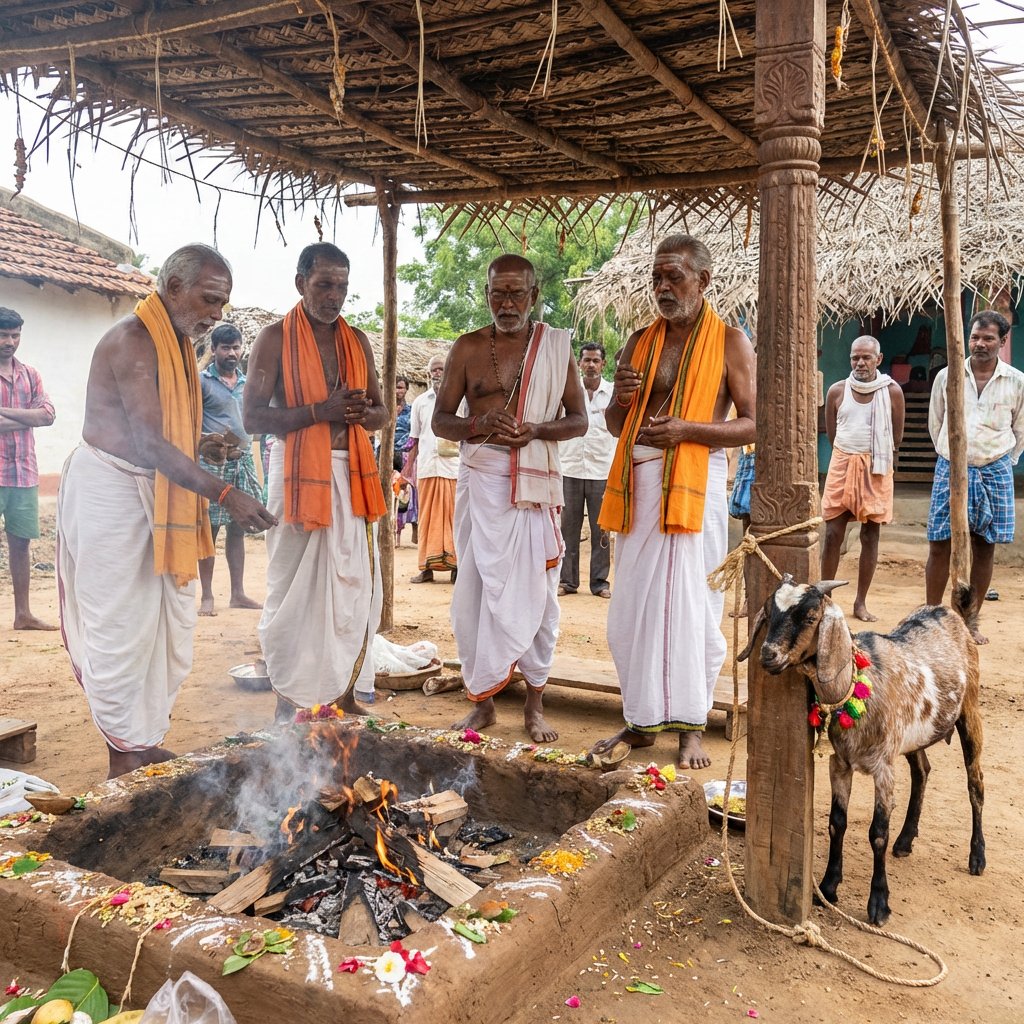
There is a word that recurs in the Rig Veda with an insistence and a centrality that leave no doubt about its importance: yajña. It is generally translated as sacrifice, and this translation has a history that needs to be told before going any further, because it says as much about those who translated as about what they were translating.
The first Western translators of the Rig Veda were nineteenth-century philologists, trained in an academic tradition that had its own lenses, its own blind spots, and its own ways of categorising the religious. When they encountered the yajña, they saw what they knew: a ritual in which an animal was killed, generally a goat, sometimes a horse in the case of the Ashvamedha, to be offered to a deity. The word sacrifice imposed itself naturally, with all its connotations of blood shed, of an immolated victim, of a god to be appeased. This reading was not entirely wrong. The ritual killing of animals did exist in Vedic practice, even though the Rig Veda itself makes little of it and gives it a very limited place relative to the corpus as a whole. But by focusing on this spectacular aspect, easily comparable to the sacrificial practices they knew from elsewhere, the first translators missed the essential. They took the periphery for the centre.
The centre is the root of the word itself. Yaj, from which yajña is derived, means to honour, to venerate, to offer. But in Vedic usage, this word carries an additional dimension that translation by sacrifice almost entirely erases: the idea of a setting in motion, of a putting into circulation. What is offered in the yajña does not disappear. It transforms and returns, amplified, in another form. The clarified butter poured into the fire is not destroyed. It becomes smoke, it rises, it nourishes the gods, and the gods in return nourish the world. It is a cycle, a circulation of energy between levels of reality, and the yajña is the mechanism that keeps this circulation in motion. Without yajña, the cycle breaks, energy stagnates, the world runs dry. This is why the hymns return so insistently to the necessity of sacrifice: not out of obedience to a divine law, but out of understanding of a cosmic mechanism whose maintenance conditions the existence of everything.
The ritual death of the animal, when it took place, belonged to this same logic of circulation. It was not a destruction. It was a transformation: the vital energy of the animal was offered to be transmuted and redistributed within the cosmic cycle. But this dimension, important as it may be in certain ritual contexts, does not constitute the heart of the Vedic yajña as the Rig Veda describes it. The heart is the fire, the chanting, the soma and the intention of the sacrificer. The animal is only one element among others, and not the most important one.
There were two types of yajña in Vedic practice, and understanding their distinction is essential to grasping what is really at stake. The first is the outer, public, collective yajña: the great ceremony with its fire, its priests, its chanting, its duration that could range from a single day to a full year, its consumption of soma, its gathered community, and sometimes the ritual killing of a sacrificial animal. This is the one that archaeology and the history of religions have documented, the one that can be reconstructed from the ritual texts that accompany the Rig Veda. But in the hymns themselves, in their second reading, the one addressed to seekers of Truth rather than to ordinary people, the yajña is something else. It is an inner process, a transformation of consciousness, in which it is the ego itself that is offered into the fire of Agni so that the Light of Brahman can appear.
This inner dimension of the yajña is explicit in the text for those who know how to read it. Agni, the sacred fire, is simultaneously the fire that burns in the sacrificial hearth and the fire of inner transformation, the heat of awakening consciousness that consumes the obscurities and resistances of the ego. When a hymn invokes Agni to accept the offering and transmit it to the gods, it describes at once the concrete ritual gesture and the inner process by which consciousness offers what limits it in order to receive what surpasses it. The outer offering is the symbol and the support of the inner offering. The two do not exclude each other. They reinforce each other mutually, the outer ritual creating the conditions in which the inner process can unfold, and the inner process giving the outer ritual its depth and its effectiveness.
What is offered in the inner yajña is not suffering, not deprivation, not the renunciation of what one loves. What is offered is resistance. It is the attachment to a vision of oneself and of the world that is too narrow to contain what the experience of Brahman reveals. It is Vritra, the inner darkness, the rigidity of the ego clinging to its certainties and its fears. When Indra strikes down Vritra with his thunderbolt, this is what takes place: the force of awakened consciousness, amplified by soma and the ritual context of the yajña, dissolves the inner resistances and liberates the waters — that is to say, the intuitive knowledge that was being held captive. The liberation of the waters after the death of Vritra is one of the most recurrent images in the Rig Veda, and it describes precisely what the inner yajña produces: an unblocking, a release of what was frozen, a flow resuming where it had been obstructed.
Soma was the accelerator of this process. Without it, the inner yajña was possible, but slow, difficult, reserved for practitioners of exceptional discipline and experience. With it, the same results could be reached in a few hours, within the framework of a collective ritual, by participants whose individual level of spiritual practice varied considerably. This is why all those responsible for Vedic society participated in the sacrifices and drank soma: not because a religious obligation compelled them to, but because the experience was real, transformative, and produced lasting effects on the way they perceived their role and their responsibilities. A leader who has lived through the complete inner yajña, who has offered his ego into the fire of Agni and received in return the experience of unity with Brahman, no longer governs in the same way. He cannot.
There is in the Rig Veda a formulation that summarises this dimension of the yajña with remarkable precision and economy of means. In the second mandala, hymn 41, verse 4: Mitra and Varuna, this juice of soma allows one to reach the Truth. This is not a vague promise. It is the description of a mechanism: the yajña, with soma at its centre, is the means by which the Truth — that is to say Brahman, the Absolute — becomes accessible. The yajña is not an act of devotion to a distant and transcendent god who would grant his favour in exchange for the offering. It is a spiritual technology, precise, reproducible, whose effects are described with a consistency and a concordance in the hymns that testify to knowledge acquired through direct and repeated experience.
The Bhagavad-Gita, composed centuries after the Rig Veda, would articulate this principle with a philosophical clarity that the Vedic text had no need to spell out, because its intended recipients were living the experience directly. Krishna says: act, but without attaching yourself to the fruits of your actions. Offer each action as a yajña. This shift from ritual sacrifice to the sacrifice of ordinary action is a natural extension of the original Vedic principle: every act accomplished without ego, offered to something greater than oneself, is a yajña. The Gita universalises the yajña, detaches it from its precise ritual context, makes it accessible to every human being in daily life. But the source of this understanding is in the Rig Veda, in those hymns where the fire of Agni burns simultaneously in the sacrificial hearth and in the consciousness of the sacrificer.
What the yajña tells us about the nature of spiritual transformation is strikingly relevant today. We live in an era that seeks transformation through acquisition: acquiring knowledge, techniques, experiences, states. Vedism says the opposite: transformation comes through offering, through what one releases rather than through what one takes. It is not the same thing to seek enlightenment as an acquisition and to welcome it as the natural result of abandoning what obstructs it. The first approach reinforces the ego that seeks. The second dissolves it. And it is precisely this dissolution, brought about in the fire of the yajña, that allows what was always there to appear — waiting simply for the obstruction to be lifted.
 Le Rig Veda
Laisser un commentaire