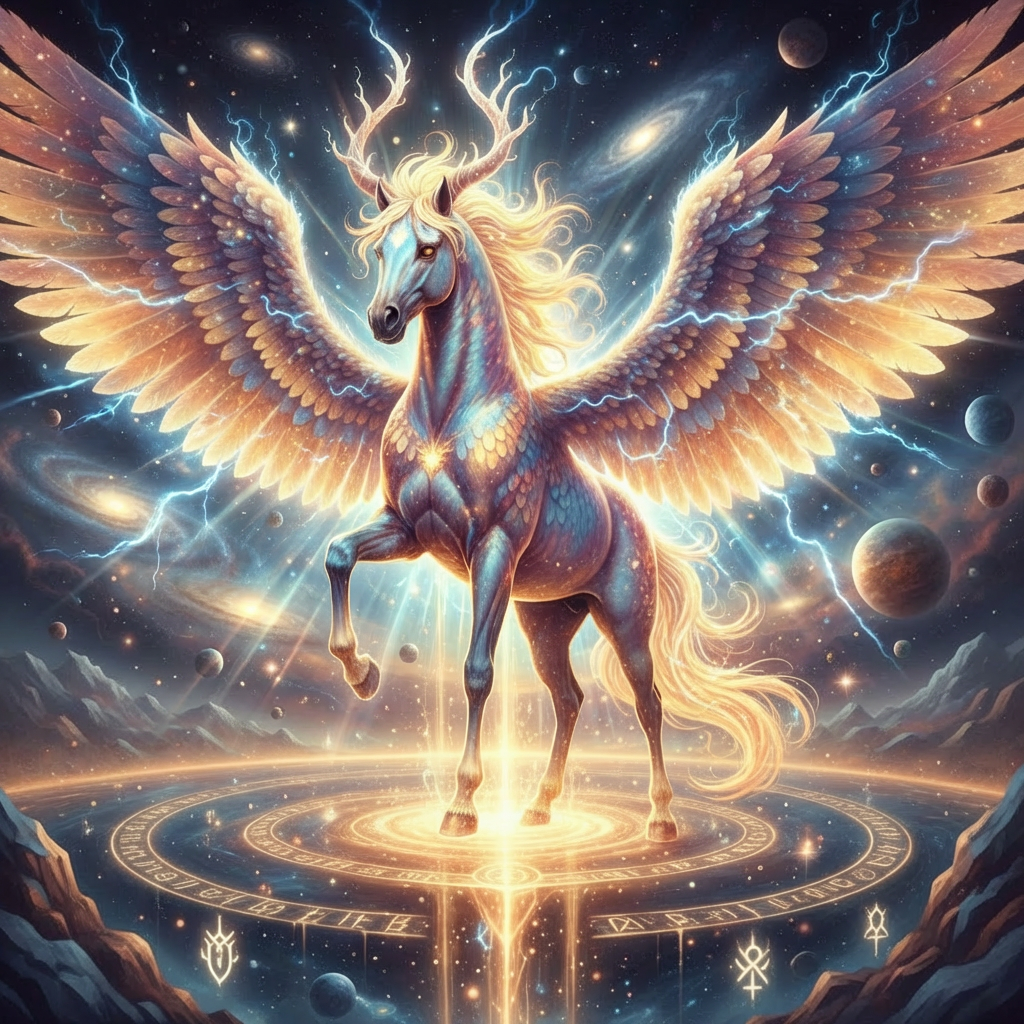
There are animals that pass through civilisations as simple tools, useful and forgettable. And there are others that become symbols, powers, mirrors in which a civilisation recognises and defines itself. In Vedic culture, the horse is one of those. It is everywhere in the Rig Veda, from the oldest hymns to the most recent, in forms so multiple and so charged with meaning that one must linger over them at length before beginning to measure their depth.
Let us start with the word itself. Ashva, the horse in Vedic Sanskrit, comes from a root meaning to reach swiftly, to permeate, to be present everywhere. This etymology is not anecdotal. It says from the outset that the Vedic horse is not simply a fast animal one rides or harnesses. It is a force that spreads, that penetrates, that is present wherever it goes. In the double reading that the hymns always invite one to practise, ashva designates the concrete horse and simultaneously vital force, spiritual energy, the power that allows consciousness to unfold and advance toward the Light. When Indra arrives on his chariot drawn by two bay horses, it is the intellect advancing, carried by its own energy, toward victory over Vritra, over inner darkness.
In the historical reality of Vedic civilisation, the horse held considerable economic and social value. It was rare, precious, difficult to raise in the climatic conditions of the region. To possess horses was to possess power in the most direct sense of the word. The hymns that ask the gods to grant horses to the sacrificer are not simple materialistic prayers. They reflect a reality in which wealth in horses was inseparable from the capacity to protect the community, to participate in the great ceremonies, to occupy a rank in society. The horse and social standing were linked in a way that our contemporary societies have no real equivalent to understand, except perhaps by imagining what the great industrial fortunes of the nineteenth century represented, but with a sacred dimension added.
The horse sacrifice, the Ashvamedha, is one of the most complex and most meaning-laden rituals of Vedism. It does not appear in the oldest parts of the Rig Veda, which suggests that it developed with the rise of the great kingdoms, probably during the classical period of Vedic civilisation. In this ritual, a royal horse was set free for a year, free to roam the territory. The lands it crossed were considered to belong to the king who had released it, and the kings of those territories had to either submit or fight. After a year, the horse was brought back and sacrificed in a ceremony of extraordinary length and complexity. This ritual says several things simultaneously: it speaks of the power of the king who can afford this sacrifice, it speaks of the cosmic nature of that power extending as far as the horse can go, and it says, in its deep spiritual dimension, that the highest vital force must be offered in order for kingship to be legitimate and cosmic order to be maintained.
But it is in the hymns of the Rig Veda itself, and in particular in the hymns to the horse in the first mandala, that the spiritual dimension of the animal finds its fullest expression. Hymn 1.163 is entirely devoted to the sacrificial horse, and it is of remarkable beauty and symbolic density. The horse is described there as born from the primordial ocean, as having the eagle for a brother, as having been born from the wind and the storm. Its limbs are compared to those of deer, its head to the eagle, its movement to that of the wind. This is no longer an animal. It is a cosmic force clothed in animal form, a manifestation of the fundamental energy of the universe rendered visible and tangible.
What is striking in this hymn, as in all the Vedic hymns that deal with the horse, is the total absence of condescension toward the animal. The rishis do not look down on the horse. They look at it with an attention, an admiration and a respect that say something essential about the way the Vedic people conceived of their relationship to the animal world. The horse is not a tool that humanity dominates. It is a power that humanity recognises, honours, and enters into relationship with. This is a fundamental difference from the vision that the West has progressively developed of the animal, and one that is not unrelated to the problems that vision has generated.
The two horses that draw Indra’s chariot deserve particular attention. They are bay, a deep reddish brown, and their pairing is not fortuitous. In Vedic thought, the dual is always meaningful. Two horses, two forces, two aspects of a single energy that must be kept in balance for the chariot to advance straight. In them one can read the two aspects of spiritual energy: the force that drives forward and the force that maintains direction. Enthusiasm and discipline. Momentum and precision. Without one, the chariot does not move. Without the other, it veers and is lost. The rishis had understood that spiritual progress is not a matter of surrender to a single force, but of dynamic equilibrium between complementary forces.
The Ashvins, those twin gods mentioned in the article on the goddesses, carry in their very name the root ashva. They are the sons of the horse, or those who resemble the horse, depending on the interpretation. They are the divine physicians, the healers, those who arrive at the break of day to come to the aid of beings in distress. Their association with the horse is not decorative. It says that healing, like the horse, is a force that arrives swiftly, that penetrates where it must go, that does not encounter the obstacles that slowness and heaviness meet. Vedic medicine, like everything connected to the horse in the Rig Veda, is a matter of speed, fluidity, force that deploys itself without resistance.
There is finally the horse as a symbol of breath and time. In certain hymns, the horse is associated with the year, its limbs with the seasons, its hooves with the days and nights. This equine cosmology may seem strange to a modern reader, but it reflects a way of thinking about time not as a neutral framework within which events unfold, but as a living, rhythmic, energetic force that advances as a horse advances: in bounds, in surges, with its own direction and its own power. Vedic time is not the homogeneous and linear time of Western modernity. It is a qualitative time, made up of favourable and unfavourable moments, phases of energy and phases of rest, exactly as the gallop of a horse is made up of moments of suspension and moments of contact with the ground.
What the horse represents in Vedic culture is therefore a synthesis of what that culture valued most: force in the service of freedom, energy in the service of consciousness, physical power transfigured into spiritual power. The Vedic horse is never only a horse. It is always also the aspiration of the human being to go further, faster, higher than their own unaided forces would allow them to reach. And it is perhaps for this reason that its presence in the hymns has lost none of its force after six thousand years. There is in the gallop of a horse something that speaks directly to something in us, something that Vedic Sanskrit had found the exact word to name: ashva, that which reaches swiftly, that which is everywhere at once, that which does not stop.
 Le Rig Veda
Laisser un commentaire