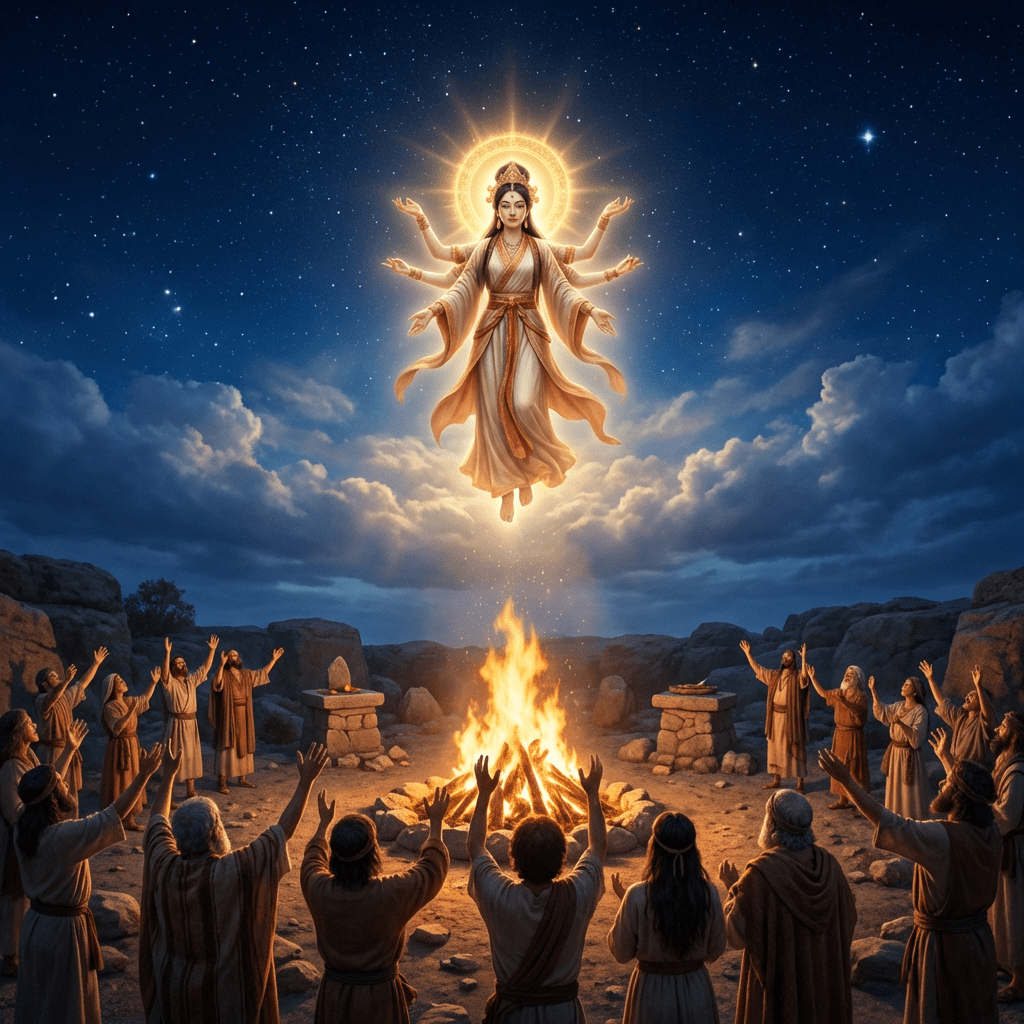
There is a figure in the Rig Veda that almost no one outside of specialists knows, and who yet touches something absolutely central to Vedic spirituality. That figure is Îla. She is not a great goddess in the way that Ushas or Aditi are. She has no mandala dedicated to her, no developed mythological cycle, no celebrated iconographic representation. She appears in the hymns in a recurrent but discreet way, like a presence one recognises without always knowing how to name it. And yet what she represents is at the heart of what Vedism understands by spirituality: the word that comes from elsewhere, the word that opens, the word that reveals.
The word Îla, in Vedic Sanskrit, designates several things simultaneously, and this multiplicity is not a lack of precision. It is on the contrary a fundamental characteristic of the way the rishis thought and named reality. Îla is the libation, the liquid offering poured into the sacrificial fire. It is also the nourishing earth, the cow, the milk. And it is the inspired word, the sacred discourse, the hymn that rises spontaneously into the consciousness of the rishi in a particular state of wakefulness. These three dimensions are not different meanings of the same word. They describe the same movement seen from three angles: something that comes from above, that descends, that nourishes, that fertilises, that makes things grow. The water that falls and makes the grain germinate. The milk that feeds the child. The word that illuminates the mind. It is the same flow.
To understand what the inspired word is in the Vedic context, one must first understand how the rishis conceived of their own activity. They did not consider themselves authors. An author creates, invents, constructs from what he knows and what he imagines. A rishi receives. The hymns of the Rig Veda are not literary compositions in the modern sense of the term. They are revelations, visions, direct perceptions of a reality that exists independently of the one who perceives it. The rishi, in the particular state of wakefulness that soma and the sacrifice produced, became momentarily transparent to something greater than himself, and that something began to speak through him. That is Îla. It is the word that does not come from the self, but that passes through the self when it has become sufficiently supple to let it through.
This conception of the inspired word is not unique to Vedism, but Vedism perhaps has its oldest and most precise formulation. It is found in all the great mystical traditions: the prophet who receives the divine word, the poet who says that his poem was dictated to him, the musician who claims to have done nothing more than write down what he heard. This is not a metaphor in all these cases. It is the description of a real experience, that of a word or a music that seems to come from elsewhere, that surprises the one who produces it, that has a different quality from what ordinary reflection can generate. Contemporary neuroscience has begun to explore these states, calling them flow, inspiration, expanded consciousness. The rishis knew them from the inside, deliberately provoked them through soma and ritual, and had found a name for what came out of them: Îla.
In the hymns, Îla is often associated with Sarasvati and Bharati, forming a triad of goddesses of speech and knowledge. This triad is invoked together in several hymns, notably in the opening hymns of the sacrifice. Sarasvati is the flow of knowledge, Bharati is abundant and nourishing speech, and Îla is precise, exact, direct speech — the one that strikes at the heart of truth without detour. Together they cover the three dimensions of what Vedism understands by sacred speech: the knowledge that irrigates, the abundance of expression, and the precision of revelation. None of the three is sufficient alone. Knowledge without expression remains sterile. Expression without precision becomes chatter. And revelation without the flow of knowledge that irrigates it remains a flash without a tomorrow.
What this triad says about the Vedic conception of language deserves attention. For the Vedic people, language is not a tool that humanity invented to communicate information. Language is a cosmic reality, a force of the universe in the same way as fire or wind. Sanskrit itself, in the tradition that would follow the Rig Veda, would be called the language of the gods, the language in which the universe thinks itself. Mantras do not work because they mean something. They work because they are something, because their sounds, their rhythm, their vibrational structure act directly on consciousness and on reality. This is why the oral transmission of the Rig Veda was of such extraordinary precision: to change an accent, to lengthen a vowel, to alter a rhythm, is to change the thing itself, not merely its representation.
Îla is the guardian of this precision. She is the word that reaches its target, that says exactly what it must say, without excess or lack. In the context of the sacrifice, it is she who ensures that the hymns pronounced have the effect they are meant to have, that the communication between the sacrificer and the forces he invokes is real and effective. She is in this sense a technical power as much as a spiritual one, but in Vedism these two dimensions are inseparable. Technique without spirituality is mechanical and empty. Spirituality without technique is vague and ineffective. Îla unites them.
In the tenth mandala there is a hymn, 10.125, that tradition would later call the Devi Sukta, the Hymn of the Goddess, attributed to a woman rishi, Vak Ambhrini. Vak, which means Speech, speaks in the first person and says something astonishing for a text several millennia old: I am she who blows like the wind, who embraces all creatures, whose power reaches beyond sky and earth. It is not one goddess among others who speaks. It is Speech itself, in its cosmic dimension, revealing itself as a fundamental force of the universe. Îla is one aspect of this Speech, its manifestation in the concrete act of sacrifice and poetic revelation.
What makes Îla particularly valuable for us today is what she says about the nature of creativity and inspiration. In an era when creativity has become a skill to develop, a technique to master, a product to optimise, the Vedic conception represented by Îla proposes something radically different. The true word, the word that matters, is not manufactured. It is received. It arrives when the self has calmed sufficiently to stop making noise, when the ego has released its grip on the need to produce and control, when consciousness is open and silent enough for something vaster to express itself within it. This is exactly what soma and the Vedic sacrifice produced as a condition. And this is exactly what artists, scientists and mystics of every era describe when they speak of their moments of grace.
Îla is not a mythological curiosity reserved for Indologists. She is the oldest name we have for something that every human being has touched at least once: that moment when the right words arrive without effort, when the sentence writes itself, when the solution appears without having been sought, when something speaks through us that is clearer and truer than anything we could have produced by our own means. The rishis knew how to bring about this state. They had given it a name. And they had raised it to the rank of the divine, which is perhaps the most honest way of saying what it truly is.
 Le Rig Veda
Laisser un commentaire