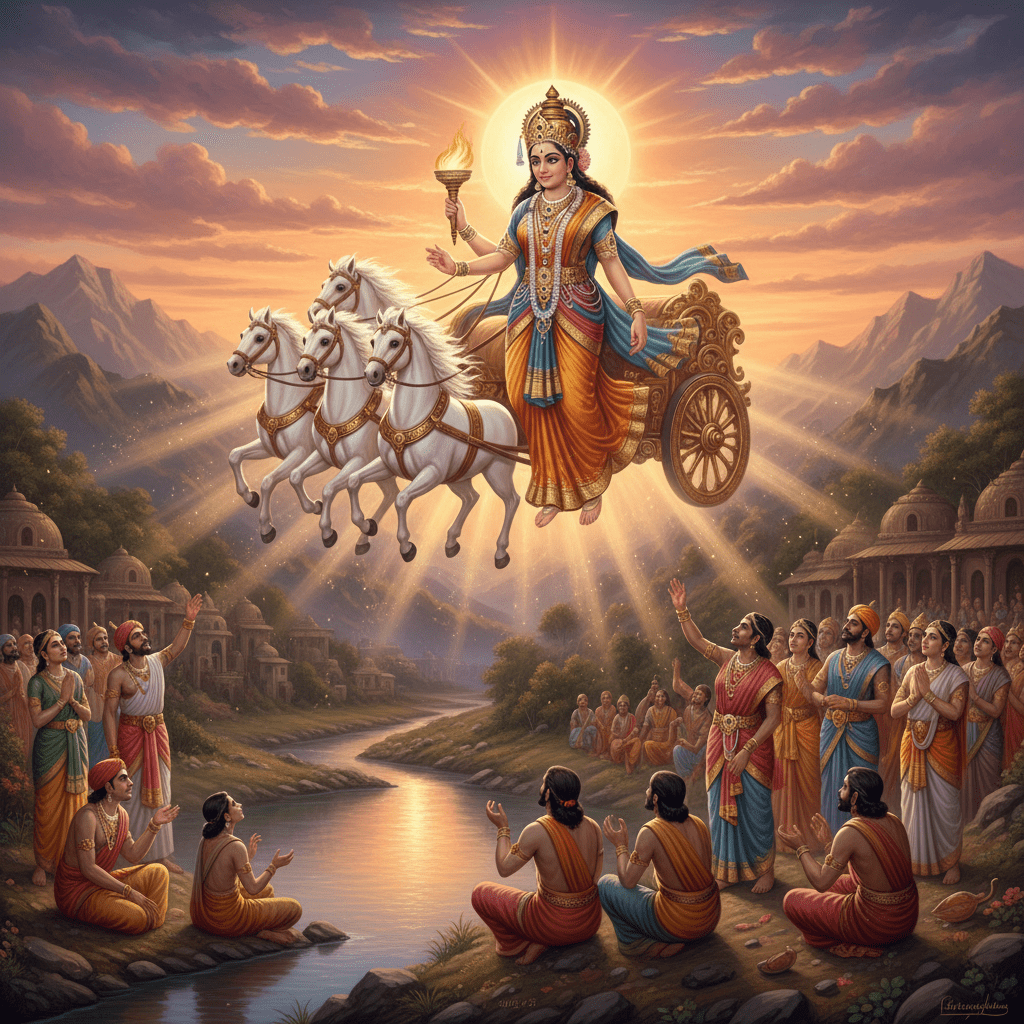
There is a paradox in the way contemporary Hinduism is perceived in the West. On one side, everyone knows the considerable place occupied by the great goddesses: Durga, Kali, Lakshmi, Sarasvati, Parvati. On the other, when the Rig Veda is discussed, one instinctively thinks of Indra, Varuna, Agni, Mitra, those masculine gods who dominate the text in its usual representations. What is forgotten, or never truly known, is that the divine feminine is present in the Rig Veda from the very beginning, in forms of remarkable richness and subtlety, and that certain of these goddesses carry aspects of spiritual reality that the masculine gods do not cover.
The most celebrated is Ushas, the Dawn. She is also one of the oldest, present in the most archaic mandalas, which says something about her fundamental importance. Ushas is not a secondary goddess, a decorative figure charged with embellishing Vedic cosmology. She is the hinge between darkness and Light, between sleep and waking, between Maya and Brahman. Each morning, it is she who opens the door. The hymns dedicated to her are among the most beautiful in the text, possessing a sensuality and poetic precision that even the finest hymns to Indra do not always match. She is described as a young woman awakening, unfolding her luminous veils, driving out darkness without violence, simply through her presence. It is not force that breaks open the darkness, as Indra does with his thunderbolt. It is gentleness that dissolves it. It is another way of arriving at the same Light, and the Rig Veda has the wisdom to offer both.
Sarasvati is the second great feminine figure of the Rig Veda, and her case is particularly instructive. She is first a river, the great river on whose banks a significant part of Vedic civilisation developed, and which dried up around 1900 BCE. But she is simultaneously the goddess of that river, and by extension the goddess of flow: the flow of water, the flow of speech, the flow of knowledge, the flow of enlightenment. In the hymns, these different dimensions are inseparable. Sarasvati irrigates the fields and she irrigates minds. She makes water run and she makes the right words run — the effective mantras, the hymns that open consciousness. It is she who illuminates meditations, the text tells us. It is she who is the flow of the divine word. In contemporary Hinduism she has become the goddess of arts and knowledge, represented with a lute and books. This representation is a direct continuation of what she already was in the Rig Veda, but impoverished: the knowledge has been kept, the river has been lost. The books have been kept, the living flow has been lost.
Aditi is perhaps the most difficult to grasp for a Western mind, and perhaps for that reason the most frequently overlooked. Her name literally means unbound, unlimited, infinite. She is the Mother of all things, the Mother of the gods themselves, the Adityas being her sons. She has no precise form, no defined attributes, no developed mythological narrative. She is the infinite space in which everything exists, the primordial matrix, what contemporary physicists might call the quantum vacuum if that vacuum were conscious and benevolent. The hymns do not ask her to do things. They recognise her, honour her, place themselves under her protection — which is the protection of the infinite itself. Aditi is Brahman in a maternal and feminine aspect. It is ultimate reality not as blinding light or terrifying power, but as welcoming space, as the maternal womb of the universe. This figure has no direct equivalent in Western monotheistic traditions, and that is perhaps why she is so little known.
Ratri, the Night, is another feminine figure whose presence in the Rig Veda deserves attention. She is the sister of Ushas, her necessary complement. An entire hymn is dedicated to her, hymn 10.127, of a sober and singular beauty. The Night is not threatening darkness, the domain of Vritra and malevolent forces. She is the great protector, the one who covers the world with her mantle and allows for rest, recovery, dream. She is also, for those who know how to read her, the moment when the boundaries of ordinary consciousness relax, when the Intermediate World becomes more accessible, when the rishis could receive the hymns that came to them as revelations. The word rishi itself is sometimes translated as seer, and many of those visions came from the night, from silence, from that space that Ratri opened and protected.
There are also the women rishis, and their existence within the Vedic corpus is a fact that academic circles have long minimised. Yet they are there, named, identified, their hymns included in the sacred text on exactly the same footing as those of their male counterparts. Lopamudra, wife of the rishi Agastya, composed a hymn of disarming frankness about desire and the relationship between man and woman, hymn 1.179, which stands in striking contrast to the solemnity of most sacred texts of the era. Ghosha composed several hymns to the Ashvins in which she speaks of her own spiritual experience with a precision and authority that owe nothing to anyone else. Apala, Vishvavara, Sikata Nivavari: these names are in the text. These women sang the gods, drank soma, received revelations and put them into words with the same seriousness and the same competence as men. Their existence in the Vedic corpus says something essential about the society that produced this text.
What all these feminine figures have in common is that they represent aspects of spiritual and cosmic reality that are not covered by the masculine pantheon. Ushas brings the gentleness of transition, Sarasvati brings the flow and fertility of speech, Aditi brings the maternal infinite, Ratri brings the protection of benevolent darkness. These are not minor divinities confined to subordinate functions. They are fundamental powers without which Vedic cosmology would be incomplete.
The fact that they are today largely forgotten in the usual presentations of the Rig Veda says less about the Rig Veda itself than about those who read and transmitted it after the disappearance of soma, after the appearance of castes, after the progressive drift from a living spirituality toward an institutional religion. This drift has everywhere in the world tended to marginalise the divine feminine, to relegate it to secondary roles or to reduce it to folklore. Contemporary Hinduism has resisted this tendency better than most other traditions, precisely because the Vedic memory, even distorted, even partially lost, was deep enough not to be entirely erased.
But it is in the Rig Veda itself, in the raw text, that these goddesses speak most clearly. Before the interpretations, before the commentaries, before the centuries of tradition that deposited over the original text their own prejudices and their own blind spots. Ushas awakening each morning, Sarasvati flowing and illuminating, Aditi containing everything without being contained by anything, Ratri protecting the sleeping world: they are there, in the hymns, intact, waiting simply to be read by someone who is not trying to reduce them to what they already know.
 Le Rig Veda
Laisser un commentaire