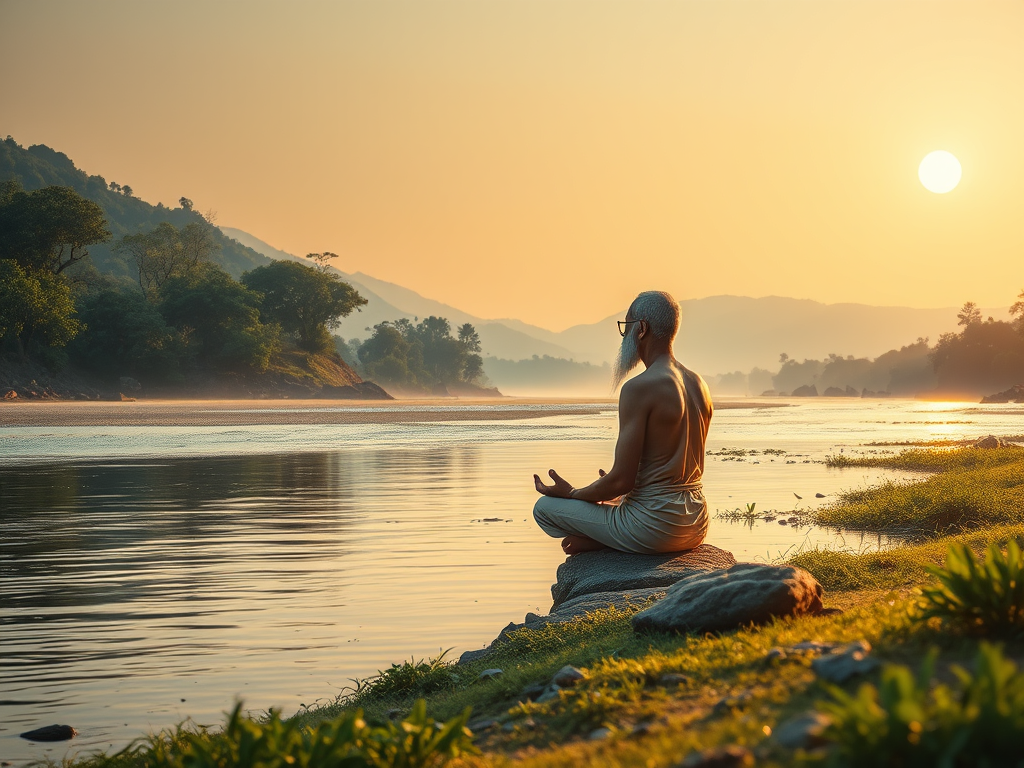
Inner peace is not a Vedic concept. That is to say, it is not presented in the Rig Veda as a goal in itself, as something one seeks because one lacks it and would like to acquire it. In Vedic thought, inner peace is not a destination. It is what remains when the obstacles have been removed. It is the natural state of consciousness when Maya has dissipated, when Vritra has been struck down, when the ego has stopped making noise. It is not constructed. It is revealed.
This distinction matters because it radically changes the way the question is approached. In most spiritual traditions that followed Vedism, and even more so in contemporary psychology, inner peace is something one builds, cultivates, earns through prolonged effort. One manages one’s stress, practises mindfulness, works through one’s traumas, develops resilience. All of this assumes that there is a self working on itself to become better, calmer, more balanced. Vedism says something different. It says that this self working on itself is precisely the problem. As long as the ego is busy searching for peace, it prevents peace from appearing.
The rishis of the Rig Veda did not write treatises on inner peace. They sang soma, invoked Indra, celebrated Ushas and the fire of Agni. But within these songs one finds an extremely precise description of the mechanisms that produce disturbance and of those that allow it to be dissolved. Disturbance is Vritra. It is inner darkness, obstruction, everything that prevents consciousness from seeing clearly. And the dissolution of that disturbance is the victory of Indra, the entry into the Light, the moment when, as the eighth mandala says, one becomes immortal and finds the gods.
The first mechanism that the hymns identify as a source of disturbance is attachment to the fruits of action. Not action itself, but the anxiety that accompanies it when one expects a particular result. The sacrificer who pours soma and sings the hymns does not negotiate with the gods. He does not say: I do this, therefore you must give me that. He offers. He gives without calculation, and in that act of uncalculated giving, something is released. This principle, which the Bhagavad-Gita would articulate centuries later with a philosophical precision the Rig Veda does not yet possess, is already there, in the very structure of the Vedic sacrifice. Act, but without clinging to the result. It is one of the oldest and most effective descriptions of what produces inner peace that the history of human thought has recorded.
The second mechanism is tied to the nature of ordinary perception. Maya, the illusion constructed by our limited senses, generates a constant underlying form of unease. We perceive the world as fragmented, as made up of separate entities in competition with one another, and we perceive ourselves as one of those separate entities — vulnerable, mortal, insufficient. This perception is the source of fear, and fear is the source of almost every behaviour that disturbs peace, within oneself and in the world around. Vedism does not propose correcting this perception through an act of will or through intellectual conviction. It proposes passing through it, by means of the direct experience of Brahman, of that vaster reality in which separation is revealed for what it is: a useful illusion, but not an ultimate truth.
This is where soma comes in, and this is where the personal experience that some of us have had with psychedelics becomes a key to reading the Vedic text with striking clarity. What one feels in the first hours of a well-conducted experience with a tryptamine is precisely the dissolution of this perception of separation. The boundaries between self and world grow faint. Fear diminishes, then disappears. A sense of deep security settles in — not the fragile security of someone who has locked their door, but the security of someone who has understood that there is no door, that there is no threatening outside because there is no separate inside. This is what the hymns call entering the Light. And it is, in direct experience, beyond any doubt, a peace of a depth that nothing in the ordinary state of consciousness can approach.
But the rishis also knew, and the text says this clearly, that this experience must be ritualised in order to be beneficial and lasting. The framework of the sacrifice is not an ornament. It is functional. The fire, the chanting, the community gathered together, the preparation of soma according to precise procedures: all of this creates the conditions in which the experience can unfold safely and productively. What hymn 79 of the eighth mandala describes when it says that soma heals the sick, makes the blind see and the lame walk, is the result of an experience conducted within these conditions. Without the ritual framework, without the community, without the preparation, the same substance can produce very different effects. The rishis knew this. That is why an entire mandala is devoted to the details of the pressing, purification and preparation of soma.
The inner peace that results from this experience is not a passive peace, a withdrawal from the world, an indifference to events. It is exactly the opposite. The rishis who drank soma and touched Brahman came back to write hymns of astonishing vitality and precision. The rajas who took part in the sacrifices governed their communities. The heads of household returned to their fields and their herds. Vedic inner peace is an active peace, a peace that gives energy rather than consuming it, a peace that clarifies vision rather than dulling it. It is not the calm of someone who has given up. It is the steadiness of someone who has understood.
This understanding has direct consequences for the way one lives with others. A consciousness that has experienced unity cannot treat others as adversaries. It can still perceive conflicts, navigate tensions, make difficult decisions, but it does so from a different place. The archaeology of the Indus-Sarasvati civilisation shows what results, at the scale of an entire civilisation, from a culture in which this experience is collective and regular: no fortifications, no weapons of war, no traces of conquest or domination, a social organisation manifestly oriented toward the common good rather than the glorification of a few.
With the disappearance of soma, the path toward inner peace does not disappear, but it becomes infinitely longer and more difficult. The Upanishads trace this path with remarkable rigour and beauty. Yoga, meditation, pranayama, the work on the breath that naturally activates the same neurological pathways as tryptamines: all of this works, but it requires years, sometimes an entire lifetime. It is no longer a collective and regular experience integrated into the life of an entire civilisation. It is an individual path, demanding, that only a minority have the time, the conditions and the determination to follow to its end.
The Rig Veda gives us the oldest and most direct version of this path. Not a philosophy of inner peace. A practice. A fire, a plant, songs, a community, and the quiet conviction that the Light is there, accessible, that it has always been there, and that everything separating us from it is the darkness of Vritra — that is to say, our own ego making noise in the dark.
 Le Rig Veda
Laisser un commentaire