It is tempting, when reading the Rig Veda, to see only the great themes: soma, enlightenment, the gods, cosmology. But the text is also, in places, surprisingly precise and familiar about everyday life. The rishis were not hermits cut off from the world. They lived in families, in villages, then in cities, and their hymns carry the trace of that ordinary life with a disarming naturalness. Between 4000 and 1900 BCE, across that vast territory stretching from the Ganges to the Indus, a civilisation developed whose coherence and sophistication we are only beginning to measure.
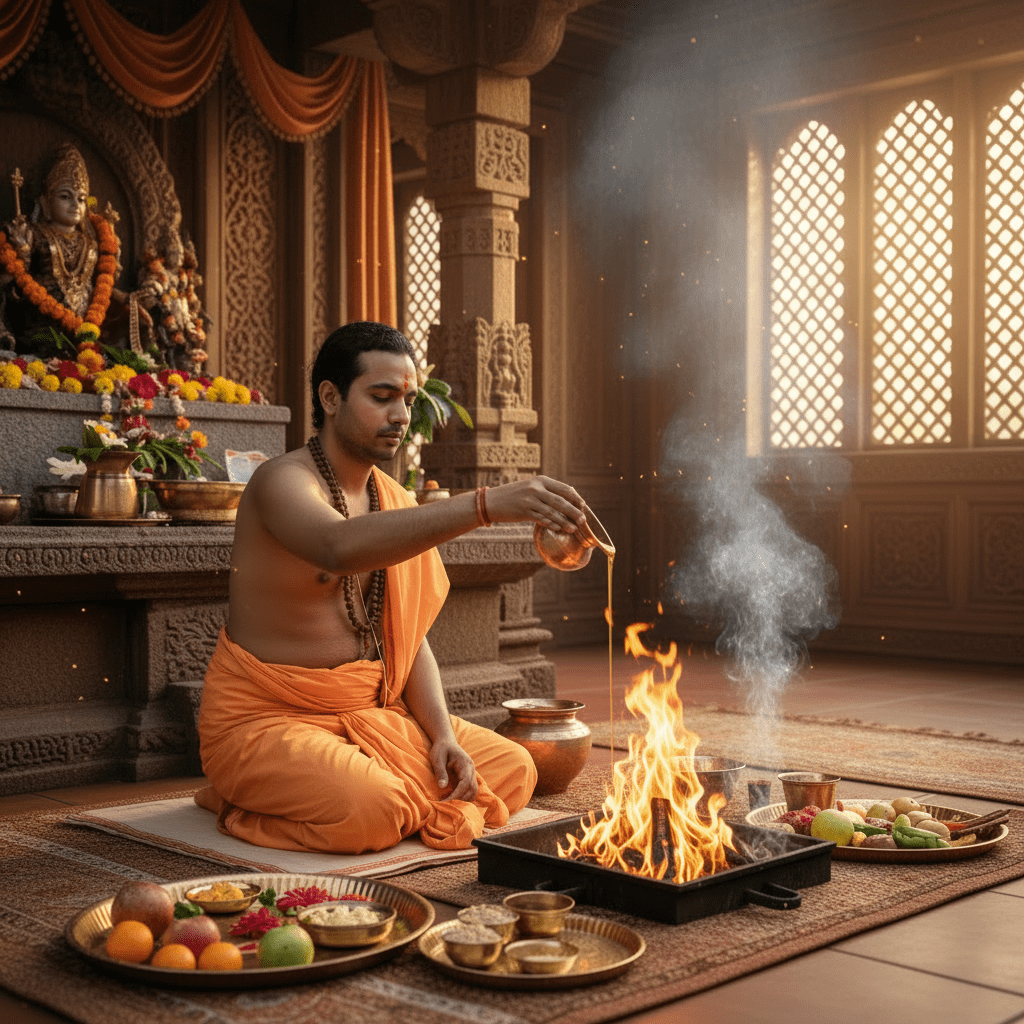
The family was the basic unit of this society, and the head of household, the master of the house, occupied a central place within it. He presided over the domestic sacrifice, the private puja, that daily ritual in which a spoonful of clarified butter was poured into the fire while mantras were recited. This gesture, which hundreds of millions of Indians still perform today, was the backbone of family spiritual life. It required no priest, no temple, no institution. It took place at home, before the domestic fire, with the members of the family gathered together. Vedic spirituality was not reserved for an elite of specialists. It was integrated into daily life as naturally as the evening meal.
Archaeology gives us a concrete image of this living environment. The houses of the Indus-Sarasvati civilisation were built of fired brick, solid and well arranged. Even modest dwellings had their own washroom. Many had dry toilets, which existed nowhere else in the world at that time. The streets were laid out on an orthogonal plan, with a wastewater drainage system whose efficiency would not be matched in Europe until the Roman period, and even then only partially. This was not a civilisation of huts and poverty. It was a mature urban civilisation, designed in detail for the comfort and dignity of all its inhabitants, including the most modest.
The day began with the sun, or even before it. The Dawn, Ushas, is one of the most celebrated divinities in the Rig Veda, and this is no accident. The rising of the day carried a strong spiritual dimension: it was the moment when the Light drove out darkness, when consciousness awakened, when the sacrificial fire could be lit or rekindled. The hymns to Ushas are among the most beautiful in the text, and they say something very concrete about these people’s relationship to passing time, to nature renewing itself, to the simple beauty of the visible world.
Economic activities were diverse and manifestly well organised. Agriculture and livestock farming formed the base. Wheat, barley and legumes were cultivated. Cattle, horses, goats and sheep were raised. The cow held a particular place, not yet in the form of the absolute taboo it would later become, but as the most precious of animals, a symbol of wealth and generosity. In the hymns, cows are omnipresent, often as metaphors for Light and knowledge, but also in their daily reality as animals whose milk fed families and whose value served as a standard of exchange. Soma itself was mixed with milk and water before being drunk, and was exchanged for a cow at its full value.
Craftsmanship flourished. Excavations have revealed an abundant and high-quality ceramic production, objects in bronze and copper, jewellery in gold, silver and semi-precious stones, engraved seals of remarkable fineness. Trade was active, not only within the civilisation but with the outside world: objects from the Indus have been found in Mesopotamia, and Mesopotamian goods in the cities of the Indus. This was an open civilisation, in contact with its surroundings, without the paranoid mistrust of the outsider that certain later societies would develop.
Women participated fully in this life. The Rig Veda does not confine them to a secondary or domestic role. They drank soma, they attended the sacrifices, some were rishis who composed hymns that form part of the sacred corpus. Archaeology confirms this impression of relative freedom: feminine representations are numerous in the art of the Indus, women appear unveiled, often adorned with elaborate jewellery, in postures that suggest nothing of submission. In certain regions, notably in Turkmenistan and Afghanistan, excavations have even shown that women occupied leadership roles in these civilisations that were contemporary with Vedism and shared the same spirituality.
Children grew up in this universe of chanting, sacred fires and recitation. The transmission of knowledge was oral, of extraordinary rigour and precision. The hymns of the Rig Veda were memorised and transmitted across millennia with a fidelity that specialists consider one of the most remarkable mnemonic achievements in human history. This presupposes an education begun very early, a discipline of breath and memory integrated from childhood, and a value placed on speech and sound that we struggle to imagine in our societies of writing and image.
The great occasions of collective life were the public sacrifices. They could last from a single day to a full year and mobilised the entire community. They were at once a spiritual ceremony, a festival, a market, a moment of encounter and exchange. This was not an austere and silent spirituality. It was alive, colourful, sensual, rooted in the pleasure of being together and sharing something important. The Kumbha Mela, that gathering of tens of millions of pilgrims that still takes place in India today, is probably the most direct echo of these great Vedic celebrations.
Death was part of this landscape without the drama we tend to accord it. In the first nine mandalas, there is no question of reincarnation. Immortality is spoken of, but it is the immortality given by the experience of Brahman, not the promise of a future life. The ancestors, the Pitris, are honoured, their memory is alive, but they do not haunt the living with their demands. Death seems to have been experienced as a transition in a world where the boundaries between states of consciousness were in any case far more porous than our own.
What strikes us, in the end, about this image of Vedic daily life is its balance. A society that had solved the problems of water and sanitation better than anyone else of its era. Families in which spirituality was not separated from ordinary life but was its guiding thread. Women who participated fully. Cities without armies and without palaces. A transmission of knowledge of extraordinary precision. And at the centre of all this, the daily fire of the domestic sacrifice, the simple gesture of pouring a little clarified butter into the flame while murmuring the words that the ancestors had found to say what is not easily said: that everything is sacred, that nothing is separate, and that the Light is accessible to those who know how to seek it.
 Le Rig Veda
Laisser un commentaire