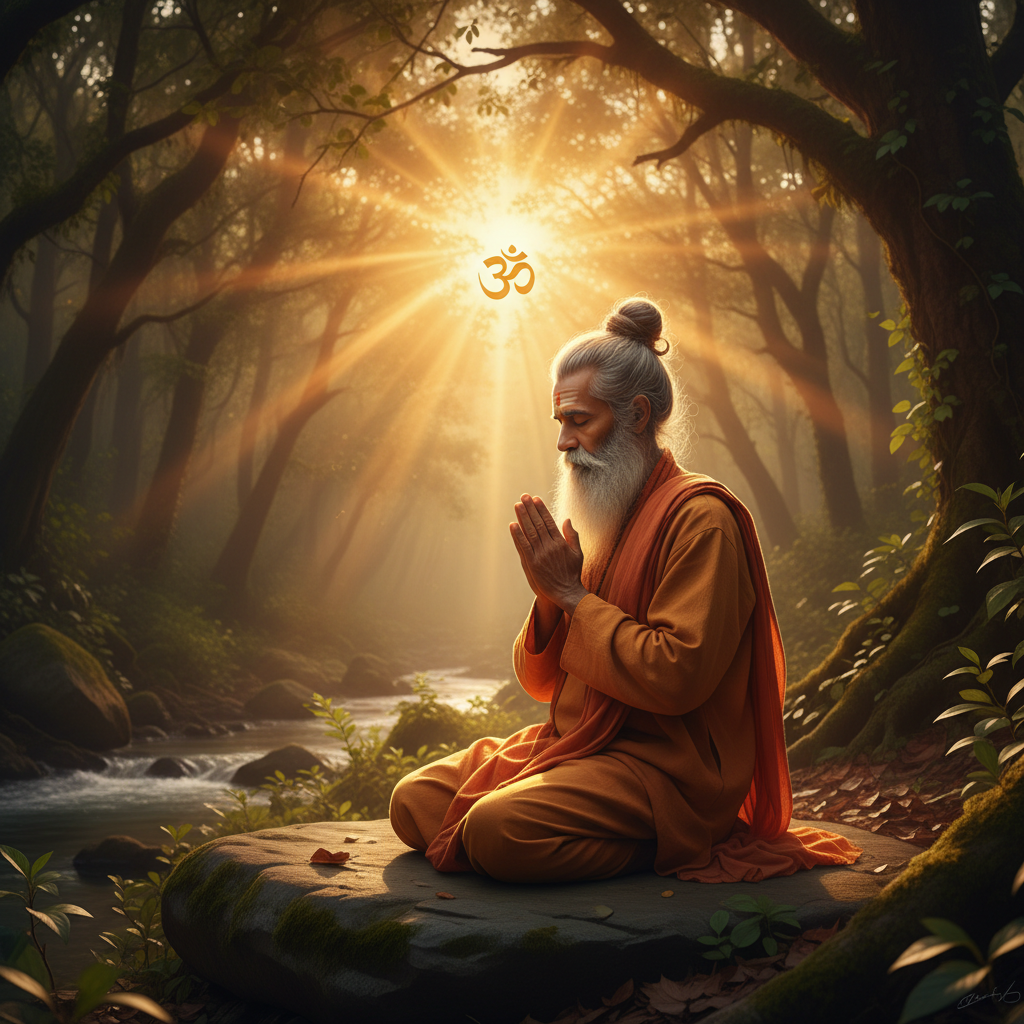
There is a question that is never asked in the Rig Veda. No one wonders whether nature is sacred. No one debates whether rivers, mountains, fire or wind deserve to be venerated. This question makes no sense within the Vedic framework of thought, in exactly the same way that it would make no sense to ask whether the ocean is wet. Nature and the divine are not two things that different epochs or cultures bring together or pull apart. They are, from the outset and beyond any possible discussion, one and the same reality.
This is a point worth insisting on, because it represents the deepest rupture between the Vedic worldview and the one that gradually came to dominate the West. In the tradition of thought that shaped Europe, there is on one side God, transcendent, separated from his creation, and on the other nature, inert or hostile matter that humanity was given the mission to dominate. This fracture, whose ecological and spiritual consequences we are still paying for today, is entirely absent from the Rig Veda. It is not contested there, it is not debated there, it simply does not exist there.
In the hymns, Agni is fire. Not the symbol of fire, not a deity presiding over fire from a distant Sky: fire itself, in its immediate and concrete reality, is divine. When a rishi pours clarified butter into the sacrificial fire, he is not making a symbolic gesture toward an abstract entity. He is entering into direct contact with a force of the universe that is simultaneously physical and spiritual, because in Vedic thought that distinction does not exist. Vâyu is the wind, Sarasvatî is the river, Sûrya is the sun. Not allegories. Realities.
Indians have always said that matter is solidified spirit. This formulation, found throughout every tradition that descends from Vedism, is not a poetic metaphor. It is a literal description of the way the world works, according to a vision that contemporary quantum physics is beginning to brush against without quite daring to state it plainly. Matter, from this perspective, is not the opposite of spirit. It is a condensed, slowed-down form of it, rendered perceptible to the crude senses we possess. The rock, the river, the mushroom and the human being are made of the same fundamental substance, animated by the same forces, subject to the same laws. What the Vedic people called Brahman.
This is why the Vedic gods are deified forces of nature, not anthropomorphic characters installed in a paradise separate from the world. Indra is the storm, but he is also the quickness of the intellect, the energy that breaks through obstacles. Rudra is destruction, but the destruction that liberates — the destruction of the storm that cleanses and renews. The Maruts are the winds, but also the will and the vital force. Ushas is the dawn, but also the first awakening of consciousness toward the Light. Every natural force has its inner counterpart, because human beings are part of nature and are therefore traversed by the same forces as nature. What governs the universe governs the human being. There are not two sets of laws.
This non-separation between humanity and nature has considerable practical consequences for the way Vedic civilisation organised and conducted itself. One does not exploit that of which one is a part. One does not enslave what is oneself. The archaeology of the Indus-Sarasvati civilisation reveals a management of water and resources of remarkable sophistication, not through technical constraint but manifestly through a relationship with the natural environment profoundly different from that which would characterise the civilisations that followed. The great cities of Harappa and Mohenjo-daro had sanitation systems that ancient Rome would not equal until two thousand years later. This is not the result of chance. It is the result of a worldview in which degrading nature amounts to degrading oneself.
There is in the Rig Veda a way of addressing natural elements that says everything about this relationship. The hymns to rivers, waters, fire and wind are not supplications directed at superior and capricious powers that need to be appeased. They are invocations to forces that the rishi recognises in himself as much as in the outer world. When hymn 10.9 says: « O Waters, today I have come to unite with you through the juice. O Agni, come here, full of juice and flow to unite us with the Light, » this is not a prayer in the sense that the West understands that word. It is a bringing into resonance. The rishi is not asking something external to grant him a favour. He is seeking to vibrate at the same frequency as the force he invokes, because he knows that this force is constitutive of him.
Soma played a central role in this experience of unity. By temporarily dissolving the boundaries of the ego, it allowed the direct experience of what the hymns describe conceptually: the absence of separation between oneself and the rest of the universe. What ordinary consciousness perceives as a boundary between inside and outside, between self and nature, is revealed under the effect of soma for what it is: a mental construction, useful for navigating daily life, but fundamentally illusory. Maya. The experience of Brahman is precisely the experience of the dissolution of that boundary. And this experience, the rishis lived regularly, collectively, within the framework of a ritual that involved fire, water, plants, chanting and breath. That is to say, the whole of nature.
What was lost with the disappearance of soma and the advent of religion in the institutional sense of the word was precisely this direct and lived experience of unity. Nature gradually ceased to be a divine reality and became a backdrop, then a resource, then a problem. The gods moved away from the physical world to settle in temples, then in texts, then in concepts. And humanity found itself alone, facing a nature it no longer recognised as itself.
The Rig Veda tells us something different. It tells us that this separation is an error of perception, a consequence of ego and Maya, and that it can be corrected. Not by an intellectual decision, not by a philosophical conviction, but by an experience. Direct, lived, repeated. The rishis had no need for anyone to explain to them that nature is sacred. They knew it from the inside. And everything else followed from there, naturally.
 Le Rig Veda
Laisser un commentaire