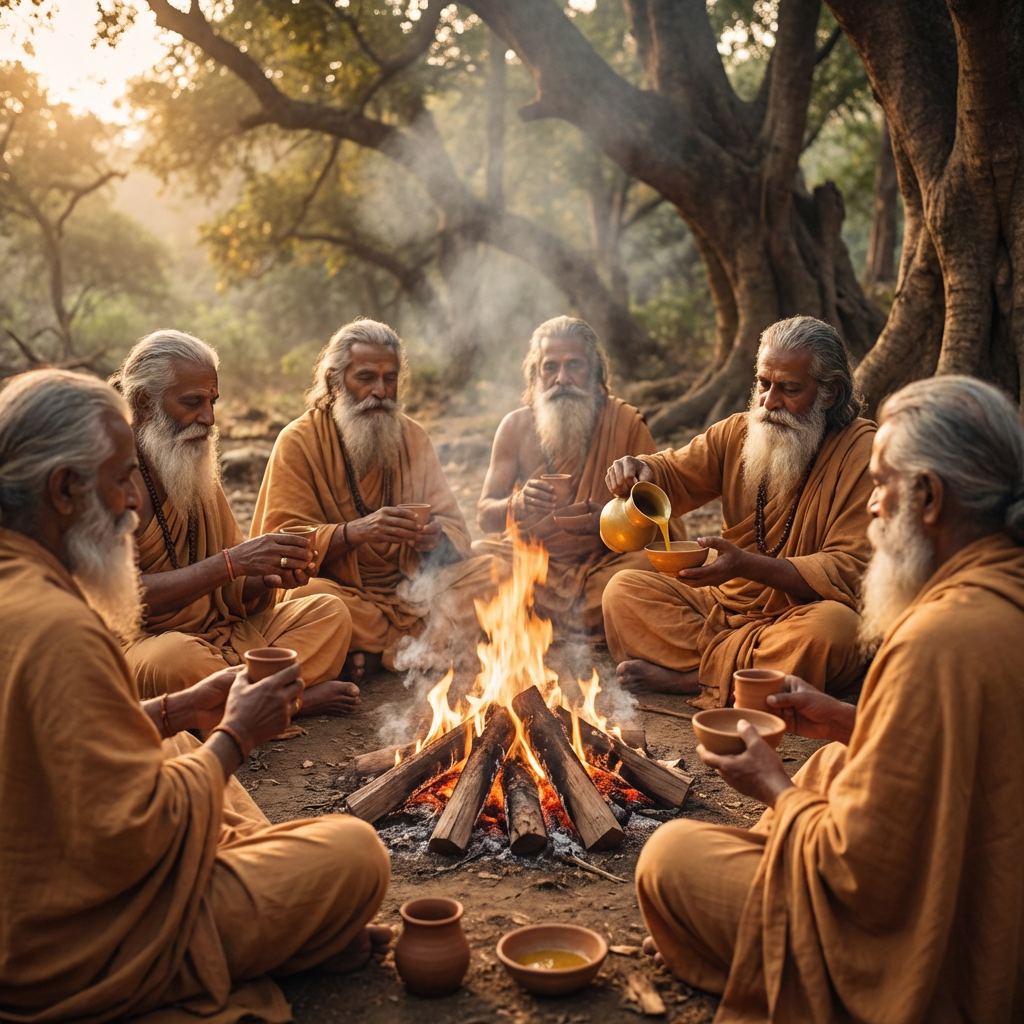
The Vedic people had a three-level vision of the world. The Sky, the Earth and the Intermediate World. This division, found in almost every spiritual tradition that followed, was not a mythological construction designed to explain thunder or the seasons. It was a map. A map of the states of consciousness that human beings can move through, and that the rishis knew from the inside, through soma among other means.
The Earth is our ordinary state. What we perceive day to day through our five senses, what we call reality. In Vedism, this is not reality — it is Maya: the illusion constructed by limited sensory organs that capture only an infinitesimal fraction of what exists. Our eyes cannot see infrared or ultraviolet. Our ears cannot hear infrasound or ultrasound. Our intellect, which Indians regard as one sense among others rather than the summit of being, only understands what it has learned to recognise. Everything else escapes it. We live in a filtered world, reduced and impoverished relative to what is actually there. That is the Earth. Not the ground beneath our feet, but the state of consciousness in which nearly all human beings spend the greater part of their existence.
The Sky is the other extreme. Fusion with the universe. What Vedism calls Brahman, the Absolute, sat-cit-ananda — Being, Consciousness and Bliss, the three inseparable aspects of ultimate reality. It is the state in which the intellect falls silent, where the ego disappears, where the boundary between oneself and the rest of the universe dissolves. It is not a state of emptiness or unconsciousness. On the contrary, it is a maximal consciousness, infinitely vaster than that of ordinary waking life. The rishis call it the Light, immortality, the Truth. In the eighth mandala, someone who has just passed through this experience writes simply: « We have drunk the soma. We have become immortal. We have entered the Light, we have found the gods there. » No elaboration, no philosophical system. A statement of fact.
Between these two poles lies everything else. That is the Intermediate World.
This is where everything actually happens. This is where the Vedic gods live, along with demons, spirits, the Angiras and the other entities that the hymns invoke ceaselessly. It is also where human beings are found who are on their way toward mystical ecstasy — those who have left the ordinary state without yet having reached complete fusion. The Intermediate World is the space of in-between states of consciousness, and it is precisely there that spiritual work is done. It is there that events we would today call paranormal take place: visions, premonitions, extra-sensory perceptions, out-of-body experiences. The rishis did not consider these extraordinary. They were part of the normal landscape for anyone making serious progress on the path.
This three-level structure reappears throughout Vedism itself in multiple forms, as though the tripartite framework were a fundamental law of the universe that the Vedic people had identified and applied across every domain. First, the three gunas: sattva, purity and luminosity; rajas, energy and action; tamas, inertia and degradation. These three fundamental qualities combine to create both matter and spirit, and Indians have always held that matter is simply solidified spirit. Then the trimurti, which would emerge a few centuries after the Rig Veda but remains its direct continuation: Brahma the creator, Vishnu who maintains and sustains, Shiva who destroys in order to make way for what comes next. The three conditions necessary to know Brahman: purified dispositions of mind, an adequate environment, an effective means. And the definition of Brahman itself: sat-cit-ananda, three inseparable terms pointing to a single reality.
It is no coincidence that the same structuring principle appears everywhere. It is because the rishis were observing the same thing from different angles. The Earth-Intermediate World-Sky tripartition is not a cosmology invented to make sense of the inexplicable. It is the description of a lived experience, repeated, transmitted from generation to generation within an oral tradition of remarkable precision. When a rishi of the sixth mandala, one of the oldest, invokes Indra or Varuna, he is not addressing external entities in a Sky located somewhere above the clouds. He is calling upon inner forces, upon aspects of himself and of the universe that are accessible within the Intermediate World, on the path toward the Light.
Indra, the warrior god associated with the senses and the intellect, is the force that fights inner darkness — Vritra, the one who obstructs, who prevents consciousness from moving forward. Agni is the fire of transformation, the Light that drives out darkness. Ushas, the Dawn, is the first sign that the Sky is drawing near. All these gods inhabit the Intermediate World, all of them participate in the passage from Earth to Sky. Vedic mythology is a phenomenology of states of consciousness — and a phenomenology of a richness and precision that contemporary psychology is only now beginning to match.
What makes this vision particularly striking for us today is that it is not dualistic. There is no matter on one side and spirit on the other, no profane on one side and sacred on the other. The Earth, the Intermediate World and the Sky are three states of a single continuous reality. Human beings can move through all three, and the goal of Vedic spiritual life is precisely to expand the field of consciousness until it encompasses the Sky without losing contact with the Earth. The rishis were not fleeing the world. They drank soma, touched Brahman, and then returned to write hymns of astonishing beauty and precision. The Intermediate World was their habitual working ground.
When the soma shortage struck between 2200 and 2100 BCE, this map was the first thing to be lost. The rites continued, but without the means that had allowed them to be lived from the inside. The Intermediate World gradually filled with fear rather than exploration. The gods, who had been well-known inner forces, became external entities that needed to be placated. And the Sky, which had been an accessible destination, became a distant paradise reserved for the virtuous dead. Religion had replaced spirituality. This is not specific to Vedism. It is the movement observed everywhere in human history, whenever the direct transmission of experience is broken.
 Le Rig Veda
Laisser un commentaire