Among the most fascinating mysteries bequeathed to us by Antiquity, the Soma of the Rig Veda occupies a singular place, suspended between ritual and ecstasy, between pharmacology and the divine. This sacred beverage, prepared and consumed during the great Vedic sacrifices, was not simply one offering among many. It was the beating heart of the ceremony, the very substance through which priests and sacrificants crossed the invisible boundary separating the ordinary world from the world of the gods.
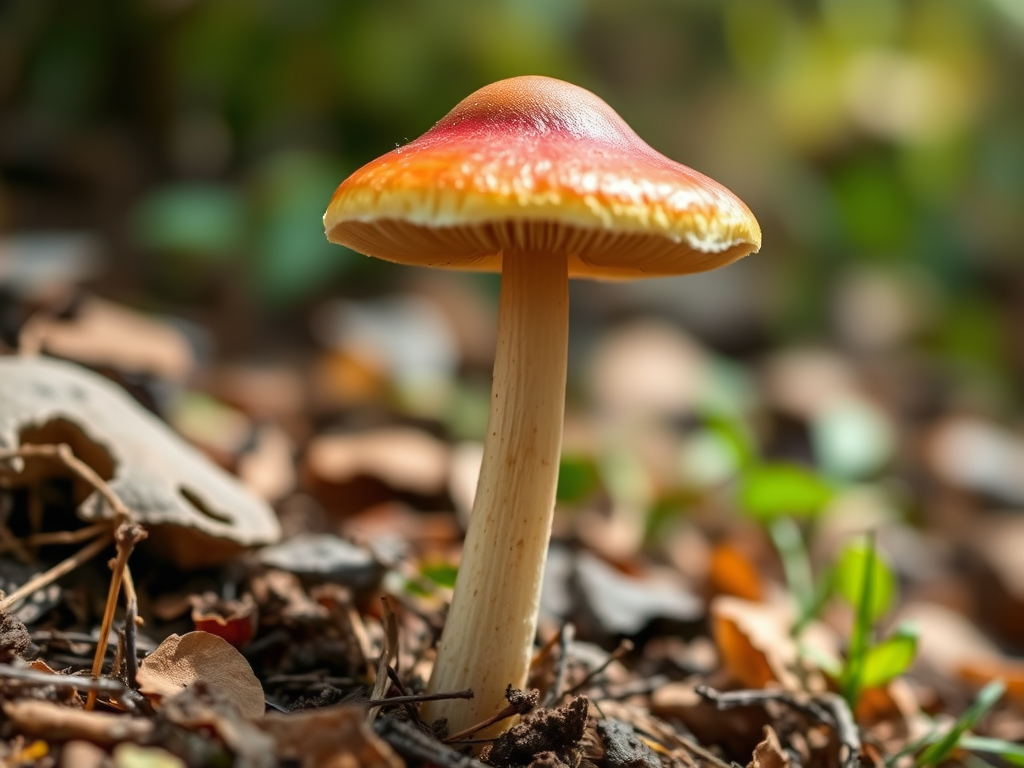
The word Soma derives from the Sanskrit root su, meaning to press. It is not an insignificant name. It designates at once the plant, the juice extracted from it, and the deity associated with it, as if the substance and the god were one, as if the simple act of pressing the plant between stones were sufficient to bring the sacred into being. The physical description of the plant in the hymns is equally revealing : the term amshu is used, meaning thread, filament. This botanical detail has led modern researchers toward a serious hypothesis, that of the fungus Psilocybe cubensis, whose finely striated cap and filiform stem correspond strikingly to this archaic description. The mushroom contains psilocybin, a psychoactive molecule today studied by neuroscience for its profound effects on consciousness.
The question of the botanical and chemical identification of Soma has long divided specialists. R. Gordon Wasson, an American ethnomycologist, was one of the first to seriously advance the thesis of a fungal origin in his work Soma : Divine Mushroom of Immortality, published in 1968. Others have proposed Ephedra, Amanita muscaria, or various plants of the Iranian steppe. But the coherence between the effects described in the hymns, the known properties of psilocybin, and the morphological description provided by the term amshu today argues in favor of the psilocybin mushroom. This is not an absolute certainty, but it is a hypothesis that withstands scrutiny.
What makes the ritual protocol particularly remarkable is its temporal structure. On the last day of the sacrifice, Soma was consumed three times : at sunrise, at noon, and at sunset. Psilocybin, when ingested, produces effects lasting an average of six hours. Three doses spaced six hours apart yield a continuous experience of eighteen hours, a total immersion in an altered state of consciousness, from dawn through the deep of night. This is not recreational or haphazard use. It is an architecture of experience, an engineering of the sacred of remarkable precision. The brahmins who designed these rituals knew what they were doing. They had observed, experimented, transmitted. Their protocol reveals an empirical knowledge of the substance’s effects that need not envy contemporary pharmacological studies.
The Rig Veda devotes an entire book to Soma, the ninth mandala, composed of one hundred and fourteen hymns exclusively dedicated to it. It is a corpus of extraordinary richness, vibrant with sensuous and cosmic imagery, where the priest’s voice oscillates ceaselessly between description of the concrete ritual and evocation of interior states of an intensity difficult to grasp through intellect alone. There the Soma is pressed upon stones, filtered through sheep’s wool, mixed with milk, curdled milk, and barley. Yet at the same time, this humble gesture becomes a cosmogony : to press the Soma is to set the universe in motion, to liberate the light imprisoned in matter, to open the gates of heaven.
The effects described in the hymns correspond in a troubling way to what contemporary psilocybin research has documented. There is first the dissolution of the boundaries of the self, that feeling that subject and object merge into one another, that individual consciousness expands to encompass the entire cosmos. The Vedic hymns speak of a vision of all the worlds, of a perception of the eternal within the instantaneous, of a direct encounter with the gods that resembles nothing like a distant or symbolic relationship, but rather an immediate presence, physically felt, luminous and overwhelming.
Then there is the experience of light. Psilocybin frequently produces an extraordinary intensification of visual perception, an inner luminescence that subjects in clinical studies describe as the purest light they have ever seen, a light that does not come from outside but seems to surge from consciousness itself. In the Rig Veda, Soma is repeatedly identified with light, with radiance, with the inner sun. It is that which opens the eyes, that which grants sight of what is invisible to the ordinary gaze. The sacrificant who has drunk the Soma no longer looks upon the world with the same eyes. He sees the filaments of light that weave reality together, the invisible connections between things, the secret web that the Vedas sometimes call Indra’s net, where each node is a jewel reflecting all the others.
The auditory and linguistic dimension of the experience is equally central. Under the effects of psilocybin, language transforms. Words lose their arbitrary character and seem to coincide with the things they designate. The voice becomes a cosmic instrument. Now the Rig Veda is precisely an oral text, sung, vibrated, whose syllables are considered to carry real power over reality. The figure of the Vac, sacred speech, is intimately linked to Soma. It is Soma that liberates the Vac within the human being, that makes the priest an inspired poet, a kavi, a seer who does not compose his hymns but receives them, hears them resonate in an interior space that has suddenly opened. Vedic poetry is not literature in the modern sense. It is a form of direct knowledge, a rhythmic gnosis, and it is Soma that is its catalyst.
The eighteen-hour experience made possible by the tripartite protocol of the sacrifice’s final day must be imagined within its sensory and symbolic context. At sunrise : the first dose coincides with the return of light, with Indra’s victory over the serpent Vritra who had imprisoned the celestial waters. Consciousness awakens together with the day, and the interior expansion accompanies the luminous expansion of the outer world. At noon : the second dose comes at the moment of the sun’s full power, at its zenith, when no shadow remains. This is the moment of the sharpest, most intense, most exposed vision. The sacrificant stands naked before reality, without protection or mediation. At sunset : the third dose accompanies the passage into darkness. But under the effects of psilocybin, this passage is not a death but a crossing. The night becomes transparent, peopled with beings and lights invisible to the ordinary eye. This is the space of the waking dream, of nocturnal vision, of dialogue with ancestors and gods.
This eighteen-hour journey was not solitary. It unfolded within a ritualized group, guided by specialized priests who knew the way. Hymns were sung continuously, providing a sonic and symbolic framework for the experience, what contemporary psychology calls set and setting, the mental and environmental context that largely determines the nature of the psychedelic experience. The ancient Vedics, without knowing this vocabulary, had perfectly grasped this principle. They had built around the ingestion of Soma a ritual edifice of remarkable coherence : the right intention, the right setting, the right companions, the right words. Nothing was left to chance.
What perhaps strikes most forcefully, upon rereading the Soma hymns in the light of these findings, is the continuity between what these priests of the late Bronze Age experienced on the steppes of Central Asia and what the subjects of psilocybin studies conducted at Johns Hopkins or Imperial College London describe today. The dissolution of the ego, the experience of cosmic unity, the encounter with what researchers call a presence or an entity, the feeling of having accessed a fundamental truth about the nature of consciousness and existence — all of this crosses the millennia without distortion, because it is not a metaphor or a cultural construction, but the documentable effect of a molecule on a human brain. The molecule has not changed. The brain has not changed. The experience, in its broad outlines, is the same.
This does not mean that Soma is reducible to pharmacology. The reduction would be as absurd as claiming that music is nothing but acoustic vibration. Psilocybin is the key, but what it opens depends on the one who turns it, on the context in which it is turned, on the depth of preparation and intention. The Vedics knew this. They had devoted years, perhaps decades, to learning the hymns, mastering the ritual, purifying body and mind before approaching the press. Soma was not accessible to just anyone. It was the heart of a rigorous initiatory tradition, transmitted from master to student across generations.
What the Rig Veda has preserved for us, through its often obscure and deliberately cryptic hymns, is perhaps the oldest and most detailed trace we possess of an intentional and systematic use of entheogenic substances in the service of spiritual knowledge. Before Eleusis, before the Orphic mysteries, before the Siberian shamans whose practices so profoundly influenced the study of shamanism, there were these anonymous priests pressing their sacred filaments between stones, beside rivers whose names have vanished, plunging for eighteen hours into the ocean of consciousness, and returning with songs that have crossed four thousand years without losing their radiance.
 Le Rig Veda
Laisser un commentaire