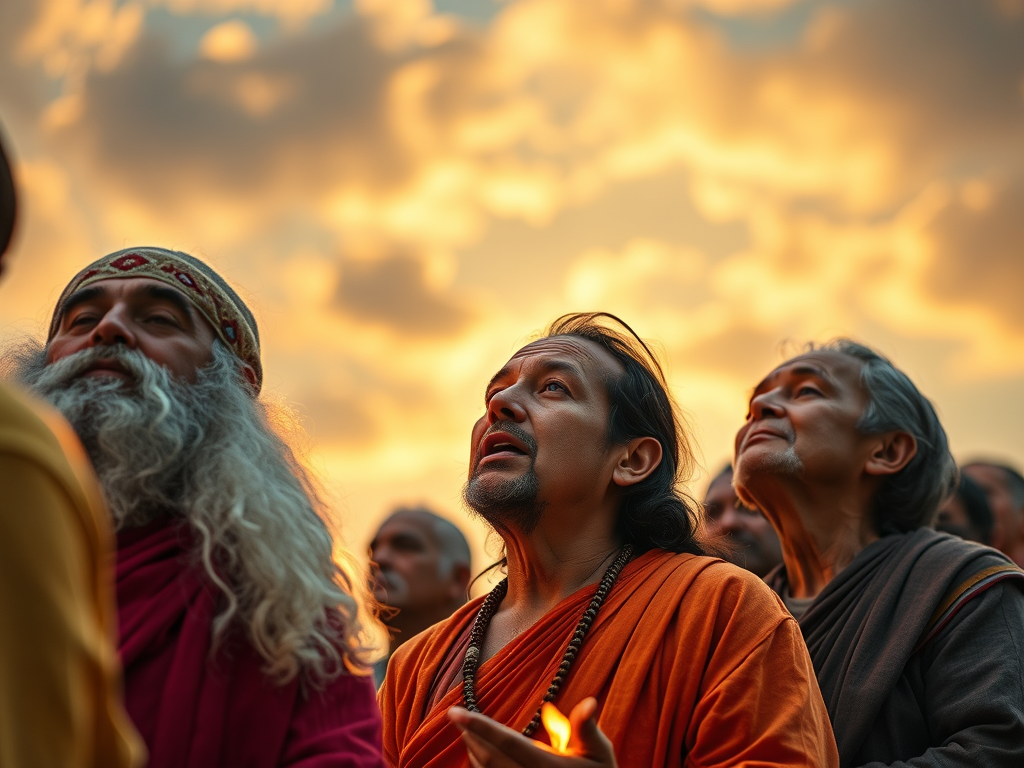
The concept of immortality, amṛta, occupies a central place in Vedic thought. The Sanskrit word amṛta literally means “non-death”: a, a privative prefix, and mṛta, death. It does not primarily refer to the survival of an individual in a distant paradise, but to a deeper principle, a reality that escapes decay, aging, and dissolution.
In the Rig Veda, amṛta often appears in connection with Soma. Soma is called amṛta because it grants the gods their power and endurance. To drink Soma is to participate in divine energy, to enter a dimension that transcends the ordinary cycle of birth and death. Immortality here is not an indefinite extension of biological life. It is a shift in the state of consciousness.
The gods themselves are described as amṛta, not because they are eternal individuals in a modern sense, but because they embody cosmic forces that do not die. Indra, Agni, Varuṇa, or Uṣas are not biological beings; they are active principles of the universe. In this sense, they are “immortal” because they participate in the cosmic order, ṛta, which endures.
Human beings, by contrast, are mortal. Yet the hymns suggest that they can approach amṛta. How? Through sacrifice, right speech, knowledge, and the experience of Soma. Immortality is not granted automatically; it is reached through inner transformation. When the inspired poet, the ṛṣi, enters a state of illumination, he touches a dimension that goes beyond ordinary existence. In that experience, the fear of death fades away.
Later, in the Upaniṣads, the concept deepens. Amṛta becomes linked to the knowledge of ātman, the Self. One who realizes the identity of the inner Self with brahman, the absolute, transcends death. The well-known formula states that one who knows the Self becomes immortal. Again, this does not mean preserving the body forever, but realizing a dimension of being that was never born and therefore cannot die.
It is important to understand that Vedic immortality does not oppose nature. It does not deny the cycle of seasons, growth, and decline. It acknowledges the law of change. But it affirms that at the very heart of change there is a stable reality. Amṛta is that inner stability, that light which does not go out.
In a more symbolic reading, amṛta may also designate a state of consciousness freed from ego. As long as an individual identifies exclusively with the body and personal history, death appears as an absolute end. But when consciousness expands and recognizes itself as part of a greater whole, death loses its dramatic character. It becomes a transition within a larger process.
Thus, immortality in the Vedic tradition is not a naïve promise of endless individual survival. It is an experience of transcendence. It invites human beings to discover within themselves a dimension that is not subject to time. Amṛta is not only a divine drink; it is a transformation of vision, an inner light, an access to that which, within us, does not die.
 Le Rig Veda
Laisser un commentaire