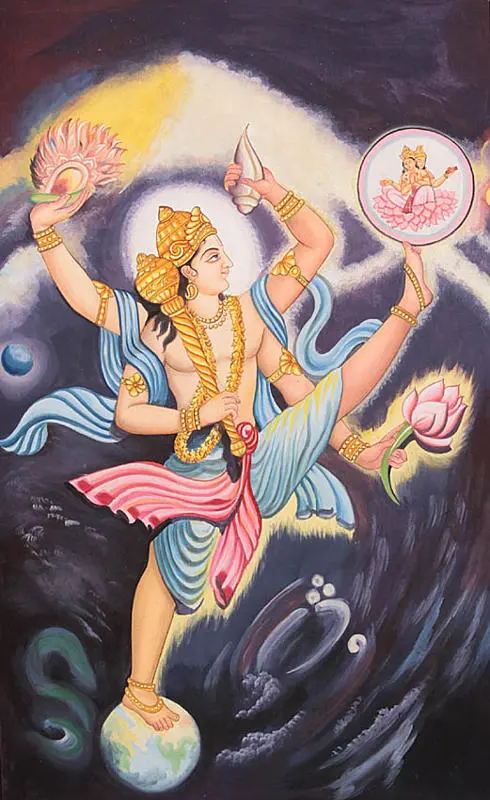
In the Rig Veda, Vishnu is not yet the supreme god of later Hinduism. He is neither the all-powerful preserver nor the source of multiple incarnations as described in the Mahabharata or the Bhagavata Purana.
In the Rig Veda, Vishnu is primarily a cosmic and luminous deity, associated with space and measurement.
1. A Discreet but Essential Presence
Vishnu is mentioned in relatively few hymns (notably RV 1.154).
Compared to Indra or Agni, he is less prominent. Yet his function is fundamental.
He is the one who:
- strides across the universe,
- establishes cosmic boundaries,
- sustains cosmic order (ṛta).
2. The Three Strides
The central motif is that of the three strides (trīṇi padāni).
Vishnu:
- steps upon the earth,
- spans the mid-space,
- reaches the highest heaven.
These strides symbolize:
- the structuring of the cosmos,
- the establishment of the world’s levels,
- the creation of a habitable universe.
His “supreme step” (paramam padam) is described as a radiant realm, a place of light seen by the seers.
This is very different from the later Vishnu of avatars such as Rama or Krishna. Here, Vishnu is primarily cosmic expansion and luminous order.
3. Vishnu and Indra
In several hymns, Vishnu collaborates with Indra.
Indra defeats chaos (especially Vṛtra), while Vishnu expands the cosmic space that makes this victory possible.
If Indra represents dynamic force,
Vishnu represents spatial vastness and stability.
He is not yet the supreme ruler, but an essential cosmic principle.
4. A Solar Deity?
Many scholars interpret Vishnu as an early solar figure.
His three strides may symbolize:
- sunrise,
- zenith,
- sunset.
This aligns with the Vedic tripartite cosmos:
- earth,
- atmosphere,
- heaven.
Vishnu traverses these levels as the sun traverses the sky.
5. The Later Transformation
In classical Hinduism, Vishnu becomes:
- the supreme deity,
- the preserver within the Trimurti,
- the source of multiple incarnations.
This theological development appears centuries after the Rig Veda.
In the Rig Veda:
- no avatar doctrine,
- no developed devotional theology,
- no exclusive supremacy.
Vishnu remains a luminous cosmic power among others.
6. A Symbolic Reading
On a more interior level, the three strides may represent:
- stages of consciousness,
- ascent toward higher awareness,
- the attainment of the “supreme step” as inner illumination.
The Vedic Vishnu is therefore less a personal god than a principle:
the one who opens space, expands reality, and makes light possible.
 Le Rig Veda
Laisser un commentaire