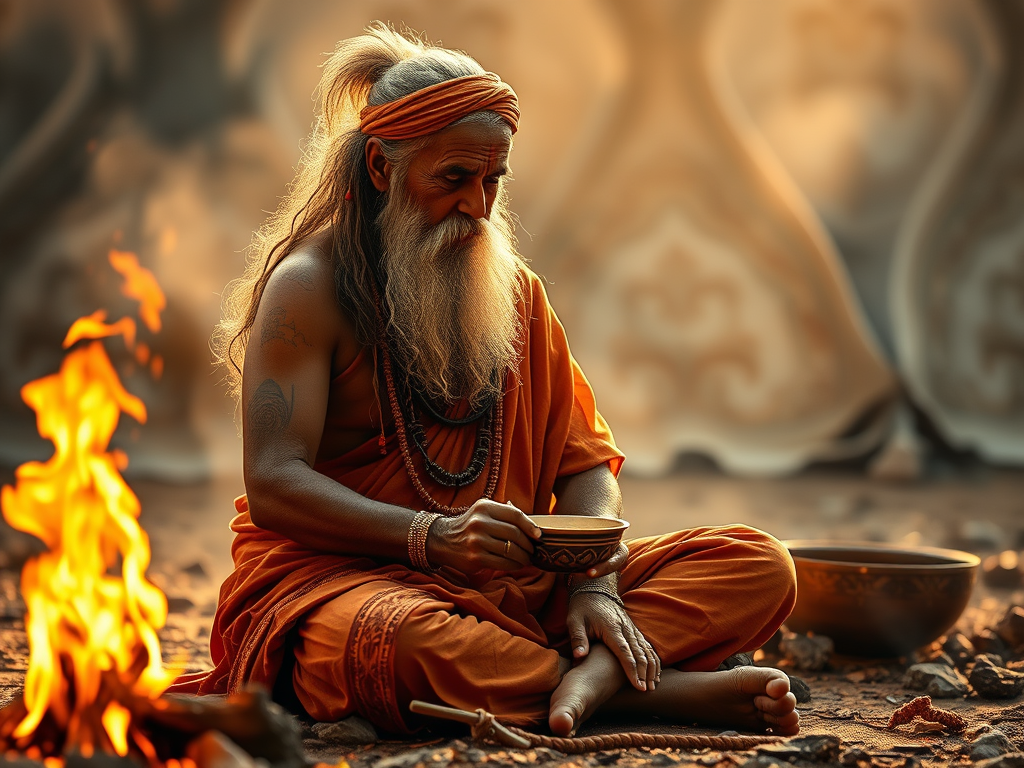
Mandala 9 of the Rig Veda holds a unique place within the Vedic corpus. Unlike the other mandalas, which invoke multiple deities—Indra, Agni, Varuna, Ushas—this one is entirely dedicated to a single reality: Soma.
This is exceptional.
Out of the 1,028 hymns of the Rig Veda, the 114 hymns of Mandala 9 focus exclusively on Soma. He is not just another deity. He is a force, a substance, an experience, a cosmic principle.
Within the civilization of the Seven Rivers (Sapta Sindhu), Soma appears as a central spiritual and social binding element.
1. A Unique Mandala
Mandala 9 is often called the Pavamāna Mandala — the Mandala of the Purified Soma.
The Sanskrit term pavamāna means “self-purifying” or “flowing while being purified.” This purification is not merely material. It is symbolic, inner, cosmic.
In these hymns, Soma is:
- pressed,
- filtered,
- poured,
- purified through wool,
- mixed,
- and offered.
Behind the ritual description lies a metaphor of consciousness.
2. Purification as Inner Process
Soma is described as flowing in luminous streams, passing through the filter, shining like gold, rising toward the gods.
This purification suggests a dual movement:
- A physical purification (the extracted plant juice).
- A psychic purification: the removal of mental impurities.
In several hymns, Soma is called:
- “purifier of thoughts”
- “illuminer of the mind”
- “generator of insight”
This is not merely a ritual drink. It is a process of inner clarification.
Light is a recurring theme: Soma shines, illuminates, dispels darkness. Passing through the filter becomes an image of moving from obscurity to clarity.
3. Soma and Light
In Mandala 9, Soma is linked with celestial light.
He is compared to:
- the sun,
- lightning,
- the dawn.
He “opens the path,” “widens space,” “grants vision.”
The light invoked here is not only solar. It is cognitive.
It concerns inner vision.
Soma enables a different way of seeing. He expands perception and grants access to a broader reality beyond ordinary awareness.
4. Soma as Mediator
Soma circulates between worlds.
He is pressed by humans.
He is drunk by the gods.
He strengthens Indra.
He sustains cosmic order (ṛta).
He is therefore a mediator.
In the civilization of the Seven Rivers—where archaeology reveals no permanent army or imperial palace—social cohesion may have rested on something other than political domination.
Soma may have been central to that cohesion.
A shared experience.
A collective state of consciousness.
A common ritual uniting society.
Thus, Soma becomes the invisible cement of a civilization.
Conclusion
Mandala 9 is a text of rare intensity.
It speaks neither of conquest nor political organization. It speaks of flow, purification, and light.
Soma appears as:
- sacred substance,
- cosmic principle,
- mediator,
- inner light,
- and civilizational unifier.
In this perspective, Soma is not merely a god.
He is the link.
The passage.
The clarification.
The light.
 Le Rig Veda
Laisser un commentaire