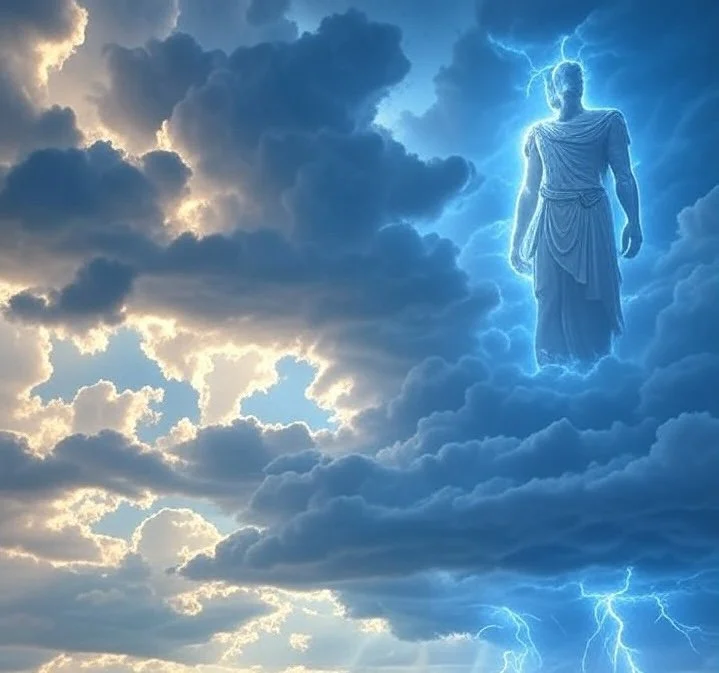
In the Rig Veda, Heaven is a living reality.
It is not simply a backdrop above the Earth, but a fundamental force of existence .
This force has a name: Dyaus .
1. Dyaus, the primordial Sky
The word Dyaus literally means the luminous sky .
It refers to the daytime sky, vast, clear, and full of light.
Dyaus is one of the oldest Indo-European deities.
He appears under other names among the Greeks ( Zeus ), the Romans ( Jupiter ), and in other ancient traditions.
But in the Rig Veda, he retains a very particular character: sober, discreet, almost unassuming .
Dyaus is not a thundering god.
He is the silent presence above all .
2. Dyaus and Prithivī: the fundamental couple
In the hymns, Dyaus almost always appears associated with the Earth, Prithivī .
They form an inseparable pair:
- the sky above
- the Earth below
- and in between, the world of humans
The Rig Veda often refers to them together as Dyaus-Prithivī , Heaven and Earth.
This couple is not symbolic in the abstract sense.
It describes a structure of reality :
everything that lives is born from the space between heaven and earth.
3. An ancient, but secondary god
Interestingly,
although Dyaus is one of the oldest gods, he does not occupy a central place in the Rig Veda.
He is rarely invoked alone.
He is not a god of victory, nor of war, nor of the intoxication of soma.
This shows one essential thing:
the Rig Veda does not glorify the authority of the “heavenly father.”
It is more interested in the active forces that transform consciousness:
Agni, Indra, Soma, Ushas…
Dyaus is the frame , not the engine.
4. Heaven as space, not as commandment
In hymns, Heaven does not command.
It encompasses .
He is :
- vast
- stable
- bright
- immutable
Heaven imposes nothing on humans.
It offers a space in which life, speech, and consciousness can unfold.
This is a very different vision from later religions, where heaven becomes a place of judgment or power.
5. A symbolic reading: Heaven and consciousness
On a more internal level, Dyaus can be understood as:
- the space of consciousness
- the open field above thoughts
- which allows enlightenment to occur
He does nothing.
He allows it.
In this interpretation, Heaven is not the illumination itself, but the space necessary for it to arise .
6. Why Dyaus is gradually disappearing
As the Rig Veda progresses, Dyaus becomes less and less present.
Not because he is rejected, but because attention shifts.
The text focuses increasingly on:
- to internal transformations
- states of consciousness
- to dynamic forces
Dyaus remains in the background, like an obvious fact that no longer needs to be named.
In summary
The hymns dedicated to Dyaus recall a simple and profound idea:
Before the active gods,
before the rituals,
before even enlightenment,
there is a space.
Heaven is not a master.
It is the condition of all things .
 Le Rig Veda
Laisser un commentaire