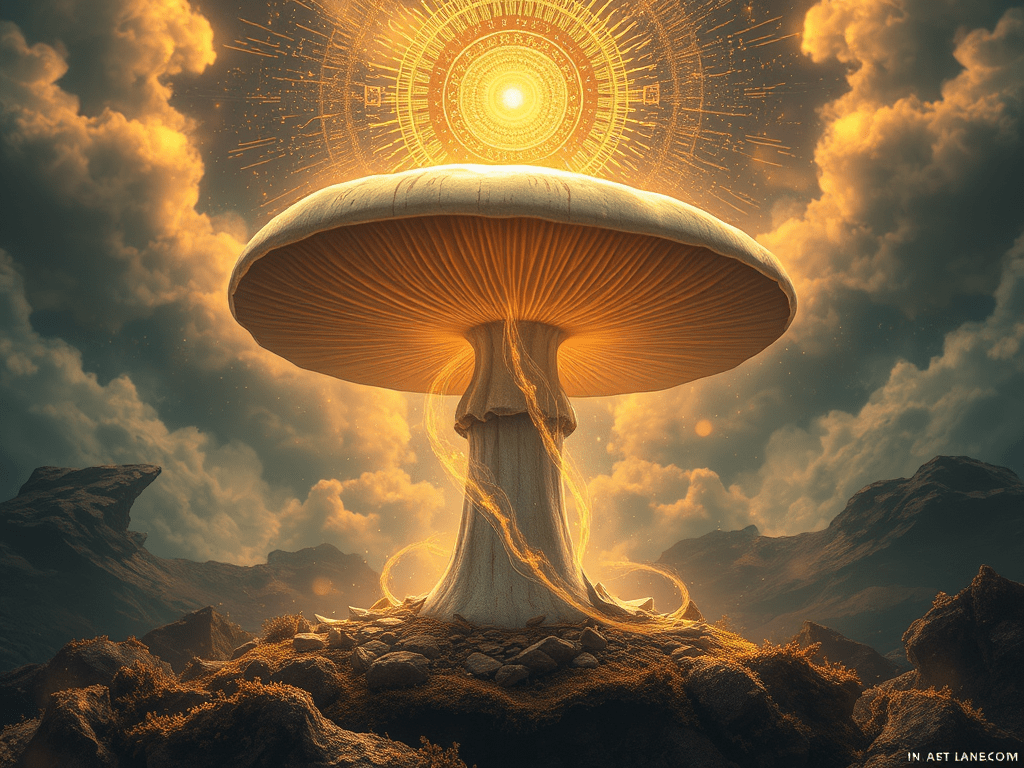
In Vedic texts, Soma occupies a central place. It is at once a plant, a beverage, a god, and a gateway to another reality. It is not merely a ritual element: it is the living link between the human and the divine. Through it, sages accessed a form of inner illumination, transcending the ego, the mind, and the ordinary limits of perception.
The Rig Veda often speaks of Soma as a substance « which illuminates thought, » « which opens inner vision, » and which gives immortality not to the body, but to consciousness. This idea of union between the individual and the divine is not symbolic: it is lived, experienced, traversed, under the effect of Soma.
Some modern researchers, such as Gordon Wasson, have proposed that Soma was actually an entheogenic mushroom , probably Psilocybe cubensis . This hypothesis is based on several clues from the Vedic hymns:
- Soma is described as leafless, flowerless, and seedless —which is consistent with a mushroom.
- It is often referred to as a filament , or fiber , by the Sanskrit word amśu , which brings to mind the mycelium or stem of the mushroom.
- Finally, its effects are anything but violent: Soma awakens love, inner peace, wisdom, and the dissolution of conflicts—the opposite of a warrior plant.
DMT, the Pineal Gland, and Accessing the Divine
From a modern perspective, the effects of Soma described in the texts are reminiscent of those of certain natural entheogenic substances such as DMT (dimethyltryptamine). However, the human body itself produces DMT, notably via the pineal gland , a small organ located in the center of the brain, sometimes called « the seat of the soul » in some traditions.
The pineal gland, associated with Ajna (the « third eye » in yoga), is thought to play an important role in altered states of consciousness, visions, and mystical union. It is possible that consuming Soma activates or enhances this natural production of DMT, opening the way to a direct experience of the divine.
Psilocybeans also contain substances from the tryptamine family, such as psilocybin and psilocin, which are closely related to DMT. This chemical relationship could explain the very specific nature of the visions induced by Soma: a feeling of fusion with the universe, access to subtle planes, ego erasure, and a sense of divine presence.
Soma, a path to peaceful enlightenment
Unlike other drugs or violent rituals present in the history of civilizations, Soma is peaceful. It unites instead of dividing. It frees instead of subjugating. It is not an escape: it is a return to oneself, to pure consciousness, to inner truth.
In the Rig Veda, the wise do not take Soma to stun themselves, but to see clearly . They do not seek any kind of intoxication, but a contact with the absolute. Soma opens a space of silence, light, and peace.
Thus, whether we see it as a sacred mushroom, a symbol of inner awakening, or both at the same time, the Soma remains the bridge between the human and the divine , between earth and sky, between the ephemeral and the eternal.
 Le Rig Veda
Laisser un commentaire