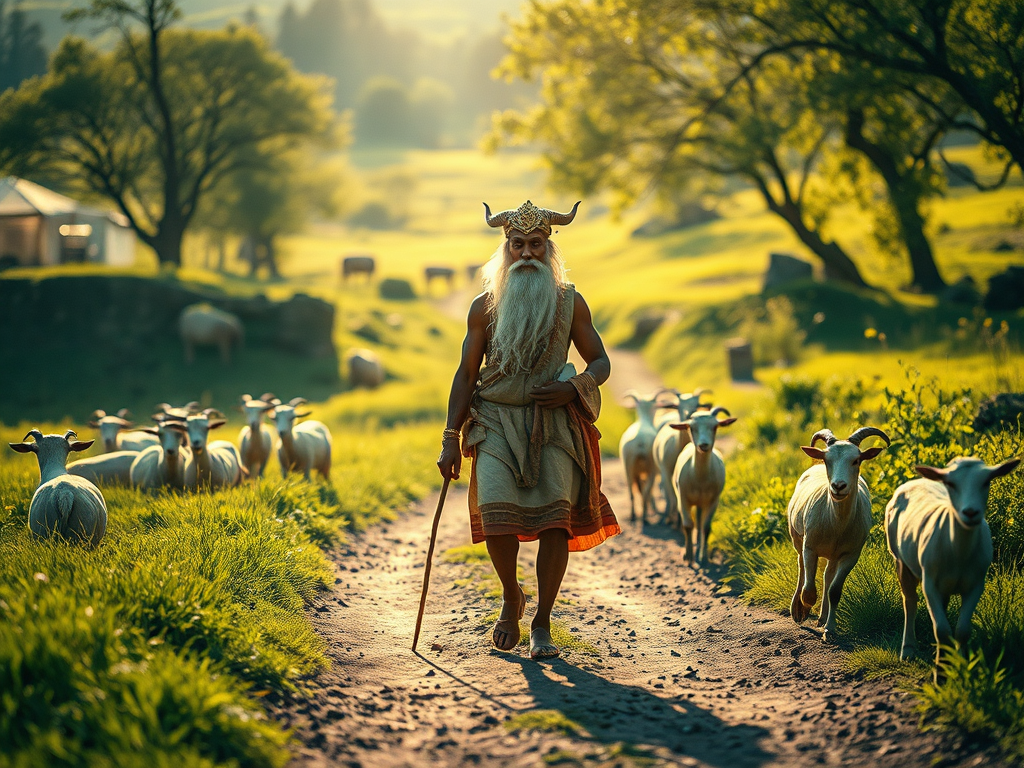
In the civilization of the 7 rivers, which the texts call Sapta Sindhu , the ancient sages sang the forces of nature in the form of gods. Some like Agni or Indra are very well known, but others, more discreet, are just as important. This is the case of Pūṣan , a benevolent deity, linked to paths, travel, light, but also to herds.
A god who guides and protects
In the Rig Veda , Pūṣan is often presented as the guide of travelers and caravans . He knows all the paths, even the most secret. He walks in front of those who travel to open the way for them, remove obstacles and avoid dangers.
Pūṣan does not drive a chariot pulled by horses like Indra, but by goats . This detail may seem strange, but it underlines a strong connection with the land, simplicity, and the life of the herders in the Sarasvati and Ghaggar valleys.
Guardian of the flocks
Pūṣan also watches over herds, cows, and pastures . He protects animals from thieves, wild beasts, and disease. In a society like the Seven Rivers Civilization , where livestock farming was important, a god who protected animals was essential.
He is also invoked to find what is lost . Whether it is an animal, an object or a person, Pūṣan helps to find what has gone astray.
A solar and luminous figure
Pūṣan is connected with sunlight , especially that which illuminates paths. He is the one who lights the way , not only in the external world, but also in a deeper sense. Some hymns describe him as the one who leads souls after death , towards the worlds of light.
He is sometimes associated with Savitr , the sun that rises and sets things in motion. He is found in several hymns where he walks with other gods to guide man in his righteous actions.
A modest but essential god
In the Rig Veda, Pūṣan is not a noisy or warlike god. He does not fight, he does not throw lightning bolts. But he is always there , on the roads, in the countryside, near animals and humans. He acts with gentleness, clarity, and constancy.
He is the god of passages , both literally and figuratively: dirt roads, paths of life, passage to the afterlife.
Conclusion
Pūṣan is a discreet god, but close to men. He walks with them, guides them, protects them, watches over their herds and helps them find their way. In the civilization of the 7 rivers , he embodies security, clarity, continuity.
At a time when nature was alive in every gesture of daily life, Pūṣan represented this connection between humans, the earth, animals, and light. He deserves to be rediscovered today for what he teaches us: to move forward in peace, without violence, keeping our eyes open to the path.
 Le Rig Veda
Laisser un commentaire