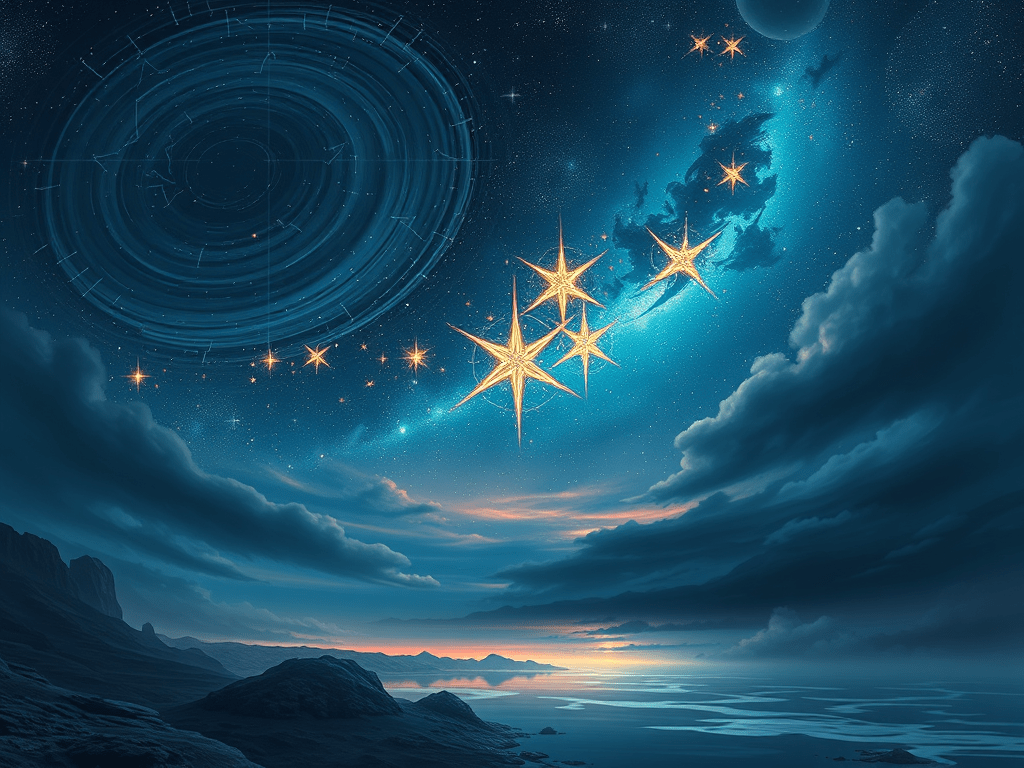
In the Seven Rivers Civilization, also known as Sapta Sindhu , stars were not just points of light in the sky. They were guides, living beings, sometimes even gods. The Rig Veda , the oldest text of this civilization, often speaks of the night sky, constellations, celestial winds, and invisible lights. Each star, each celestial movement had a force, a history, an energy.
The Ashvins: Twin Morning and Evening Stars
The Ashvins are two divine brothers, always together, bound by light. They are the first stars to appear just before dawn. They announce the coming of dawn (Ushas). Hymns say they travel on a swift chariot, shining like lightning. They are often called upon to save, heal, or guide. The Ashvins are the stars that awaken us to the light. Modern astronomers call them Castoir and Pollux.
The Maruts: the young winds and the stars in motion
The Maruts are described as fiery young gods, sons of Rudra. They are associated with storms, lightning, thunder, and also with shifting constellations. They cross the sky like a band of joyful and brilliant warriors. They can be seen as the moving, dancing stars that herald the monsoon. Their connection to Indra, the god of strength, associates them with celestial battles, storms, and seasonal changes.
The Panis and the myth of the stolen cows: an eclipse described in the hymns
A Vedic myth tells that the Panis—meaningful, stingy beings attached to darkness—stole the cows of heaven. These cows represent light, knowledge, and truth. The god Indra, with the help of the sage Angiras and his dog Sarama, tracks them down and brings back the light.
This story is not just a symbolic tale. Astronomers have shown that it could refer to a solar eclipse. Thanks to precise calculations, we know that a total eclipse took place on February 19, 3929 BCE , along the Indus River and visible throughout the Sapta Sindhu region. During this eclipse, the cows (the light) disappear, hidden by the Panis (the shadow). Then, they return when the eclipse ends, as in the myth.
Source for verifying the eclipse: Past Eclipses – IMCCE
The sky, an open book for consciousness
For the people of the Seven Rivers civilization, the sky was never empty. It was filled with signs, forces, and presences. The stars were not separate from the human world. They formed a vast network of energies and relationships. Observing the sky allowed one to understand the rhythms of life, breath, and thought. Vedic cosmology is therefore a living, lived cosmology.
The rituals, the chants, the offerings were not random. They responded to the movements of the stars. Man sought harmony with the universe, and the starry sky became a map of consciousness.
A memory in the stars
What is remarkable is that this knowledge has survived the millennia. It has been preserved in hymns, in the form of songs. It is thanks to this oral tradition that we know today what these ancient peoples thought. The stars, for them, were not far away. They lived with them, in songs, in prayers, in the breath of the night wind.
 Le Rig Veda
Laisser un commentaire