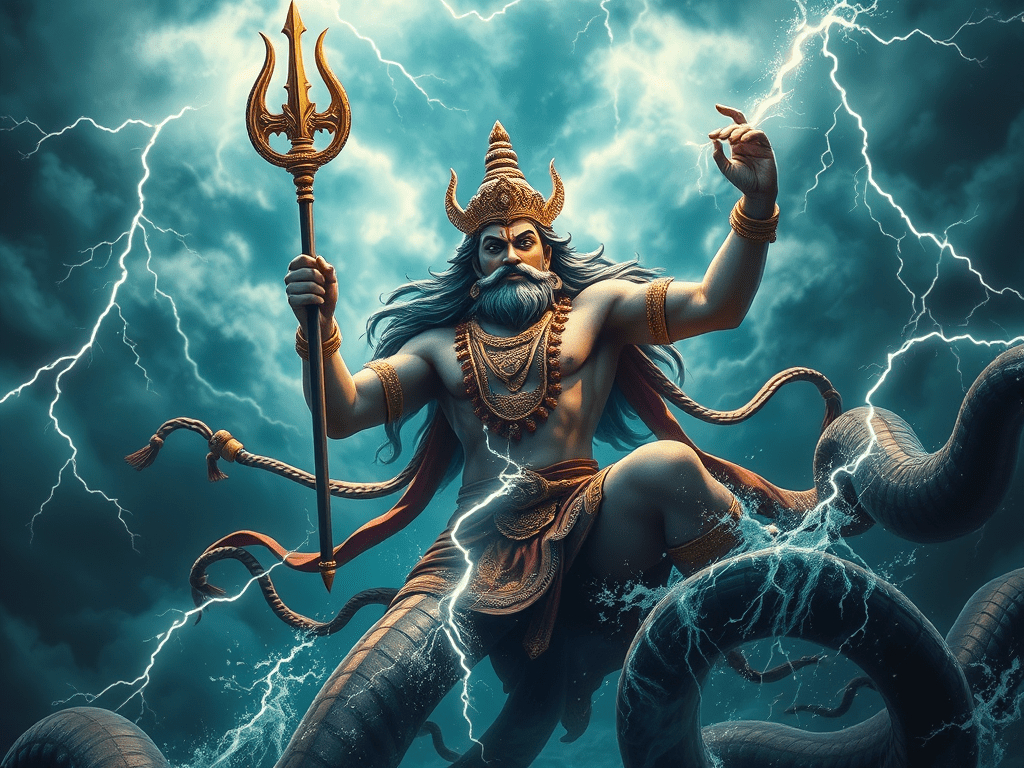
In the Seven Rivers civilization, storms and lightning were not simply natural phenomena. They carried profound meaning. They were part of a sacred world where every force of nature played a role in the path to enlightenment. The master of storms and lightning was Indra.
Indra: the god of strength and awakening
Indra is one of the most important gods in the Rig Veda, the sacred book of the civilization of the seven rivers. He is the one who makes the rain fall, casts lightning, and makes the thunder rumble. But behind this outward power, Indra also represents an inner strength. He symbolizes willpower, courage, and the energy of transformation.
In Vedic ceremonies, Indra’s lightning is not used to punish, but to enlighten. It pierces the darkness of ignorance. It shatters whatever blocks access to inner light. His weapon, the vajra (lightning or thunderbolt), is not only a tool of war, it is a tool of liberation. It destroys the ego, fears, doubts—everything that prevents access to deep peace.
Victory over Vritra: A Myth of Liberation
The most famous myth associated with Indra is that of his battle with Vritra. Vritra is a serpent or dragon who holds back the waters, preventing them from flowing. This myth isn’t just a story about rain. It’s an image of spiritual awakening. Water represents life, clarity, and flowing energy. Vritra is anything that blocks this energy: pride, illusion, attachment.
Indra, armed with lightning, destroys Vritra. The rivers begin to flow again. The world comes back to life. This battle is actually internal: each person must confront their own Vritra. Each person must allow Indra to act within them so that the blockages disappear.
The storm as a spiritual awakening
In Vedic thought, a storm is not seen as a misfortune. It is a moment of rupture, a necessary upheaval. It shakes the earth as it shakes the soul. It reminds us that nothing is fixed, that everything can change. Lightning strikes suddenly, like spiritual awakening. It illuminates in a flash what was in shadow.
The sages of the seven rivers saw every storm as a call to awaken. They knew that inner light sometimes requires external testing. The chaos of the sky often reflects the chaos of the mind. And it is precisely in this tumult that Indra acts.
A force to destroy illusion
Indra is a force of destruction, but not a vain destruction. He destroys to liberate. He is not afraid of disorder, for he knows that after the storm comes clarity. His role is to tear down the walls we build around ourselves. He breaks down the barriers of the mind. He tears through the clouds to let the light through.
In Vedic rituals, Indra was called upon to guide the faithful. Soma, an entheogenic plant that opened consciousness, was drunk and hymns were chanted to invoke his power. The goal was not to worship an external force, but to awaken that force within oneself.
Conclusion: Indra, the lightning of consciousness
In the civilization of the seven rivers, each god represented a facet of the human being. Indra, through lightning and storms, is the force that breaks to liberate. He acts externally as well as internally. He brings rain to the earth and light to consciousness.
Vedic thunderstorm myths remind us that awakening is not always gentle. It can be brutal, sudden, and as bright as a flash of lightning. But it always brings life. Thanks to Indra, the sky opens, water flows, and the spirit rises.
 Le Rig Veda
Laisser un commentaire