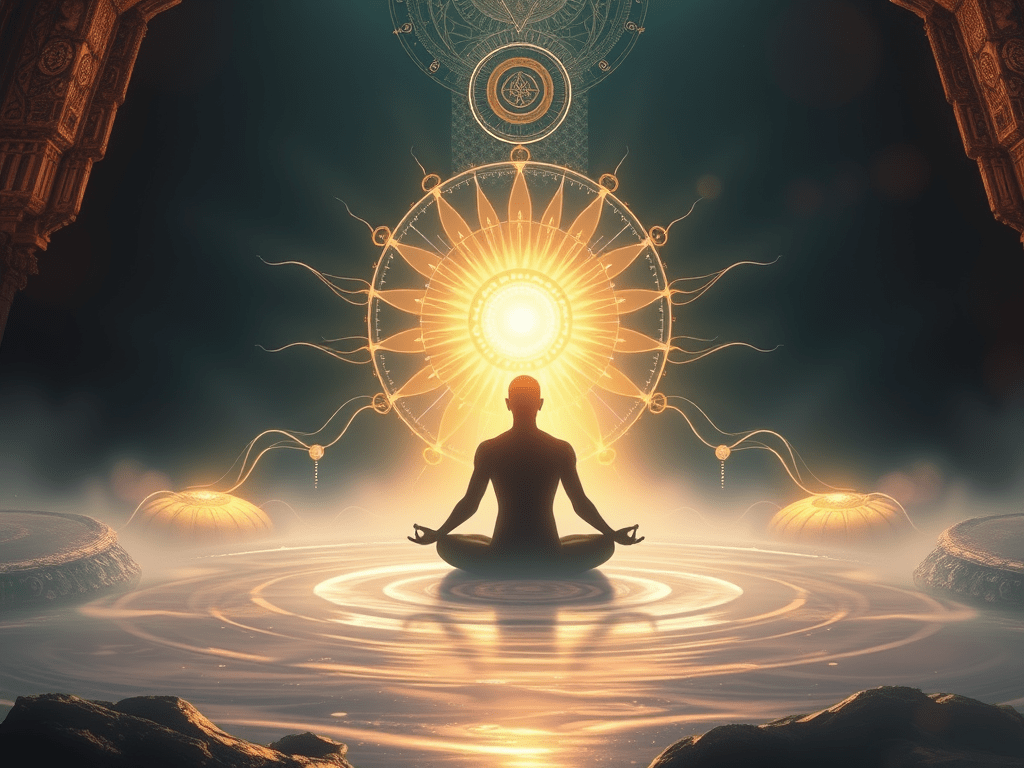
In the Seven Rivers civilization, long before the great organized religions, the ancients had a direct relationship with the forces of nature and with consciousness. The Rig Veda, the oldest known sacred text, evokes a mysterious and sacred plant: Soma. This plant, which has no leaves, flowers, or fruit, was crushed, pressed, filtered, and then ingested during specific rituals. Its effect was not simply physical: it opened the doors of the mind and allowed those who consumed it to transcend their ego.
Soma: a plant to see beyond
In many hymns of the Rig Veda, Soma is presented as a living, luminous, divine being. It is « the eye of the gods, » « the son of truth, » « the inner light. » Soma is described as giving strength, knowledge, and profound clarity. It allows the one who takes it to see the invisible, hear the inaudible, and understand what is beyond the ordinary mind. It is a form of purification, a kind of symbolic death of the limited self, to achieve a state of expanded consciousness.
Here is an excerpt from the Rig Veda (8.48.3):
« We drank the Soma, we became immortal; we entered the light, we found the gods. »
This famous verse sums up the desired effect well: to cross the limits of body and mind to reach pure knowledge.
Soma and the Dissolution of the Ego
In Indian spiritual traditions, the main obstacle to awakening is the ego: the sense of separation between self and the world. Soma allowed this ego to be dissolved, not through thought or words, but through direct experience. This temporary but powerful disappearance of personal identity gave access to a profound peace, a sense of oneness with all that exists.
Psychiatrist Stanislav Grof , one of the pioneers of research into altered states of consciousness, explains in his work on psychedelics:
« LSD and other substances can induce an experience of ego death and rebirth. This experience has immense healing power; it can profoundly transform a person’s outlook on life. »
(Stanislas Grof, The Adventure of Self-Discovery , 1988)
Although it does not speak directly of Soma, the effect is very similar to what the Rig Veda describes: a descent into oneself, followed by awakening.
Soma, the ancestor of modern psychedelics?
Today, many researchers are once again taking an interest in natural substances that have been used for thousands of years to heal and expand consciousness. Dr. Rick Strassman , famous for his research on DMT (dimethyltryptamine), has shown that this molecule occurs naturally in the human brain, and that its effect is comparable to stories of spiritual enlightenment:
« DMT can give us direct access to incredibly rich and organized inner worlds, sometimes inhabited by conscious entities. These experiences have a lasting impact on the meaning of life, death, and our place in the universe. »
(Rick Strassman, DMT: The Spirit Molecule , 2001)
The description of Soma in the Rig Veda corresponds to an entheogenic plant, possibly a psilocybin-containing mushroom, such as Psilocybe cubensis . The Sanskrit word amshu , often used for Soma, means « filament » or « fiber, » which recalls the shape of the mycelium. Soma is also described as being without seeds, flowers, or fruits, which reinforces this hypothesis.
Medicine for the soul
Beyond the debates over the identification of Soma, what matters is its effect. It was a tool to purify the mind, heal sadness, calm the mind, and free consciousness. What modern science is rediscovering today was already understood by the ancients more than 4,000 years ago: certain plants can help us rediscover our true nature, beyond the mind, beyond suffering, beyond conditioning.
Depression, stress, loss of meaning, lack of confidence: all these modern sufferings find resonance in the words of the Rig Veda. Soma offered a way out, an inner rebirth. It was not an escape, but a return to the essential.
Conclusion
In the Seven Rivers civilization, soma was not a drug in the modern sense (no addiction is possible). It was a sacred tool, a key to unlocking the doors of consciousness. Its consumption was surrounded by rituals, chants, and prayers. It was not a matter of personal pleasure, but a quest for truth.
At a time when science is rediscovering the power of sacred plants, the Rig Veda reminds us that true healing begins with the destruction of the ego. Soma was not there to escape the world, but to better understand it.
 Le Rig Veda
Laisser un commentaire