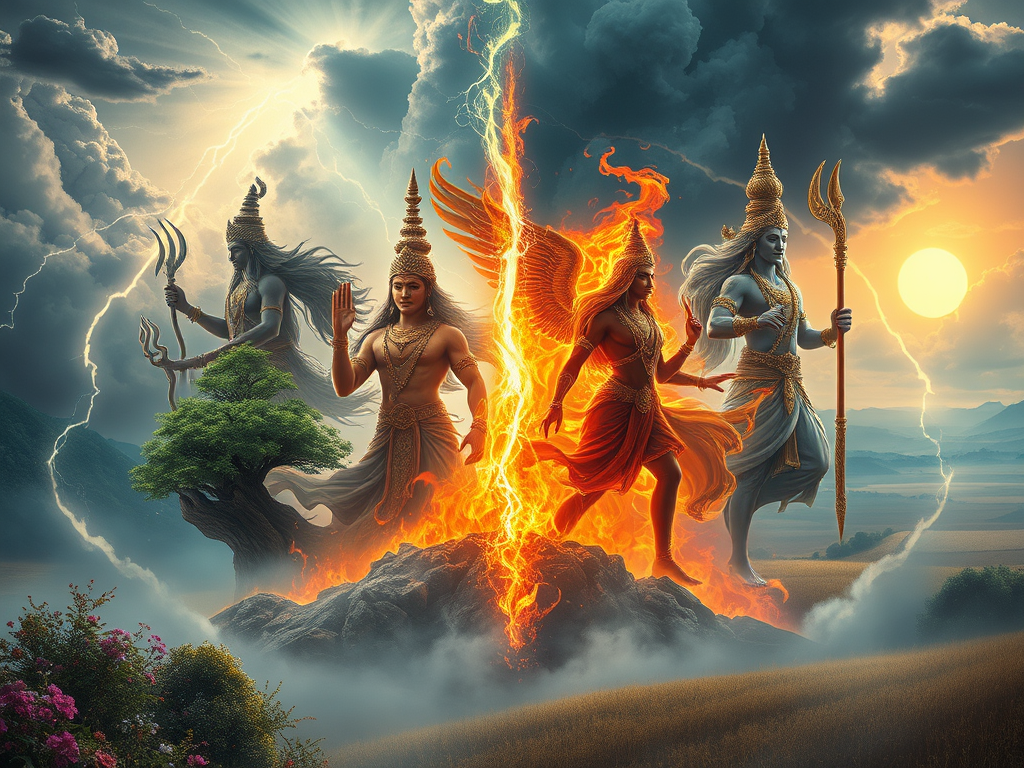
The Seven Rivers civilization lived in harmony with its environment. The seasons dictated daily life and rituals, marked by a close relationship with natural forces. Storms, rain, wind, fire, and daylight were perceived as divine manifestations. These phenomena were celebrated through prayers and offerings to attract their favor or avoid their anger.
Storm and Rain: Benefits and Fears
The deified storm (Indra) was seen as a powerful force, capable of purifying the air and fertilizing the land with rain. Drought was a serious threat, and rituals invoked lightning and thunder to bring the necessary water to crops. The roar of the sky was interpreted as a sign of power, and priests offered soma to establish a connection with this force.
The wind: breath of life and celestial messenger
The deified wind (Vayu) was associated with the breath of the universe. Sometimes gentle and refreshing, sometimes violent and destructive, it was a messenger between worlds. The hymns of the Rig Veda honored it as a bringer of vitality and energy. Rituals associated with caravan movements and trade voyages called upon its protective breath.
Fire: light, purification and transformation
Deified fire (Agni) was central to ceremonies. It consumed offerings and carried prayers to the invisible spheres. Present in every home, it provided warmth and protection. During solstices and major seasonal festivals, fires were lit to mark the passage of time and strengthen the bond between humans and the universe.
Dawn and daylight: renewal and awakening
The deified dawn (Ushas) symbolized daily renewal. Its appearance marked the beginning of activities and was welcomed with songs. Peasants prayed for abundant light and prosperous crops. During monsoon periods, when sunlight was scarce, offerings were made to restore the balance between light and shade.
The seasons and the organization of rites
Climate change dictated the timing of rituals. Spring was a time of celebration, when the abundance of flowers and fruit heralded prosperity. Summer required prayers to prevent excessive heat. Autumn marked the harvest and gave rise to ceremonies of gratitude. Finally, winter was a more sober time, honoring the protective forces that helped people weather the cold.
A spirituality rooted in nature
The inhabitants of the Seven Rivers Civilization perceived nature as an expression of the sacred. Each climatic force had its role, and people sought to live in harmony with it. Rituals were not simply religious acts, but ways of maintaining balance with the world around them.
Thus, the Vedic gods were not abstract figures, but the living embodiment of the elements that governed everyday life. Even today, this vision of an interconnected universe resonates as a call to respect and understand the natural forces that surround us.
 Le Rig Veda
Laisser un commentaire