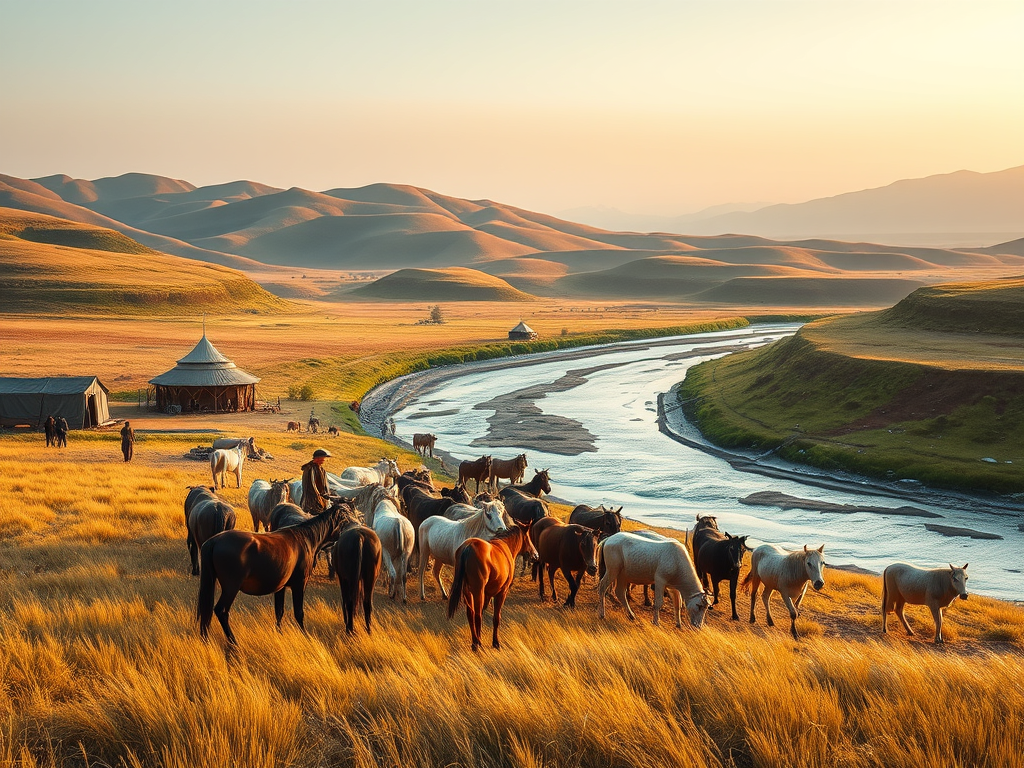
The Rig Veda, the oldest sacred text in India, gives clues to the life of the people of the Seven Rivers civilization before the emergence of large cities. In mandalas 2 to 7, called « family books » because they were transmitted by lineages of priests, there are numerous references to a nomadic lifestyle, based on livestock breeding and mobility. The first mandala, although later, also contains traces of this period, but in a less clear way.
A pastoral and itinerant way of life
The hymns of the Rig Veda describe a people who raised herds of cows and horses. Livestock farming was central to the economy and society. The cow was considered a form of wealth, and prayers to the gods often asked for protection and the multiplication of herds.
Warriors and tribal chiefs were also pastoralists. Hymns speak of constant movement, temporary encampments, and conflicts over control of pastures and watering holes. Trade routes were not yet established, and exchanges were more direct between clans and tribes.
Shushna, Vritra and Shambara: Myths Rooted in an Ancient Past
Several figures in the Rig Veda seem to be metaphors related to the living conditions of that time.
- Shushna is often described as a force that dries up the land, which could refer to periods of drought that caused herders to move in search of new pastures.
- Vritra is depicted as a serpent or dragon holding back the waters. This myth may reflect conflicts over water sources and the need to irrigate the lands to survive. Indra, the warrior god, fights him and releases the waters, perhaps symbolizing access to new fertile lands.
- Shambara is an enemy mentioned several times. He lived in stone fortresses, which suggests conflicts between nomadic populations and more sedentary groups already living in fortified habitats.
The evolution towards urban planning
While the Rig Veda emphasizes mobility and pastoralism, it also shows a gradual transition to more sedentary forms of life. The last parts of the text speak of villages, cultivated fields, and sovereigns protecting a territory. This process was accentuated with the construction of the first cities of the civilization of the 7 rivers, which mark a new stage in the history of these peoples.
The Vedic hymns thus preserve the memory of an ancient way of life, made up of travel, livestock breeding and struggles for resources. Before the rise of cities, the civilization of the 7 rivers was that of pastoral peoples, whose life was punctuated by the cycles of nature and the migrations of herds.
 Le Rig Veda
Laisser un commentaire