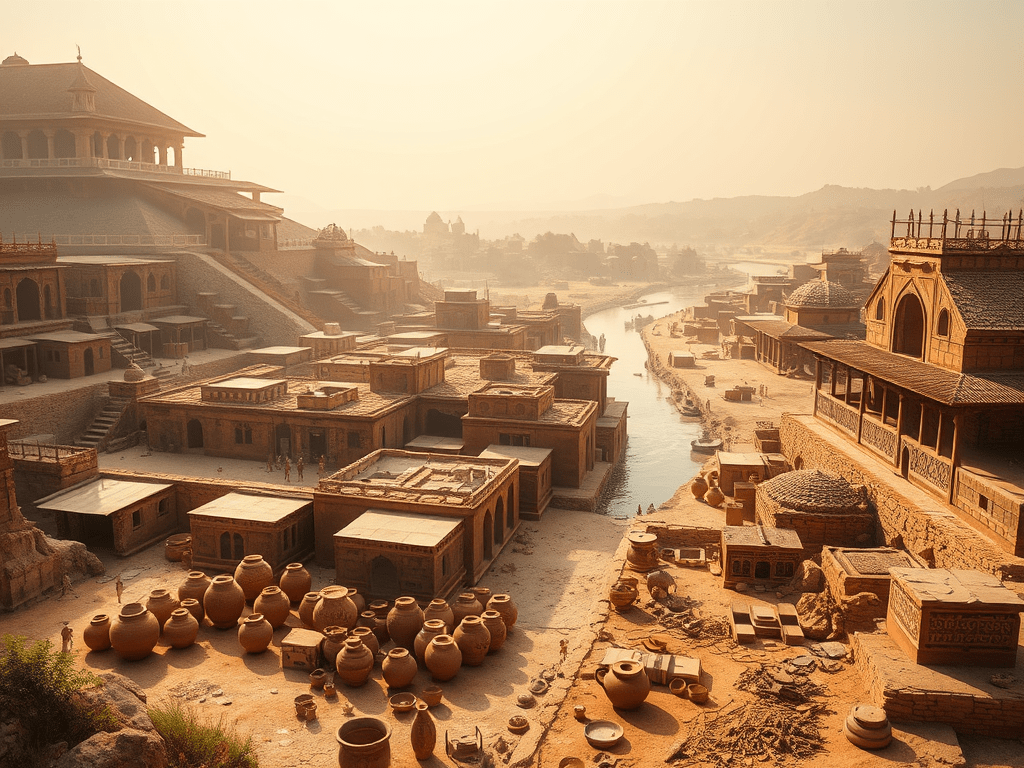
Rakhigarhi, located in the present-day state of Haryana in India, is one of the largest archaeological sites of the Seven Rivers Civilization. This impressive site, which dates back nearly 5,000 years, raises many questions about its role: was it an advanced urban city or a thriving rural center? Analysis of its social organization reveals fascinating elements about the daily lives of its inhabitants.
A well-planned city or a large village?
Rakhigarhi covers over 300 hectares, making it one of the largest sites of this civilization. Excavations have revealed well-laid out streets, organized dwellings, and sophisticated drainage systems. This type of planning is often associated with urban centers, indicating that Rakhigarhi played a key role in the administration and trade of the region.
However, finds of agricultural tools and grain storage also show that agriculture occupied a central place in the local economy. This raises the hypothesis that Rakhigarhi may have been a hybrid, combining urban and rural functions.
Social organization and daily life
The objects found, such as jewelry, pottery, and tools, indicate a diverse society. Houses were of different sizes, suggesting social disparities, but not extreme ones. Instead, there is a harmonious organization where each individual contributed to the community, whether through crafts, trade, or agriculture.
The burials discovered at Rakhigarhi also provide important clues about beliefs and social hierarchy. Some graves contained valuable objects, while others were more modest. This shows that although differences existed, they did not dominate the social structure.
A key role in the civilization of the 7 rivers
Rakhigarhi was not just a village. Its size, infrastructure and diversity show that it was an active and well-connected centre. Its strategic location on the Sarasvati, a sacred river and axis of life, made it a focal point for exchanges and ideas.
In conclusion, Rakhigarhi illustrates the versatility of the 7 rivers civilization, capable of combining agricultural, artisanal and administrative functions. This site, both urban and rural, remains a living testimony to the ingenuity and balance of this ancient civilization.
 Le Rig Veda
Laisser un commentaire