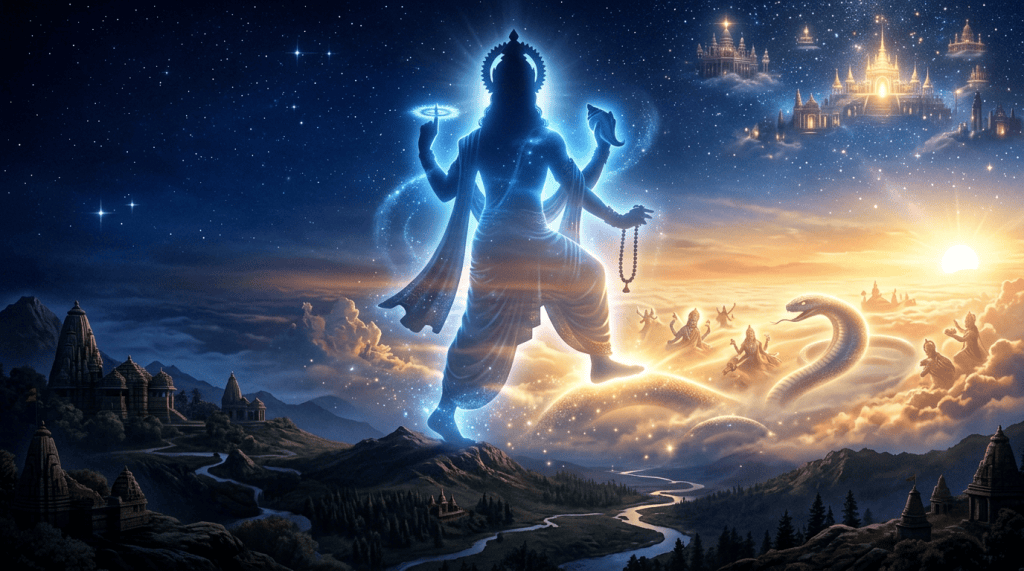
There is a god in the Vedic pantheon who will become, a few centuries later, one of the most venerated figures in all of India. In the Rig Veda, Viṣṇu is still in the background. Only three hymns are expressly dedicated to him. He appears on the margins of a hundred others. And what he does, in those appearances, comes down to almost always the same thing: he walks.
The meaning of the name
My working definition: Viṣṇu, the one who is active. He is the guarantor of the world’s functioning, the lord of activity, the one who helps man in his spiritual ascent. This is not yet the Viṣṇu of the Bhagavad-Gītā, nor the one who descends to Earth in the form of Rāma or Kṛṣṇa. He is a solar deity, discreet, powerful in his own way — and his three strides are his founding act.
Hymn 1.154: the three great strides
Hymn 1.154 (To Viṣṇu, ṛṣi: dīrghatamas aucathya) is the central text. It opens: “I will declare the mighty deeds of Vishnu, he who measured the earthly regions, who upheld the highest regions, making three great strides, striding mightily.”
And then: “I honour Vishnu with his Energies, terrible as a tiger roaming the uninhabited mountains. He is the one whose three wide strides embrace all living beings.”
And again: “May my thoughts rise like a Force for Vishnu, the mighty strider who dwells in the mountains, he who, alone, with his three strides, has measured this world, wide and vast.”
Three strides. Heaven, Earth, and the intermediate world — or: the Earth, the firmament, and the realm of the gods. Commentators disagree on exactly what these three steps are. But they agree on their meaning: Viṣṇu contains the universe in his walk.
The trimūrti in embryo
Viṣṇu already appears, in the Rig Veda, as one of the three great cosmic functions that will later form the trimūrti: Brahmā the creator, Viṣṇu who maintains and operates, Śiva who destroys. In the Rig Veda, Śiva does not yet exist under that name — he is Rudra. And Brahmā is barely sketched. But Viṣṇu is there, already, with his own function: keeping the world in order.
In hymn 1.736 we read: “You are Indra for the devout mortal. […] When the foot of Vishnu was placed at its highest, you protected the secret name of the cow.” Viṣṇu and Indra often act together — Indra slays the serpent Vṛtra, Viṣṇu assists, guarantees the space. One strikes, the other measures.
Almost nothing — and yet everything
What strikes me about the Vedic figure of Viṣṇu is precisely this discretion. He has none of Indra’s brilliance, none of Rudra’s terror, none of Agni’s warmth. He walks. He measures. He maintains. In the symbolic reading I use for the Rig Veda, this is the image of ṛta — the Truth-Reality that underlies everything, the silent cosmic order on which existence rests. Viṣṇu is its quiet guardian.
The Seven Rivers civilisation, which I explore on saptasindhuveda.com, has often struck me with that same discretion: no palaces, no royal statues, no temples. A society that functions, durably, without putting itself on display. I sometimes wonder whether Viṣṇu was not, in his own way, its tutelary deity. To explore further the silent order that structured the cities of the Sapta Sindhu, I invite you to read [my article on urban hygiene at Mohenjo-daro on saptasindhuveda.com].
Group mini-text EN: In the Rig Veda, Viṣṇu is not yet the great god of classical India. He takes three strides, measures the world, maintains the cosmic order — and that is almost all. But those three steps contain the universe. New article on rigveda.blog.


Votre commentaire