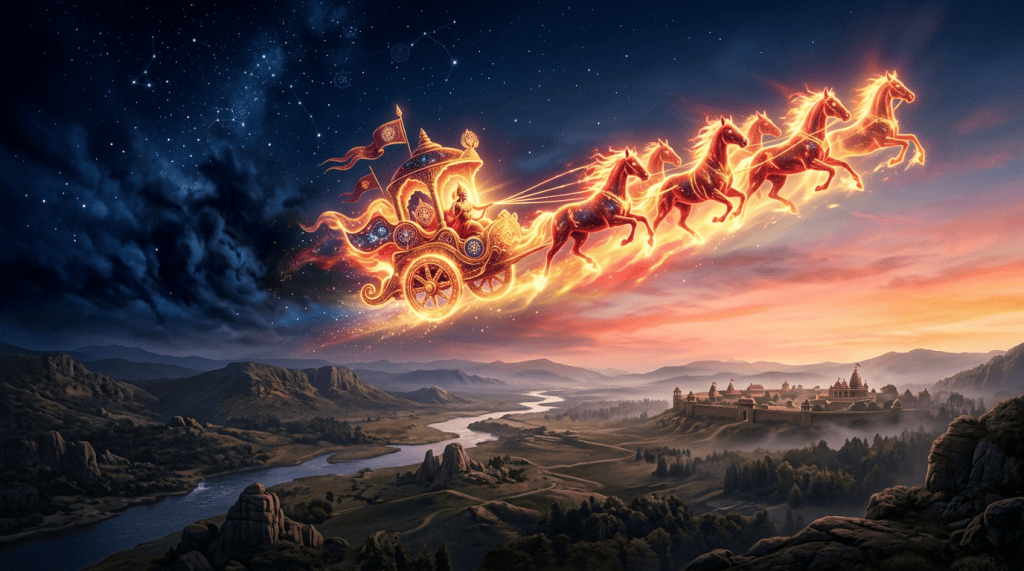
There is a moment, in reading the Rig Veda, when the text changes nature. You leave behind the great invocations to Indra, the battle hymns against Vṛtra, the praise of the sacrificial fire — and you fall upon Uṣas. The Dawn. And there, something happens that you did not expect to find in a text four thousand years old: pure beauty.
The hymns to Uṣas are, to my mind, the most beautiful in the Rig Veda. Perhaps the most beautiful in all Vedic literature. Not the most philosophical, not the most metaphysically dense — the most beautiful. And that beauty is not an accident of translation: it is in the very structure of the text, in the repetition of its images, in the way the goddess is summoned through the stanzas.
Uṣas: what the name says
In Sanskrit, ushas means “she who illuminates.” Not only the astronomical dawn — the light rising at the horizon each morning. It is also, and above all, the Light of knowledge, illumination, truth. Uṣas is at once the goddess of a natural phenomenon and the personification of inner awakening. In the symbolic reading Sri Aurobindo gives us, these two readings do not exclude each other — they overlap, and it is precisely that overlap that makes the text so rich.
She is the Daughter of Heaven (Divo duhitā). She is the sister of Night — and their relationship is described with a precision that still moves me: “The way of the sisters is identical and eternal, taught by the gods, they travel alternately. Well established, of different appearances, but unanimous, Night and Dawn do not meet and do not rest.”
This is not decorative poetry. It is a description of cosmic alternation, of the law that governs the movement of the world — and in that law, Uṣas is the agent of renewal.
The goddess who arrives each morning
What strikes me in the hymns to Uṣas is their physical presence. She is not an abstraction. She arrives. She drives her chariots. She awakens.
Here is one of the stanzas I return to most often: “O luminous Dawn, the birds take flight, the two-footed and the four-footed rise when your hour comes back in the Sky. You are splendid. Your rays of Light illuminate the Universe.”
And this one: “The Dawn shines when the Fire is lit and the rising Sun spreads Light afar.” That link between Uṣas and Agni is not incidental — the dawn and the sacrificial fire are both agents of the same light. One opens the sky, the other opens the inner space.
The reddish Cows that draw Uṣas’s chariot — I find them again in stanza after stanza. In Vedic symbolic vocabulary, the Cow is Light. The reddish Cows of the Dawn are the first rays that flush the eastern horizon crimson. The goddess unfurls the light as one releases a herd — a generous gesture, an everyday gesture, a gesture that begins again without ever being exhausted.
The most feminine of the great Vedic deities
Uṣas is almost unique in the Rig Veda’s pantheon by reason of her gender. The great cosmic forces — Indra, Agni, Varuna, Mitra — are masculine. Uṣas is a goddess in the fullest sense. She is described as a “reddish mare,” as a woman who awakens, who radiates, who advances.
This matters in the context of Vedic civilisation. Several women were rishis — authors of hymns. Women drank soma. The space given to a great feminine deity within the very structure of the collection says something about a society in which the feminine was not relegated to a secondary position.
Uṣas is also the friend of the Ashvins, the twin gods of sunrise — her brothers in certain traditions. She precedes the Sun; she wakens what was sleeping. She is, symbolically, what makes consciousness possible: the inner Dawn that precedes the full light of awakening.
A goddess who returns
What perhaps moves me most deeply in the hymns to Uṣas is their awareness of cyclical renewal. She returns. She has always been there. She will return again.
“The last of the endless mornings has gone, the first of those to come arrives. The Dawn shines.”
This one sentence says everything. The Dawn is never exactly the same — each morning is a new morning — and yet she is always the Dawn. The Rig Veda has no concept of linear progress. It has a concept of cyclical renewal. Uṣas is its central figure: she who reminds us, morning after morning, that the light always returns.
For a civilisation that saw consciousness as the central stake of human existence, having a goddess of daily awakening — of that light which rises, literally and symbolically, each morning — was not a metaphor among others. It was the foundation of practice.
“Awaken us today to great wealth, divine Dawn.”
This invocation opens every day. It asks for the same thing as Agni, as soma, as all the great rituals: access to a light that exceeds ordinary light.
Agni, the other agent of light at the heart of the sacrifice → Agni, the First Word of the Rig Veda: Why Everything Begins with Fire
Soma, another pathway to inner Light → Soma: Plant, Drink, God — What the Hymns of the 9th Mandala Really Say
The civilisation that celebrated Uṣas and her sisters → Mehrgarh, 7000 BCE: the First Farmers of the Indus


Votre commentaire