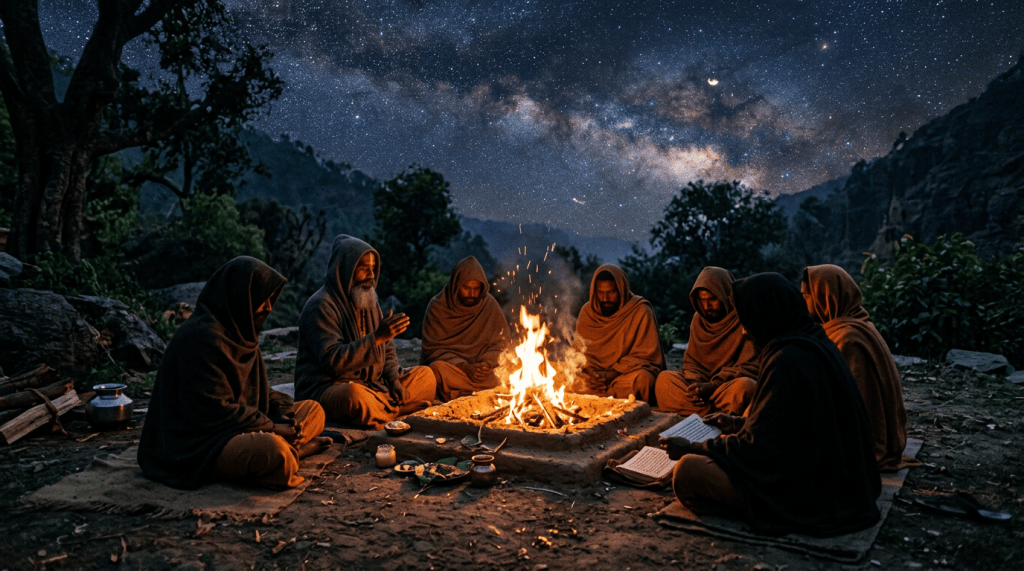
The Rig Veda is not the work of a single author. Nor is it an anonymous compilation. It is something more complex and more fascinating: the product of several generations of families of seers — the rishis — whose names are precisely preserved in the text itself, verse by verse, hymn by hymn.
Every hymn of the Rig Veda carries its signature. We know who composed it. We know which family they belonged to. We know in which metre it was composed. This precision is itself a form of transmission — the transmission not only of the content of the hymns, but of their origin, their lineage, their history.
The rishi: seer, sage, poet
In the introduction to my translation of the Rig Veda, I formulate it thus: rishi is translated as seer, sage or poet. They are the authors of the hymns. Some of them were the Purohitas of kings — the officiating priests attached to a chief’s court.
But the definition of the rishi does not reduce to a social function. A rishi is someone who has seen — who has had access, through the experience of soma or another contemplative practice, to a dimension of reality that ordinary consciousness does not perceive, and who has put it into words. The mantra is not invented by the rishi. It is revealed to them — śruti, « what is heard, » is the term the tradition uses to designate all the Vedic texts. The rishi is the one whose ear is fine enough to hear what is said in the depths of the cosmos.
And in the introduction to my translation, I specify something important about transmission: the lineage of teachings does not necessarily pass from father to son — it passes from master to student. Even today, certain brotherhoods of sadhus and tantric teachings pass through lineages of an ancient rishi. From master to student, not father to son.
The eight families and their mandalas
The Rig Veda is organized in ten mandalas. Mandalas 2 to 7 — the six « family mandalas » — are the oldest. Each is associated with a family of rishis whose members composed the majority of its hymns, and who transmitted it from generation to generation.
Mandala 2 belongs to the Gṛtsamada Bhārgava Śaunaka family — and its principal rishi, Gṛtsamada, composed the most developed hymns on Rudra. It is he who formulates in hymn 2.33 the most complete portrait of this terrifying and compassionate force.
Mandala 3 belongs to the Viśvāmitra family — one of the most celebrated in the entire Vedic tradition. Viśvāmitra is that legendary rishi who, starting from a warrior lineage, became one of the greatest sages of his time after an extraordinary inner transformation. It is he who composed hymn 3.62 — and in this mandala is found verse 3.62.10, the Gāyatrī mantra, the most recited in all of human history.
Mandala 4 belongs to the Vāmadeva Gautama family — whose hymns are among the most mystical and contemplative in the entire Rig Veda.
Mandala 5 belongs to the Atris — a family whose name means « the one who eats » or « the one who devours darkness. » The Atris composed some of the most beautiful hymns to the Maruts (5.54-58), to Sūrya (5.81-82) and to Pṛthivī (5.84).
Mandala 6 belongs to the Bharadvāja Bārhaspatya family — a family of court priests whose founding rishi is Bharadvāja, one of the seven legendary sages (saptarishi). It is Bharadvāja who composed the series of hymns to Pūṣan (6.53-58) and the richest hymns on Sarasvatī (6.61).
Mandala 7 belongs to Vasiṣṭha — the most celebrated rishi in the entire Vedic tradition, legendary rival of Viśvāmitra. Vasiṣṭha composed the most tender hymns to Uṣas (7.75-80) and to the Sarasvatī (7.95-96). It is he who also intervenes in the Battle of the Ten Kings (hymns 7.18 and 7.33) to support King Sudās.
Mandalas 1 and 8 are more heterogeneous compilations. Mandala 1 contains hymns from many families — notably the Kaṇvas, whose members always bear the family name Kaṇva and who composed some of the most musical hymns in the Rig Veda.
Mandala 9 — the Soma mandala — is a compilation entirely devoted to purified soma, with contributions from almost all families.
Mandala 10 is the most recent. It reflects a time when Vedic society was in transformation — one finds the first mentions of castes, developed funeral hymns, and philosophical hymns like the Nāsadīya Sūkta.
The Vasiṣṭha-Viśvāmitra rivalry: a family war in the text
One of the most human and fascinating dimensions of the Rig Veda is the way rivalries between rishi families show through in the text itself.
The rivalry between Vasiṣṭha (mandala 7) and Viśvāmitra (mandala 3) is the most celebrated. In the Battle of the Ten Kings — the greatest internal conflict in Vedic society of which the Rig Veda bears witness — Viśvāmitra was the priest of King Sudās before being replaced by Vasiṣṭha. This rivalry between the two royal priests, between the two families, crystallized into an opposition that runs through all of Indian epic tradition — in the Mahābhārata and the Rāmāyaṇa, Vasiṣṭha and Viśvāmitra are always rivals.
Hymn 3.33, composed by Viśvāmitra himself, recounts how he opened the waters of the rivers for Sudās’s army to cross — a demonstration of ritual power and military support that says how deeply the rishis and their families were involved in the political affairs of their time.
The transmission: mouth to ear, across millennia
What is perhaps most extraordinary in the history of the rishi families is the fidelity of transmission.
In the introduction to my translation, I underline this: the Rig Veda was transmitted orally for at least four thousand years — and the current transmission of the text in certain Brahmin families of Kerala and Andhra Pradesh corresponds, with very few variants, to the text written fifteen hundred years ago. The technique of padapātha recitation — word by word, alternated with continuous recitation — ensured a redundancy that allowed errors to be corrected.
But there is something still deeper than the technique. What made this transmission possible across millennia is the families’ attachment to their heritage. Vasiṣṭha’s mandala is their mandala. Bharadvāja’s hymns are their hymns. They carry them as one carries one’s name — with a sense of responsibility and a pride that go beyond mere mechanical memory.
This form of transmission — through family lineage, from master to student, with technical precision and emotional fidelity — is perhaps one of the most effective modes of knowledge preservation that humanity has ever invented.
It has survived the disappearance of the 7 Rivers civilization, the drying up of the Sarasvatī, invasions, empires, centuries of darkness. And these families still recite today the hymns that their ancestors heard on the banks of the Sarasvatī four thousand years ago.
 Le Rig Veda
Laisser un commentaire