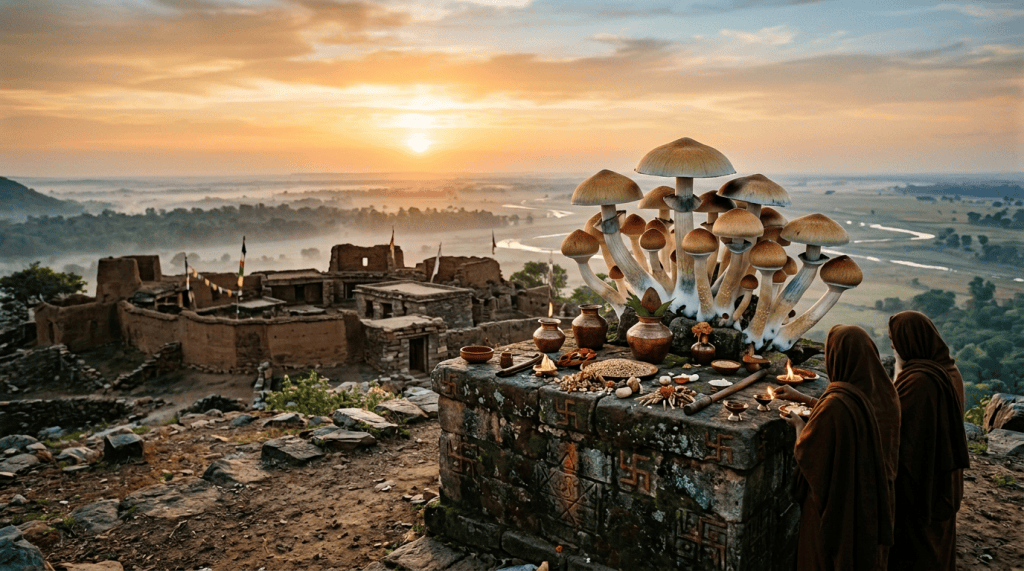
Four thousand years ago, on the plains of the Sarasvatī, men and women were drinking an entheogenic substance in a precise ritual framework, guided by specialized priests, prepared by days of fasting and mantra recitation. What they experienced during those hours — the rishis described it in one hundred and fourteen hymns of the ninth mandala of the Rig Veda: bliss, plenitude, ego dissolution, contact with eternal light, feeling of immortality.
What they were describing, contemporary medicine is rediscovering. And this meeting between the oldest spiritual literature of humanity and the laboratories of Johns Hopkins, Imperial College London and NYU is perhaps one of the most important of our time.
What soma contained
In the introduction to my translation of the Rig Veda, I establish this precisely: the soma plants contained a tryptamine — from the same family as the dimethyltryptamine (DMT) that we naturally generate in our own brain. This molecule is « triggered, » among other things, by yoga, meditation and especially pranayama.
The archaeological proof of the psychedelic nature of soma came from an unexpected place. In 2009, Russian archaeologists discovered in Mongolia a tapestry in a tomb dating from the first century CE, woven in Palestine or Syria and embroidered in the cities of the Indus. The motif depicts priests of Zoroastrianism — the Iranian religion directly descended from Vedism — venerating a mushroom identified as an Indian variety of the genus Psilocybe, containing psilocybin.
Now Zoroastrianism used the same drink as Vedism — called haoma in Avestan, soma in Sanskrit. Same word, same plant, same ritual. And in the ninth mandala of the Rig Veda, the descriptions are consistent with a psychedelic experience: never any mention of leaves, seeds, fruits or flowers — only fibres (aṃśu).
Stanislav Grof: the bridge between ancient and modern
The key figure bridging the Vedic tradition and contemporary medicine is Stanislav Grof — Czech psychiatrist, pioneer of transpersonal psychiatry.
In the introduction to my translation, I document this: for more than ten years, Grof treated patients — notably victims of severe trauma and people at the end of life — with LSD in a controlled clinical context. The results were remarkable: resolution of old traumas, reduction of death anxiety, mystical experiences described as the most significant of the patients’ lives.
Then came the wave of political and media repression of the 1970s. Clinical research on psychedelics was banned in the United States. Grof did not resign himself. With the help of Indian yogis, he developed an alternative technique: holotropic breathing — a technique of intense, sustained breathing that produces altered states of consciousness without any substance.
The most astonishing result of his decades of work: holotropic breathing produces exactly the same states as LSD. The same experiences of ego dissolution, mystical union, trauma resolution, contact with a transcendent presence. Without a molecule. With breath alone.
This result has a direct implication for understanding Vedic soma: if a rhythmic breathing technique can produce the same states as tryptamines, then it is probable that the rishis, who mastered pranayama, knew these states independently of soma. Soma was a tool, not the only path.
The research renaissance: Johns Hopkins and beyond
From the 2000s, and especially since 2010, clinical research on psychedelics has experienced an extraordinary renaissance. Under the impetus of Roland Griffiths at Johns Hopkins, Robin Carhart-Harris at Imperial College London, and a new generation of researchers, studies have multiplied.
Here are the principal documented effects, with their scientific references:
Expansion of consciousness — psychedelics provoke an expansion allowing individuals to feel a deeper connection with the universe or nature, described as mystical unity. (Griffiths et al., 2006)
Reduction of the ego — they temporarily diminish the sense of self, allowing individuals to feel more in harmony with others and the environment. (Carhart-Harris et al., 2016)
Exploration of spirituality — they encourage individuals to explore their personal spirituality and to seek a deeper meaning in life. (MacLean et al., 2011)
Experience of transcendence — users describe experiences where they surpass the limits of ordinary reality and enter a higher state of consciousness. (Pahnke, 1963)
These descriptions resonate with troubling precision with verses 7 to 11 of hymn 9.113 of the Rig Veda — in my translation:
9.113.7 — There, where eternal Light resides, in that world the Sun has been placed. Place me, O Purified One, in that immortal and imperishable world.
9.113.10 — There where desires and pleasures are, there where the reddish Sky is, there where comfort and satisfaction lie — there, make me immortal.
9.113.11 — There where bliss, plenitude, jubilation, Happiness reside — he sits there. There where one attains the delights of desire — make me immortal.
Bliss, plenitude, jubilation, immortality — the Vedic words and the words of contemporary researchers describe the same experience.
Current therapeutic applications
What distinguishes the contemporary renaissance from a simple repetition of the 1960s experiences is scientific rigour and therapeutic focus.
Psilocybin — the active molecule in Psilocybe mushrooms — shows remarkable results in treating treatment-resistant depression. Studies at Johns Hopkins and Imperial College show lasting remissions after two or three guided sessions — where years of conventional medications had failed.
Treatment of addiction — to alcohol, tobacco, opioids — shows success rates unprecedented in addiction research.
End-of-life care for patients facing existential anxiety linked to death: studies show that patients who have lived a guided psychedelic experience report a deep acceptance of death, dramatic reduction of anxiety, and often a transformation of their relationship to existence in their final weeks of life.
In all these protocols, what makes the difference from unguided consumption is not the molecule itself — it is the framework. The set and setting — the patient’s inner disposition and the environment in which the experience unfolds — largely determines the nature and therapeutic value of the experience.
The Vedic framework: four thousand years of wisdom
This is precisely where the Vedic tradition brings something irreplaceable to contemporary medicine.
In the introduction to my translation, I underline this: for everything to go well, it is essential that the soma experience be ritualized. The sacrifices were not occasions for recreational consumption. They were preceded by days — sometimes weeks — of preparation: fasting, physical purification, mantra recitation, work with an experienced guide.
This Vedic protocol anticipated by four thousand years what contemporary research is rediscovering: the crucial importance of the ritual framework. Griffiths, at Johns Hopkins, prepares his subjects for hours before each session. Carhart-Harris speaks of « integration » — the work that follows the experience to integrate it into daily life.
What the rishis understood, and what our societies forgot with the disappearance of soma, is that these states are not ends in themselves. They are doors. And like all doors, their value depends on what one does once one has crossed them.
What changed with the disappearance of soma
In the introduction to my translation, I document the deepest consequence of soma’s disappearance.
When soma disappeared — after the great drought of 2200 BCE that weakened the production zones, then that of 1900 BCE — substitutes took over: ephedra, cannabis, mixed to imitate the effects. Ephedra, whose active principle belongs to the amphetamine family, produces intense excitement but not ego dissolution. It does not allow one to know non-duality. It keeps one in what Vedic cosmology calls the Intermediate World — experiences can be impressive, but duality persists.
And with the loss of the experience of non-duality, the Ego progressively reasserted its rights. The castes solidified. Wars began. And religion replaced spirituality for the overwhelming majority.
Contemporary medicine, in rediscovering the therapeutic properties of psychedelics, is not merely discovering new medications. It is recovering a knowledge that the 7 Rivers civilization had institutionalized for fifteen centuries — and whose loss may have cost far more than we imagine.


Votre commentaire