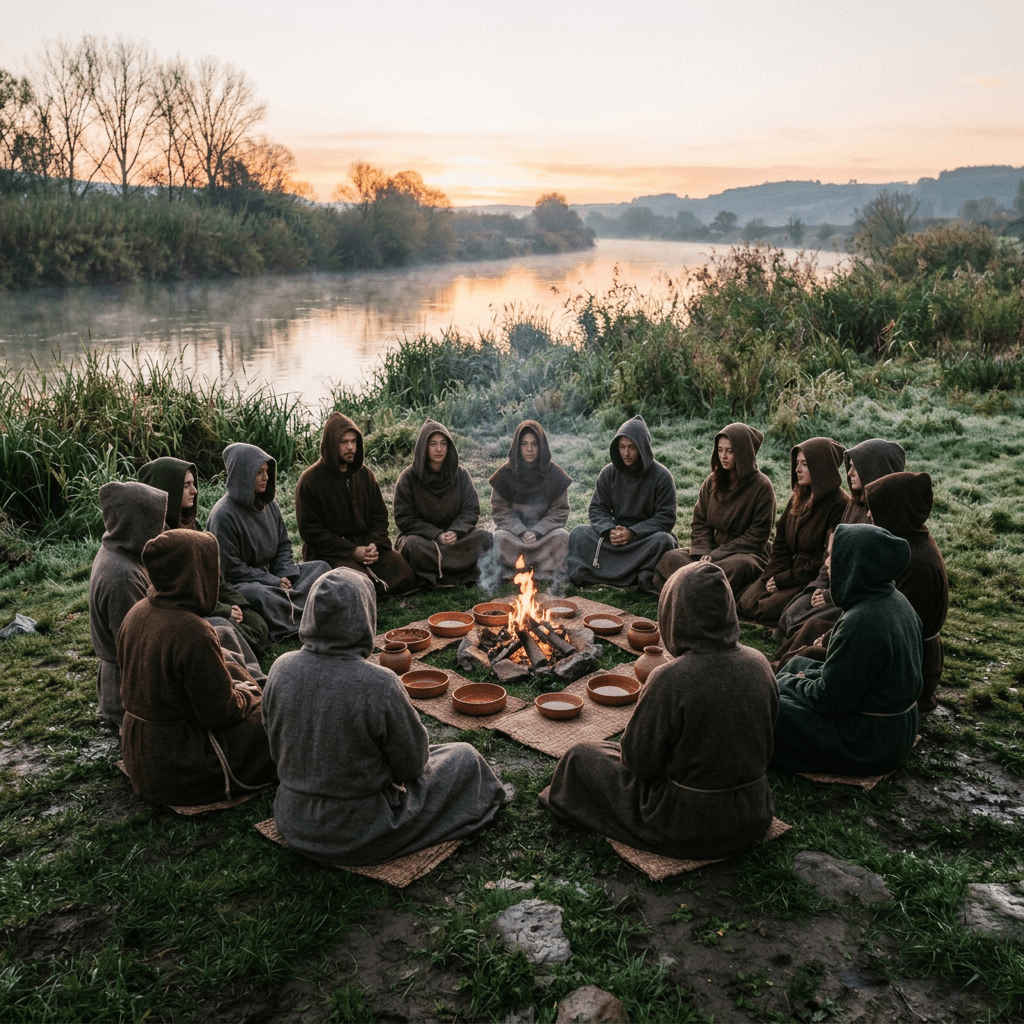
The Rig Veda is the oldest book in the world. But for millennia, it did not exist as a book. There was no parchment, no tablet, no palm leaf. There were voices — hundreds, thousands of voices — transmitting from generation to generation, from master to student, from father to son, a corpus of over ten thousand verses with a fidelity that defies imagination.
This oral transmission is not primitive archaism. It is a technology — one of the most sophisticated humanity has ever developed for preserving and transmitting knowledge.
An oral book for four thousand years
In The Civilization of the 7 Rivers, I insist on this fundamental point: the Rig Veda is, in its origins and throughout almost the entirety of its history, an oral text. It has been transmitted from generation to generation for at least four thousand years — and continues to be so today, in certain brahmin families of Kerala, Andhra Pradesh and Tamil Nadu, by the same techniques as four thousand years ago.
This is not a metaphor. Studies conducted on the current oral transmission of the Rig Veda in these families have shown that the orally transmitted text corresponds, with very few variants, to the written text compiled fifteen hundred years ago. The transmission error is lower than that observed in manuscripts copied by hand.
How is this possible?
The techniques of Vedic memory
The answer lies in the very design of the hymns. Every verse of the Rig Veda is constructed to be memorized — in its sonic form, its rhythm, its metric.
In The Civilization of the 7 Rivers, I describe this precisely: the rishis attached paramount importance to the sound produced by each verse. If the word that suited the meaning was not right for the required sound, the rishi created a new word from a Sanskrit root. If the correct grammatical declension did not fit the desired rhythm, it mattered little — rhythm came first.
This is why the Rig Veda contains hundreds of words found nowhere else in the entire history of Sanskrit — words created for their sound, not for common usage.
Metre — the number of feet per verse — was the primary memorisation tool. The Gāyatrī metre, three times eight feet, engraved the verse in memory through its regularity and musicality. The Triṣṭubh, four times eleven feet, produced a different effect. The Jagatī, four times twelve feet, yet another. These metres were not literary ornaments. They were mnemonic architectures.
The second tool was the technique of padapātha — word-by-word recitation, alternated with normal text recitation. Each verse was learned in two ways: in continuous flow, with its melody and rhythm; and in decomposed form, word by word, to identify each unit of meaning. This double recitation created a redundancy that reinforced memorisation and allowed errors to be corrected.
Reciting together: memory as a collective act
What distinguishes Vedic transmission from simple memorisation is its collective dimension. The hymns were not learned in solitude to be recited in solitude. They were recited in the sacrifice — in the presence of a community, with priests fulfilling precise roles, in a determined order, with codified variations of intonation.
In my translation of hymn 1.37.13:
When the Maruts travel, they speak together, everyone hears them.
This image of the Maruts — the troop of winds that speaks with one voice — is also the image of collective recitation. When the priests recite together, the individual voice dissolves into the common voice. The error of one is corrected by the accuracy of the others. Individual memory is sustained by collective memory.
And in hymn 1.85.1, again in my translation:
Those who, like women walking with grace, perform wonderful actions, are incitators.
Recitation is an action — an act that produces real effects on the consciousness of those who recite and those who listen. It is not an artistic performance. It is a collective spiritual practice.
Recitation as spiritual technology
In The Civilization of the 7 Rivers, I cite the documented effects of psalmody on the human body: sustained recitation on a single note sends vibrations to the crystalline palate, activating in particular the pineal gland and the hypothalamus. Concentrating on sound and meaning simultaneously engages cerebral zones that ordinary thought does not activate.
This is not mysticism. It is physiology. Contemporary neuroscience, studying the effects of meditation and rhythmic recitation on brain activity, documents these effects with functional MRI.
But the collective dimension of Vedic recitation goes further than effects on the individual. It creates something one might call shared memory — a representation of the world, an interpretation of existence, a set of values and metaphors that becomes the common substrate of a community.
Reciting together the same text across generations is to build together the same relationship with the world. It is to share the same way of naming inner forces, cosmic forces, the challenges of human existence. It is to keep alive, in minds and throats, a vision of the world that the death of each individual cannot take away — because it lives in the voice of those who continue.
What Vedic oral transmission says to our time
We live in a civilization that has bet everything on writing, print, digital — supports external to human memory. Libraries, servers, clouds store infinite quantities of information. And yet, transmission between generations has never been so fragile.
A child who has never heard an adult recite a poem from memory, who has never learned a text by heart until they feel it vibrate in their throat, who has never participated in a collective recitation — this child has no access to this dimension of human memory that the Vedic rishis had elevated to the rank of sacred art.
The Rig Veda survived four thousand years without a single book. It survived because men and women devoted their lives to carrying it in their memory and transmitting it with accuracy.
Our civilization could lose the essential of its cultural memory if the servers go dark.
 Le Rig Veda
Laisser un commentaire