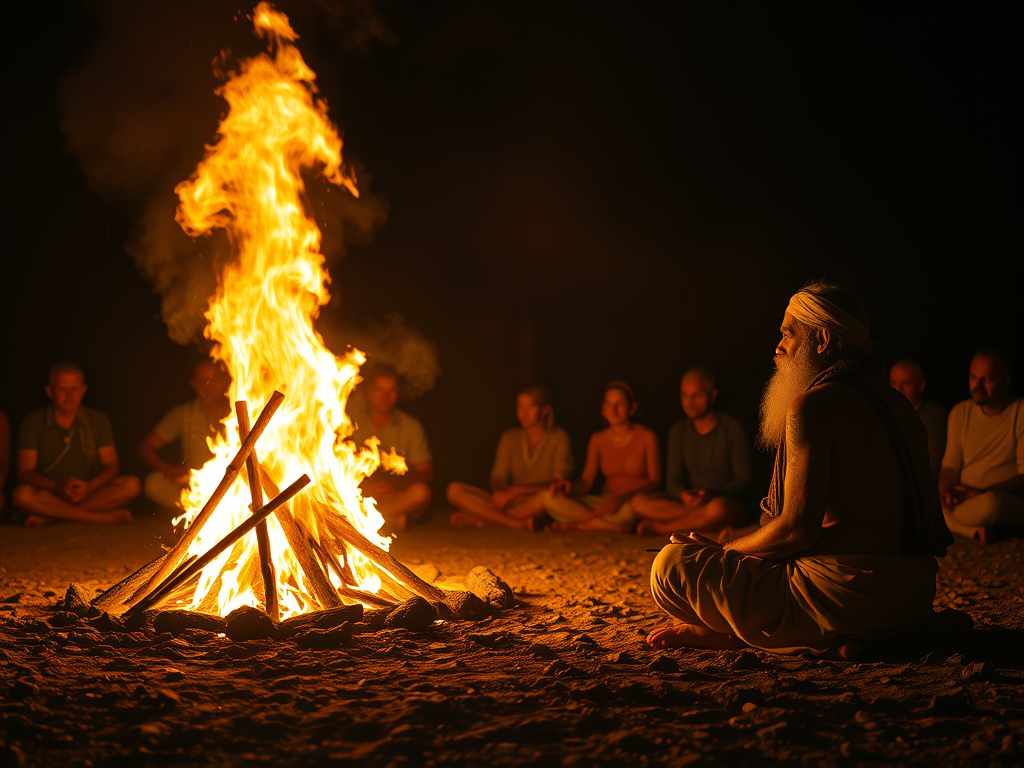
The word ego does not exist in the Rig Veda. Vedic Sanskrit has no term that corresponds to it exactly, and this is no accident. For a word to exist, the thing it describes must be sufficiently present and problematic for a community to feel the need to name it. In the Vedic civilisation of the first nine mandalas, the ego was not yet the central problem it would become. It was there, of course, but it was held in check by a regular and collective practice whose precise effect was to dissolve it. It is only in the tenth mandala, the most recent, the one that bears the traces of soma’s disappearance, that we begin to see the symptoms of what we would recognise today as a society dominated by egotistic constructions.
To understand what is at stake, we need to start from Vedic cosmology and from what the rishis meant by Vritra. Vritra is darkness. It is the one who covers, who obstructs, who prevents consciousness from moving toward the Light. It is the enemy that Indra, the warrior god armed with the thunderbolt, must strike down so that the waters are freed, the sun rises, and the Truth appears. Western translators long searched in Vritra for a historical adversary, an enemy tribe, a meteorological phenomenon. This is to miss the text entirely. Vritra is the ego. It is the mental structure that takes itself for the centre of the universe, that filters every experience through the narrow prism of its fears, its desires and its habits, and in doing so obstructs access to Brahman, to reality as it actually is.
The battle of Indra against Vritra, which recurs across dozens of hymns, is therefore a description of what happens inside a human being in the process of spiritual progress. Indra, associated with the senses and the intellect, is the force of awakening that fights inner darkness. His power is revealed through soma, the hymns state repeatedly. And this is not symbolic: it is literal. Soma, by temporarily dissolving egotistic constructions, allowed consciousness to see what Vritra had been concealing from it. The Light, the Cows, the Waters, the Horses — all the riches that the hymns ask Indra to conquer are metaphors for what becomes accessible when the ego releases its grip: clarity, fluidity, energy, vital force.
What contemporary research on psychedelics calls ego dissolution, the rishis experienced regularly within the framework of the sacrifice. Carhart-Harris and his team have shown that psilocybin reduces activity in the brain’s default mode network — precisely the network that is the seat of the narrative we construct continuously about ourselves, that uninterrupted flow of self-referential thoughts that constitutes what we call our ordinary identity. When this network quietens, something else appears. The rishis called it entering the Light. Neuroscientists call it an oceanic experience. It is the same thing described in two different vocabularies, separated by six thousand years.
What is remarkable about the first nine mandalas is the near-total absence of what we would recognise as collective egotistic manifestations. No glorification of military conquest, no cult of the leader, no hymns to the glory of a divinised king crushing others beneath his greatness. When a raja is mentioned, it is as a sacrificer — that is, as someone who takes part in the collective ritual and drinks soma like everyone else. A passage in the tenth mandala states: « They chose him as a people chooses its king. » This is not a despot who imposed himself by force. It is someone the community designated, who remains within the community. Archaeology confirms this reading: no trace of palaces, no prestige constructions, no display of individual wealth anywhere in the Indus-Sarasvati civilisation throughout its long period of maturity.
It is worth understanding what this implies concretely. A society in which all those responsible for its running regularly drink a substance that dissolves the ego and produces a profound sense of unity and fraternity cannot function like the societies we know. The mechanisms that ordinarily fuel war, slavery, compulsive accumulation of wealth and hierarchical domination are all grounded, to varying degrees, in egotistic constructions: the fear of scarcity, the need to feel superior, the confusion between personal identity and material possession. When these constructions are regularly suspended, collectively and ritually, the behaviours that flow from them are suspended too.
The soma shortage changes all of this brutally and irreversibly. This is not a metaphor. A widespread drought strikes the planet between 2200 and 2100 BCE. Soma, which requires precise conditions of humidity to grow, gradually disappears. Other plants are substituted — ephedra mixed with cannabis, blue lotus — which do not have the same effects. The rite continues, but the heart of the rite is no longer there. And without this regular and collective dissolution of the ego, something shifts profoundly in the way society functions.
The tenth mandala bears the visible traces of this transformation. It is there that the castes, the Varnas, appear for the first time, with their logic of fixed hierarchy. It is there that the first genuine moral lessons emerge, the first prohibitions formulated as such. It is there that the notion of reincarnation makes its entrance, as though the promise of another life had become necessary to compensate for what this life no longer gave directly. The Truth, which the hymns of the older mandalas describe as something one reaches, drinks, passes through, gradually becomes something one believes in, hopes for, waits for.
This is the passage from spirituality to religion, and the ego is at the centre of that passage. Vedic spirituality in the sense of the first nine mandalas was a practice of regular and collective dissolution of the ego into something greater. The religion that succeeded it is, like all religions, a social organisation built around individual and collective egos that need to believe in something because they can no longer — or no longer wish to — live it directly. The castes that harden, the priests who consolidate their power, the kings who divinise themselves: all of this follows mechanically from the disappearance of soma, that is to say from the disappearance of the only tool that allowed the ego to be put back in its proper place regularly and without ambiguity.
The Upanishads, which would come a few centuries later, attempted to recover by other means what soma had given directly. Yoga, meditation, pranayama, the work on the breath that naturally activates the same tryptamines: all of this is a response to the same question. How does one dissolve the ego without the plant? The answer exists, it works, but it requires years of assiduous practice where soma produced the result in a few hours. It is not the same civilisation. It is not the same relationship to time, to spirituality, or to the ego.
The Rig Veda is the testimony of a world where the ego had not yet won. Not because the people of that time were better than us, but because they had a collective, ritualised and effective tool for preventing it from taking up all the space. That tool disappeared. Everything else followed.
 Le Rig Veda
Laisser un commentaire