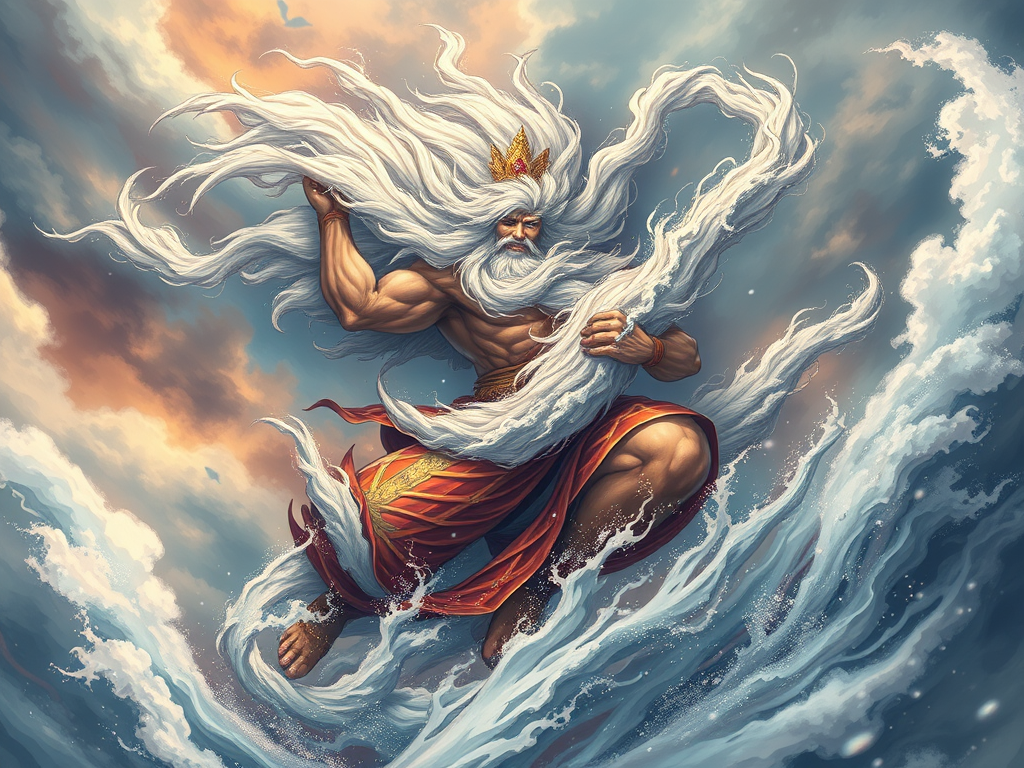
In the Rig Veda, Vāyu is the wind. Yet he is more than a meteorological phenomenon. He is movement, respiration, the invisible energy that moves through the world. His name comes from the Sanskrit root “vā”, to blow. Vāyu is the one who blows, the one who sets things in motion.
In the Vedic hymns, Vāyu is often invoked together with Indra. He is among the first to receive the soma. This detail matters. Breath and consciousness are connected. The outer wind and the inner breath are not separate. What the rishis describe on a cosmic scale also exists within the human being.
Vāyu moves between heaven and earth. He fills the intermediate space, the atmosphere. He is invisible, yet his effects are visible. He bends trees, lifts dust, announces the storm. He can be gentle or violent. Like human breath, he can be calm or disturbed.
In the Vedic vision, the world is not an inert mechanism. It is alive. It breathes. The wind that crosses the plains of Sapta Sindhu is not merely moving air. It is the expression of a vital force. Vāyu embodies that force.
Later, in the Upanishads, this intuition takes a more interior form through the concept of prāṇa. Prāṇa is the life-breath that animates beings. But this idea is already present in seed form in the Rig Veda. When Vāyu is invoked, it is not only to bring freshness or disperse clouds. He is recognized as a bearer of life.
Breath marks the boundary between life and death. A living being breathes. A dead being does not. This biological fact becomes, in the Vedic poets’ vision, a cosmic truth. The world itself breathes through Vāyu.
There is also a spiritual dimension. Breath links inner and outer. By inhaling, we take in the world. By exhaling, we return ourselves to it. Vāyu is this constant bond between the individual and the cosmos. He moves through everything, without belonging to anyone.
In the civilization of the seven rivers, which is connected to the Rig Veda, the relationship to nature was direct. Wind was not a scientific abstraction. It was experienced. It was felt on the skin, heard in the trees, seen in dust storms. To give a divine name to the wind was not poetic excess. It was a way of acknowledging that life depends on a fragile balance, on a breath.
Vāyu, as vital breath, is therefore not merely a wind god. He is the principle of movement and universal respiration. He reminds us that life is circulation, exchange, rhythm. Without breath, everything freezes. With breath, everything becomes possible.
 Le Rig Veda
Laisser un commentaire