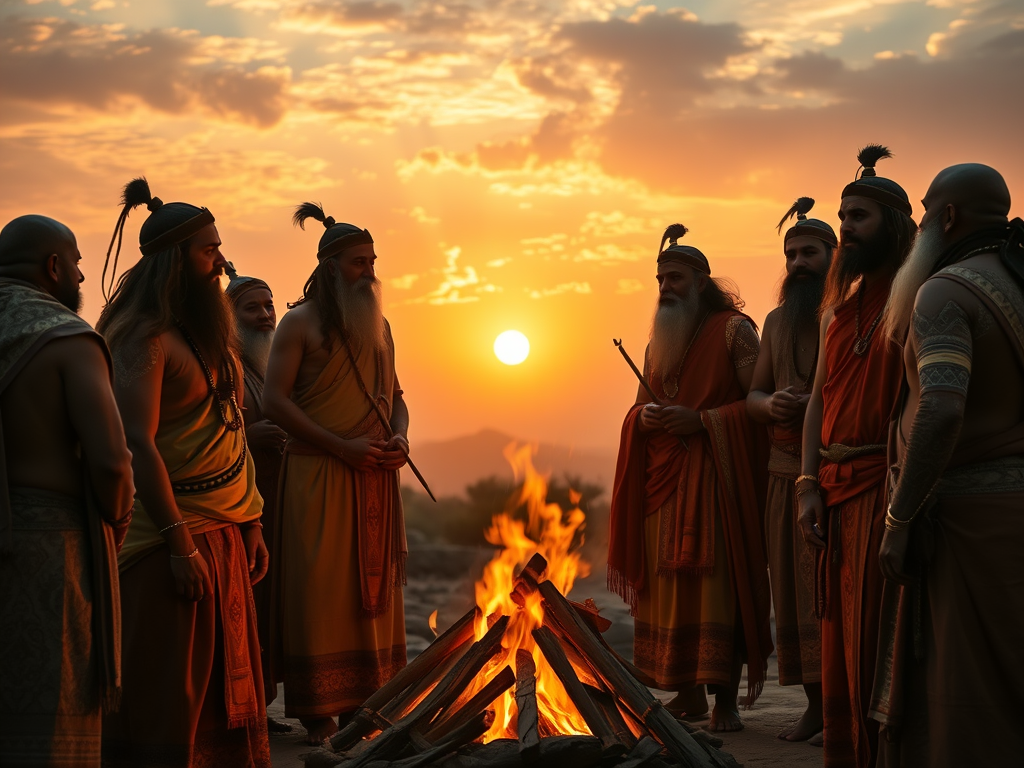
When we speak about the Civilization of the Seven Rivers, or Sapta Sindhu, we often focus on urban planning, hydraulic systems, architecture, and trade. Yet a careful reading of the Rig Veda shows that spirituality was not separate from daily life. It formed its invisible center.
In this civilization, spirituality was not confined to monumental temples nor reserved for a distant elite. It was lived at dawn, in the domestic fire, in chant, and in attentive observation of natural forces. Fire, Agni, was not an abstract deity. It was present in every household. It connected the home to the cosmic order. To light the fire was to participate in the balance of the world.
The Rig Veda describes a universe inhabited by divinized natural forces: Indra as energy and power, Ushas as dawn, Vâyu as wind, Surya as the sun. These forces are not distant from humanity. They are observed, invoked, and praised. Spirituality consists in recognizing that human beings live within a living network of relationships. They are not separate from nature; they belong to it.
Speech holds a central place. A mantra is not merely a formula. It is vibration, rhythm, breath. Daily recitation, transmitted orally with remarkable precision, structures consciousness. It disciplines the mind. It creates a link between the individual and the cosmos. The musicality of Vedic meters is not decorative; it acts upon the psyche.
The Vedic sacrifice, often misunderstood, was not simply a spectacular ritual. It expressed a fundamental law: giving sustains balance. The universe functions through exchange. Humans receive light, water, and food; in return, they offer praise, gratitude, and part of their goods. This principle nurtures a daily ethic grounded in measure and responsibility.
Society itself was conceived as an image of the cosmic body. Social functions were not rigid privileges but necessary roles for the proper functioning of the whole. Daily spirituality meant fulfilling one’s role with accuracy and without excess ego. Social order reflected cosmic order.
It is likely that certain practices related to Soma also contributed to this spiritual experience. Soma was not merely a drink. In Mandala 9 of the Rig Veda, it is light, purification, and elevation of consciousness. Whether it was an entheogenic plant or not, the text emphasizes its power to expand perception and dissolve the ordinary limits of the mind.
What stands out most is the absence of a sharp divide between sacred and profane. Cultivating the land, tending cattle, trading goods, chanting a hymn, lighting the fire — all belonged to the same order. Spirituality was not an occasional activity. It was a way of inhabiting the world.
In the Civilization of the Seven Rivers, daily spirituality rested on three foundations: harmonious relationship with natural forces, inner discipline through speech and ritual, and awareness of belonging to a cosmic order greater than the individual. This deep integration may help explain the social balance suggested by archaeology: limited signs of warfare, organized urban life, and material sobriety.
More than a religion in the modern sense, it was a culture of consciousness.
 Le Rig Veda
Laisser un commentaire