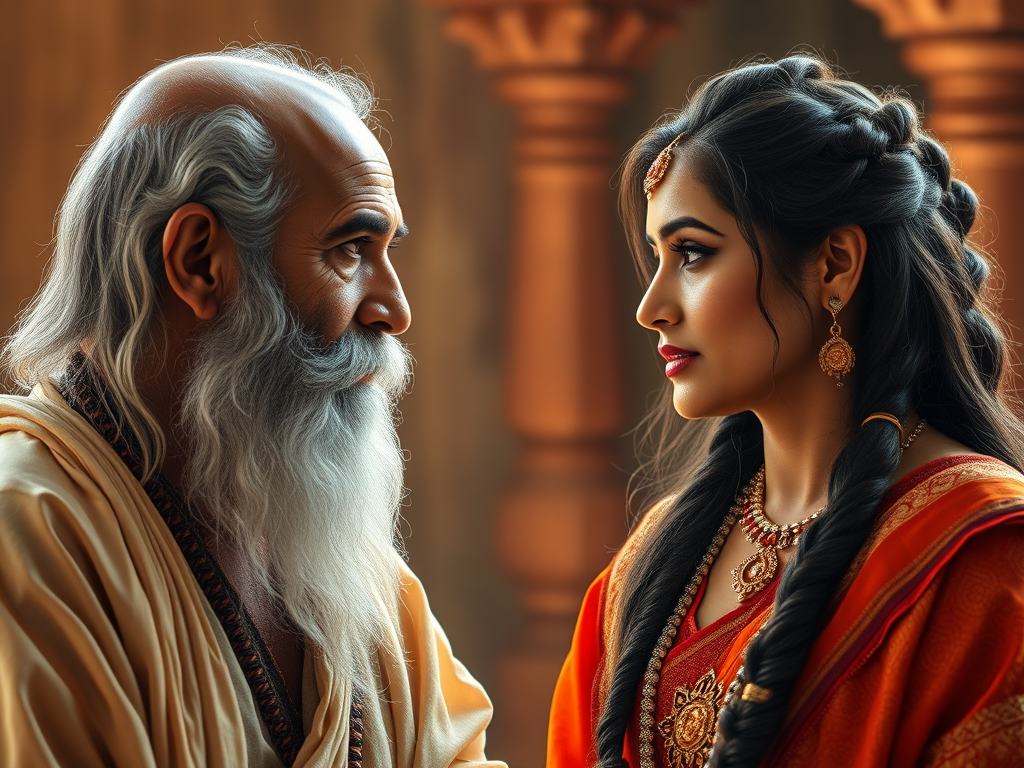
Rig Veda – Mandala I, Hymn 179
Agastya and Lopâmudrâ: The Dialogue Between the Sage and His Wife
Introduction
This hymn presents a rare and intimate dialogue between the sage Agastya and his wife Lopâmudrâ. It is one of the few hymns in the Rig Veda that openly explores human love, aging, and the desire for union — both physical and spiritual.
Through their exchange, the hymn reveals a profound Vedic vision: the reconciliation of asceticism and earthly life, of the spiritual quest and natural human longing.
Text of the Hymn (Translation)
Mandala 1; Hymn 179 – To Agastya, Lopâmudrâ
Rishi: Lopâmudrā; Agastya Maitrāvaruni
Meters: Triṣṭup; Nicṛt Triṣṭup; Nicṛt Bṛhatī; Virāṭ Triṣṭup
1 – (Lopâmudrâ speaks)
For many autumns, I have been tired from morning to evening through the Dawns which induce age.
Old age destroys the beauty of bodies. Let husbands now approach their wives.
2 – The ancients served the Truth. They spoke with the gods. Together they proclaimed the Laws.
They have not completely reached the limit of life. Therefore, let women unite with their husbands.
3 – (Agastya speaks)
There is no point in tiring when the gods lead us all into the battle that devours.
They lead the Winner, who has a hundred tricks here into battle when the couple looks in the same direction.
4 – A child’s desire was not born from a roar, it came from here.
Lopâmudrâ is imprudent, she exhausts the strength of her prudent husband. He is out of breath.
5 – I chant this soma, which is near us, which has imprinted itself in the hearts,
to have compassion for the offenses we have committed. Mortal has many desires.
6 – Agastya, therefore, desiring children, dug with a shovel and generated Strength.
The mighty rishi nourished the two colors, and among the gods, he obtained the Truth.
Interpretation and Commentary
Shloka 1
Lopâmudrâ, the wife of Agastya, speaks first. Her tone is weary but lucid.
She evokes the passage of time — “many autumns” — and the fatigue of life. The “Dawns which induce age” are symbols of the cycles of existence, and the fading of physical beauty. Her call, “Let husbands now approach their wives,” expresses a natural desire for union, not only physical but also a renewal of life’s energy.
Shloka 2
She recalls the example of the ancients who “served the Truth” and “spoke with the gods.” These are the ṛṣis of old, who lived in harmony with divine order (ṛta).
Lopâmudrâ’s argument is that even the sages, though devoted to truth, did not renounce human union.
Her plea is for balance — spiritual practice should not deny the laws of nature.
Shloka 3
Agastya responds. He sees life as a battle (yuddha) — not of violence, but of spiritual struggle.
He reminds her that all are led by the gods “into the battle that devours” — meaning the continual cycle of desire, death, and rebirth.
However, he concedes that when “the couple looks in the same direction,” their union can be a path toward victory — that is, toward harmony with divine law.
Shloka 4
This verse reveals the tension between ascetic restraint and earthly desire.
Agastya admits that Lopâmudrâ’s passion “exhausts” his strength, calling her “imprudent.”
Here, “the child’s desire” is symbolic — not merely physical conception, but the creation of spiritual energy through the union of opposites.
The image of “breathlessness” (out of breath) evokes both sexual exhaustion and the loss of prāṇa, the vital force.
Shloka 5
The sage turns inward, invoking Soma, the sacred plant of illumination.
He seeks compassion “for the offenses we have committed” — perhaps referring to the conflict between duty and desire.
The phrase “Mortal has many desires” encapsulates a Vedic truth: the human being is a field of impulses, which must be purified rather than repressed.
Shloka 6
Finally, Agastya acts: “desiring children, he dug with a shovel.”
The act of digging represents penetrating the depth of existence. The “two colors” he nourishes — light and darkness, male and female, body and spirit — symbolize the dual forces of creation.
By accepting the call of life, Agastya attains “the Truth among the gods” — he transcends duality through union.
Conclusion
This hymn unites the sacred and the human.
Through the dialogue of Agastya and Lopâmudrâ, the Rig Veda teaches that true spirituality embraces life rather than rejecting it.
The power of the sage lies not in denial but in integration: reconciling passion with wisdom, desire with awareness.
Their union becomes the very act by which divine truth manifests in the human realm.


Votre commentaire