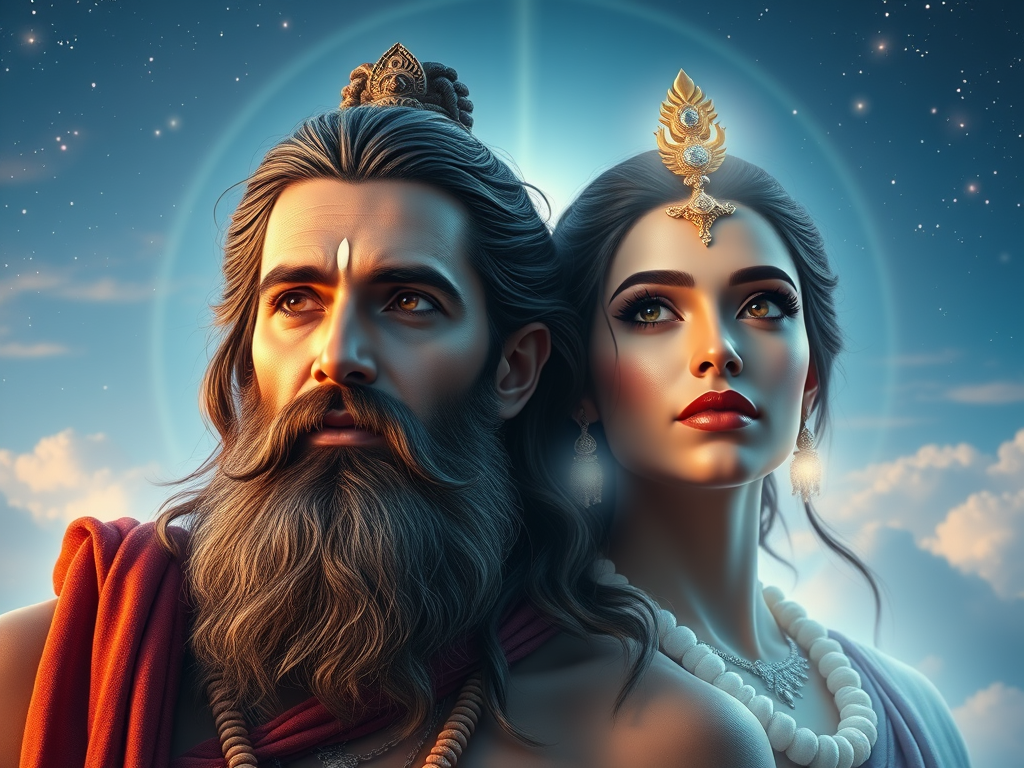
Rig Veda – Mandala 10, Hymn 10
Dialogue between Yama and Yamī
Introduction
This hymn is one of the earliest moral dialogues in human history.
It stages the twins Yama and Yamī, children of the Sun (Vivasvat).
Yamī, driven by desire, wishes to unite with her brother, while Yama, the embodiment of restraint, refuses.
The text goes far beyond the theme of incest: it symbolizes the triumph of moral awareness over instinct, the birth of conscience, and the separation between Heaven and Earth, a central theme in Vedic cosmology.
1 – (Yamī speaks)
I can transform the friend through friendship, through many flowing streams. The sages have placed patience toward the son of the father, toward the farthest Light.
Commentary:
Yamī tries to justify her desire by appealing to the natural flow of life.
The “flowing streams” represent the vital and instinctive forces.
Yet she already evokes “patience” and “the farthest Light” — a sign that her inner self senses another, higher path.
2 – (Yama speaks)
Your friend does not want your friendship, which bears marks of different forms. The sons of the great Asura, the heroes, have brought the knowledge of the distant Heaven around us.
Commentary:
Yama refuses.
He points out the difference between them — not only in form, but in cosmic function.
The “sons of the great Asura” symbolize primordial beings who established cosmic order.
Yama aligns himself with that order, opposing heavenly knowledge to earthly desire.
3 – (Yamī speaks)
The immortals wish for you a lineage from the only mortal. Your spirit descends and is placed in mine. The husband must enter the body of his wife.
Commentary:
Yamī now uses a religious argument: she claims divine approval for their union.
Her words mix spirit and flesh — “your spirit descends into mine.”
Yet her final verse reveals the fall from spiritual union to carnal desire.
It is the instinct seeking divine justification.
4 – (Yama speaks)
What we have not done before, should we do it now? In speaking truth, should we speak lies? The Gandharva in the waters and the maiden in the waters — that is our umbilical bond, our highest kinship.
Commentary:
Yama recalls the cosmic memory: their bond is not erotic but ontological.
The “umbilical bond” refers to their shared origin in the waters of creation.
He distinguishes spiritual unity from physical union — affirming that to respect cosmic law is to maintain differentiation.
5 – (Yamī speaks)
Now, the master of the house has generated us in the womb. Which god gives all forms: Tvashtri or Savitri? No one violates his laws. Heaven and Earth understood them for us both.
Commentary:
Yamī invokes Tvashtri (the shaper) and Savitri (the generator) to claim: “If all forms come from one act, why forbid ours?”
But she misunderstands creation’s cycle: Heaven and Earth were once united, then separated to allow manifestation.
Her wish is to return to unity; Yama’s mission is to preserve the order born from separation.
6 – (Yama speaks)
Who knew that first day? Who saw it? Let him tell here. Great is the house of Mitra and Varuna. What obscenities do men utter in their seduction?
Commentary:
Yama raises the question to a cosmic level.
He reminds her that law is not man-made; it is harmony observed by Mitra (the bond) and Varuna (the order).
His last line suggests that desire can distort truth, just as falsehood clouds the light.
7 – (Yamī speaks)
The desire for Yama, my twin in the womb, came to me — to be together in the same bed. As a wife abandons her body for her husband, we could be torn apart like the two wheels of a chariot.
Commentary:
Yamī confesses her physical longing.
The image of “the two wheels of a chariot” expresses both unity and inevitable tearing apart.
Even in her passion, she evokes division — the paradox of desire.
8 – (Yama speaks)
The spies of the gods who come here are not still; they do not close their eyes. With another than me, a lustful one, go quickly to be torn like two wheels of a chariot.
Commentary:
The “spies of the gods” are the eyes of conscience.
Yama warns that the divine sees all.
Yet he does not condemn her desire — only redirects it.
Desire is not evil; it must find its rightful channel.
9 – (Yamī speaks)
Day and night she could serve him; she could raise him in the eye of the Sun instantly. Heaven and Earth are a couple; Yamī can bear not being kin to Yama.
Commentary:
Here, Yamī begins to accept.
She recognizes that Heaven and Earth, not the twins, form the true cosmic couple.
She transforms her passion into devotion and endurance — a first glimpse of transmutation of desire.
10 – (Yama speaks)
Parents of all ages will come here to witness the non-kinship. Keep your arms closed for the Bull and quickly seek another husband than me, one who will suit you better.
Commentary:
Yama speaks now as a moral founder.
He sets a principle valid for “all ages”: incest is against the order of life.
The “Bull” represents male potency; Yama redirects it toward another, establishing the separation between instinct and duty.
11 – (Yamī speaks)
What brother lies when he says he will not help? What sister can reject what comes from below? Driven by love, many times I say: mix your body with mine.
Commentary:
Yamī makes one last emotional appeal.
She accuses Yama of coldness and defies the inner law.
Her reference to “what comes from below” clearly denotes instinctual energy, which she cannot yet sublimate.
12 – (Yama speaks)
I must not languish for you. My body and yours must not mingle. I must not fertilize my sister — it would bring misfortune upon her. Have a proper relation with another than me, your brother. With another who will desire you, you will both rejoice.
Commentary:
Yama affirms the law of separation.
The act of restraint here is not repression but preservation of order.
To unite brother and sister would be to return to undifferentiated unity — to chaos.
He defines the first distinction between biological law and spiritual law.
13 – (Yamī speaks)
Alas, you are weak, Yama; we found neither mind nor heart in you. Another woman will unite with you surely, as a corset that binds you like climbing ivy.
Commentary:
Yamī, hurt, accuses him of lack of heart.
Her image of the “ivy” shows the nature of attachment — the will to entwine and possess.
She embodies the earthly feminine, still tied to the cycle of emotion and desire.
14 – (Yama speaks)
Another will embrace you, Yamī, and you will embrace him, like ivy climbing. Seek his mind, or let him come to know you, for great Happiness.
Commentary:
Yama ends with tenderness and clarity.
He blesses her future union and affirms love as a legitimate path, provided it follows divine order.
The dialogue ends in harmony — desire transformed into awareness, passion into peace.
Conclusion
This hymn is a dialogue between instinct and consciousness.
Yamī represents life’s natural drive, emotion, and sensuality.
Yama stands for moral clarity, spiritual order, and the birth of conscience.
Through their exchange, we witness the passage from nature to culture, from fusion to differentiation, from impulse to ethics.
It is perhaps the oldest known text where a human being chooses restraint over instinct, founding the very idea of moral awareness in Vedic thought.
 Le Rig Veda
Laisser un commentaire