Rig Veda – Mandala 1, Hymn 106
To All the Gods
Rishi: Kutsā Āṅgirasa
Metres: Jagatī; Nicṛt Triṣṭubh
Introduction
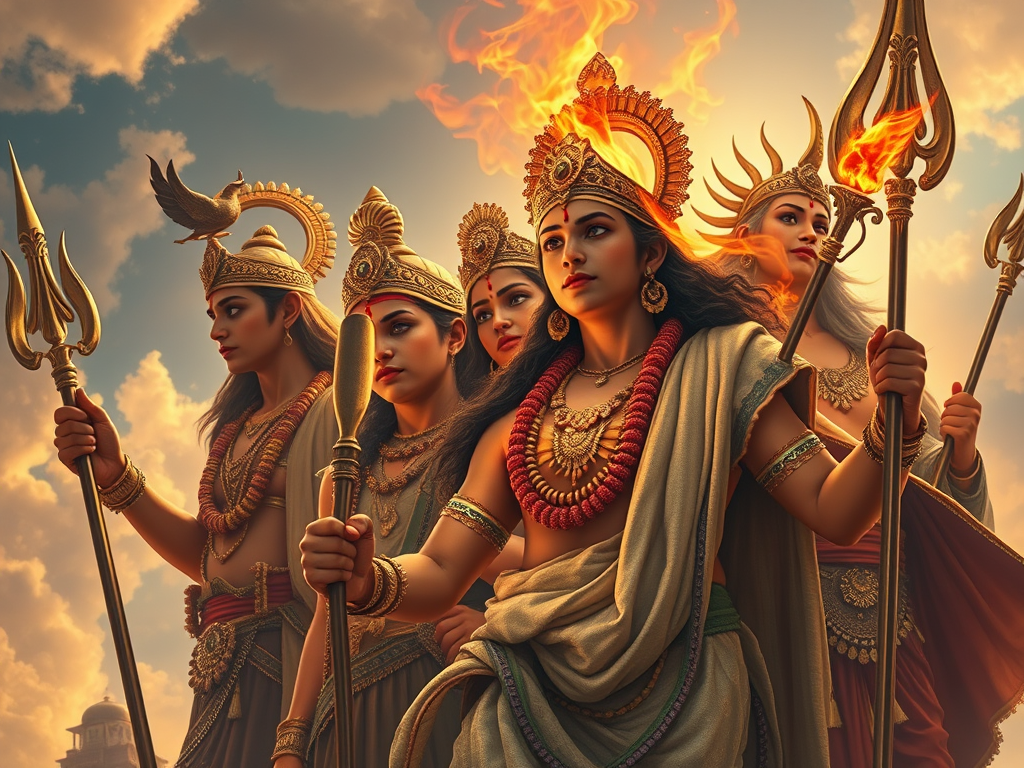
This hymn is a collective invocation to all the Vedic deities including Indra, Mitra, Agni, the Maruts, Aditi, and the Ādityas….
It expresses the seer’s trust in divine assistance and the unity of all spiritual forces.
The repeated refrain — “Like from a chariot in distress, the brave Vasus save us from all anguish” — symbolizes the divine rescue of the human soul when it falls into doubt or darkness.
The “pit” mentioned in the sixth verse refers to a spiritual fall, from which Indra, the power of consciousness, lifts the Rishi back to light.
Shloka 1
Translation:
We call for help Indra, Mitra, Agni, the host of Maruts, and Aditi. Like from a chariot in distress, the brave Vasus (the good ones) save us from all anguish.
Interpretation:
Indra stands for strength and clarity; Mitra for harmony; Agni for inner fire; the Maruts for life’s vital forces; and Aditi for infinite consciousness.
The chariot in trouble is the human being shaken by life’s trials — yet lifted by divine powers.
Shloka 2
Translation:
Come, Ādityas (sons of Aditi), for our full prosperity, to conquer Darkness. O gods, bring us Happiness. Like from a chariot in distress, the brave Vasus save us from all anguish.
Interpretation:
The Ādityas are the guardians of light and truth (ṛta).
They dispel inner darkness — ignorance and fear — granting spiritual wholeness rather than material gain.
Shloka 3
Translation:
May the Fathers of good renown help us, and the Goddess, Mother of the gods, who increases Truth. Like from a chariot in distress, the brave Vasus save us from all anguish.
Interpretation:
The ancient sages (Pitṛs) still radiate their light into the world.
Aditi, the universal Mother, nourishes Truth — the divine perception of Reality.
Shloka 4
Translation:
We implore the mighty Narâśaṃsa (another name of Agni, lit. “he who receives men’s praise”), who quickens here through Happiness, and Pūshan, who governs mankind. Like from a chariot in distress, the brave Vasus save us from all anguish.
Interpretation:
Narâśaṃsa, as Agni, represents the fire of praise and purification — the luminous intelligence within.
Pūshan is the spiritual guide who ensures safe passage along the path of truth.
Together they sustain the upward movement of consciousness.
Shloka 5
Translation:
We implore Brihaspati that our path be easy, to obtain from him the Happiness that is good for Men. Like from a chariot in distress, the brave Vasus save us from all anguish.
Interpretation:
Brihaspati, Lord of the sacred Word, harmonizes thought, speech, and action.
He bestows the peace that arises from wisdom and inner alignment.
Shloka 6
Translation:
Fallen into the pit, the Rishi called for Indra’s help, slayer of Vritra (the darkness), God of Power. Like from a chariot in distress, the brave Vasus save us from all anguish.
Interpretation:
Vritra represents darkness and obstruction — the forces that imprison the light.
Indra, the power of illumination, breaks these barriers and releases the waters of consciousness.
The Rishi’s fall and deliverance symbolize the soul’s journey from ignorance to enlightenment.
Shloka 7
Translation:
May the Goddess Aditi protect us with the gods; may the god guard us here, effectively. This mantra can be heard by Mitra, Varuna, Aditi, the Rivers, the Earth, and the Sky.
Interpretation:
The hymn ends with a universal blessing: divine protection extends to all creation.
The mantra vibrates through the natural elements, expressing the unity of the cosmos under Aditi’s boundless care.
Conclusion
This hymn brings together all the divine forces in one harmonious call.
The repeated refrain expresses faith in divine support at every fall.
The slaying of Vritra is the victory of light over darkness, consciousness over ignorance.
Aditi, the Mother infinite, gathers all gods and beings within her — the image of the total, unbounded consciousness.
 Le Rig Veda
Laisser un commentaire