English Version
To Indra
Rishi : Vāmadeva Gautama
Meters : nicṛttriṣṭup ; virāṭtrisṭup ; svarāṭpaṅkti ; triṣṭup ; paṅktiḥ ; nicṛtpaṅkti
Introduction
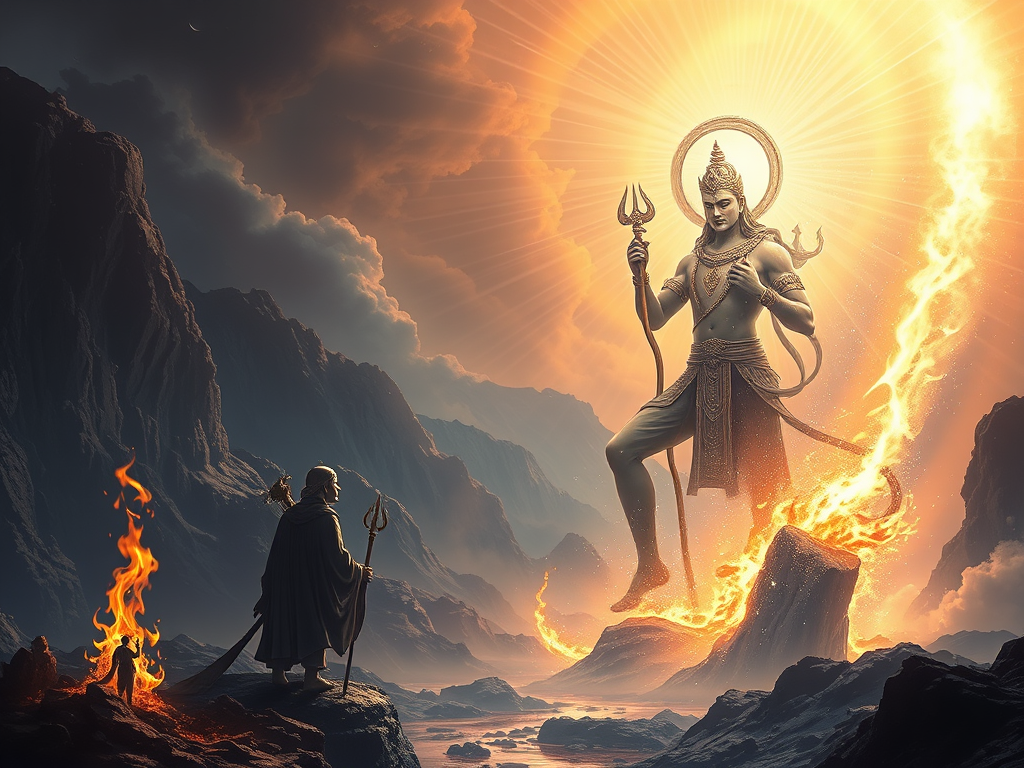
This hymn, composed by the rishi Vāmadeva Gautama, is dedicated to Indra, the god of thunder and strength. It celebrates him as protector, liberator, and giver of wealth. Soma plays a central role, for Indra is exalted and empowered by this sacred drink.
Verse by verse
1 – Translation
“From near or far, Indra comes to us, bringing powerful help. The lord of men, bearing his thunderbolt, with the strongest, defeats those who fight him in hand-to-hand battles.”
Explanation
Indra is close and always ready to intervene. He fights with his strongest companions — whether gods or men (note 1). His thunderbolt symbolizes immediate victory.
2 – Translation
“May Indra come to us with his bay steeds, bringing food and success. This generous bearer of the thunderbolt, giving exuberant success, stands with us in the sacrifice.”
Explanation
His bay horses are symbols of vitality and prosperity. His generosity flows especially within the sacrifice.
3 – Translation
“By placing the sacrifice before us, O Indra, you will win our intent. May we win in the battle of noble riches, as once when the hero slew like the gods.”
Explanation
Sacrifice is the key to Indra’s favor. Just as he once struck down the divine foes, he now grants wealth and victory to men.
4 – Translation
“You desire us with a pure mind, now in the presence of the good juice of soma that gives inner power. Drink the sweet offered to you, to be intoxicated by the plant that comes from above.”
Explanation
Indra is invited to drink soma, the plant that comes from the mountain (note 2). It intoxicates him with divine power, a symbol of inner strength shared with worshippers.
5 – Translation
“He is reached by the new rishis like a fruit tree, like a man with a sickle. I sing Indra, the venerable, invoked by many, as the mortal does of the woman.”
Explanation
Indra is likened to ripe fruit, gathered by the rishis. Song is the sacred offering that creates intimacy with the god.
6 – Translation
“He is self-powerful like a mountain, Indra the mighty, born for the rishis from the beginning. Terrible like the flood, with unbroken force, he fills the cup of the excellent.”
Explanation
Indra is compared to a mountain — eternal and firm — and to a mighty flood. He fills the cup of soma (note 3), the divine source of strength.
7 – Translation
“For him, by nature, the destruction of favors does not exist; he who holds power distributes wealth. O Mighty One, give us, give much wealth, you who are worshiped by many.”
Explanation
Indra never withholds, but constantly gives. His nature is generosity, and abundance is expected.
8 – Translation
“You are master of wealth and of the people’s homes; you freed the cows with your thunderbolt. You help the masses of men in battles for many treasures.”
Explanation
The myth of freeing the cows is recalled. Indra is shown as helper of men, supporting their fight for prosperity.
9 – Translation
“How is he known as the most powerful, to be honored? The noble does so instantly for the one who follows him. He is the one who most effectively removes anxiety from the pious. Thus, he gives wealth to the singer.”
Explanation
Indra’s greatness is seen in his swift help. He removes anxiety — the greatest enemy encountered in the soma experience (note 4) — and rewards the singer with wealth.
10 – Translation
“Do not abandon us. Bring what must be abundantly given to the pious. With this new gift, in this auspicious hymn that praises you, we laud you, O Indra.”
Explanation
The poet implores Indra to stay near and give generously. The new hymn itself is a living offering.
11 – Translation
“Now, O Indra, worshiped, now glorified, swell the energy like the flood of rivers for the chanting priest. For you a new hymn has been made, O Lord of the ruddy ones. By our mind may we be like a lasting chariot.”
Explanation
The hymn ends with a prayer for overflowing energy. The poet wishes for a strong and enduring mind, like a well-built chariot.
Conclusion
Indra appears as victorious warrior, liberator, and giver of wealth, but also as the drinker of soma, remover of anxiety, and source of inner strength. Through sacrifice and song, humans create a direct, living bond with him.
 Le Rig Veda
Laisser un commentaire