Rig Veda – Mandala 8, Hymn 21
To Indra, Sarasvatī, and Citra
Rishi: Sobhari Kāṇva
Metres: kakubuṣṇik; nicṛtpaṅkti; virāḍuṣnik; pādanicṛtpaṅkti; nicṛduṣṇik; bhurikpaṅkti; virāṭpaṅkti
Summary
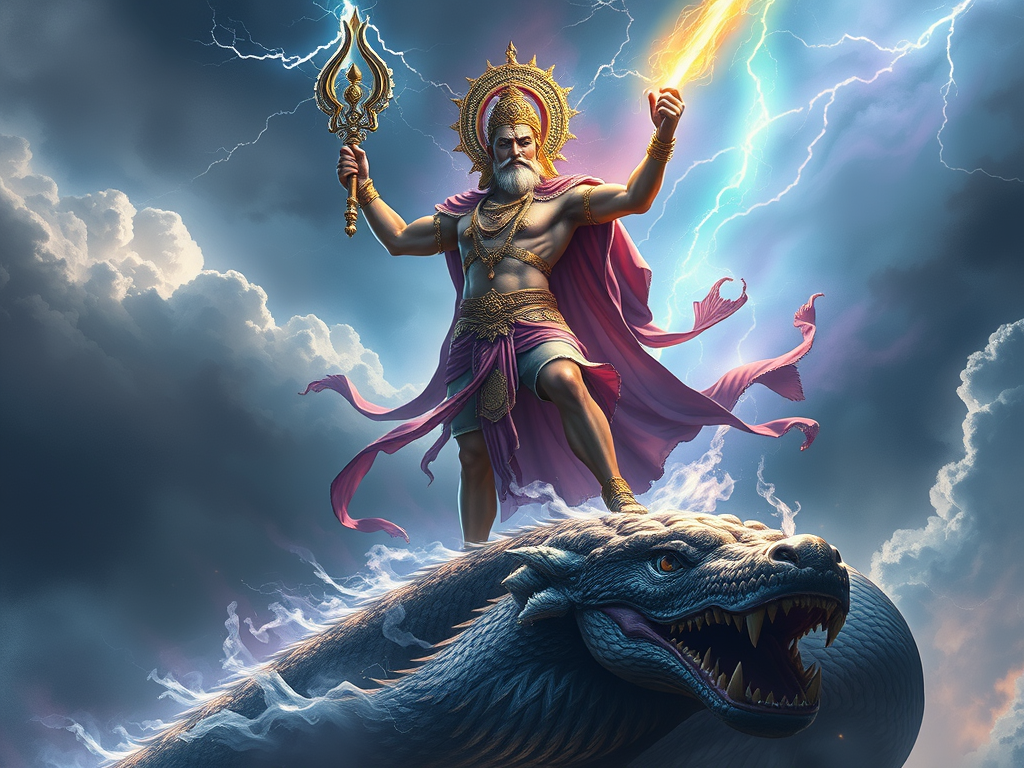
This hymn addresses Indra, the god of strength and thunder, while invoking Sarasvatī, the sacred river and source of inspiration, as well as Citra, a radiant deity. The faithful ask for protection, abundance, and light. They praise Indra as a friend, soma-drinker, and destroyer of darkness. The hymn also highlights the power of Sarasvatī and Citra against local petty rulers.
Hymn text with short commentary
1 – O You who have no predecessor and who are strong, we call upon you for luminous strength, we who seek your help.
→ Indra is seen as the primordial being, source of light and power.
2 – The mighty youth, vigorous and courageous, has come to you for help in his action. For you are the guardian chosen by us, your friends, O Indra who brings treasures.
→ Indra is the protector of the faithful, linked to prosperity.
3 – Come to these drops, O Master of Horses, Master of Cows, Master of fertile lands. Drink the soma, O Master of soma.
→ Soma connects men and Indra, source of fertility and divine strength.
4 – For we, the sages without connections, have supported you, who have many connections, O Indra. Come here, into these houses, O Bull, come with all to drink the soma.
→ The sages present themselves as humble but rely on Indra for collective strength.
5 – Like birds, seated as you wish, we offer you the sweet one, mixed with milk, intoxicating and exuberant. We cry out for you, O Indra.
→ The soma offering is joyful and communal, lifting the assembly.
6 – When we speak with you, with our homage, do you hesitate for a moment? Our desire is this: that you give, O You who are rich in bay horses. They are always in our thoughts.
→ The hymn expresses the expectation of a swift divine response.
7 – We have recently come to you, O Indra, by your help, O Possessor of the stone. The ancient abundance has enlightened us.
→ Indra’s past gifts are seen as promises for the future.
8 – We have recognized your friendship, O hero, and we appreciate it. That is why we go to you, O Thunderbearer. You sharpen each of us by your strength, O Excellent one, rich in cows, with beautiful cheeks.
→ Indra is the friend of the faithful, granting them vigor and energy.
9 – This ancient one, who has led each toward the best, I honor for his help, for Indra, for friendship.
→ The elder is seen as a guide toward Indra, guardian of transmission.
10 – The possessor of bay horses, master of the seat, ruler of peoples, has truly become intoxicated. Thus the generous one provides hundreds of cows and horses to those who honor him.
→ Indra’s sacred intoxication with soma opens the way to abundance.
11 – Surely, through you, through union, we can answer the one who resists, O Bull, at the gathering of cattle-rich men¹.
→ Union with Indra gives strength against opposition.
12 – May we be victorious in our accomplished acts, O you who are often invoked. May we resist evil thoughts, destroy darkness, and grow, O Indra, making our thought more favorable.
→ Victory is both spiritual and material: resisting inner darkness.
13 – You are without rival, without friend, O Indra, from your birth and forever. You desire friendship through battle.
→ Indra is unique, his power manifest in struggle.
14 – You know that no one can buy friendship with wealth. Those who drink alcohol insult you. But when you make noise, when you drive them, all together you call them like a father.
→ Indra punishes arrogance but remains a protective father.
15 – When we are with you, O Indra, we are not like old maidens who age in the household. We sit together at the pressing.
→ The shared sacrifice is a moment of vitality, not sterility.
16 – Do not deprive us of wealth, O Indra rich in cattle, do not disappoint us. We have seized the solid nobility that touches us. Bring it here! Do not bring it to those who insult you.
→ A clear request for protection and prosperity, denied to enemies.
17 – Is it Indra who gives so abundantly the gifts, or Sarasvatī, who has a good portion, O Excellent one? Or is it you, O Luminous one, who gives to the pious?
→ Indra, Sarasvatī, and divine light are linked in abundance.
18 – Citra² is the king. The others³, the spirits who live along the Sarasvatī, are but petty rulers. For, like the cloud, he spreads out, giving a thousand and ten-thousand⁴ through his rain.
→ Citra embodies superior radiance over limited earthly rulers.
Notes
- To those attending the sacrifice.
- Literally: “Brilliant.”
- The kings of the cities along the Sarasvatī.
- Ten-thousand gifts.
Explanatory article
This hymn of the Rig Veda (8.21) highlights the intimate relationship between the faithful and Indra.
Indra is invoked as protector, friend, and distributor of wealth, but also as inner strength that destroys darkness and purifies thought. The sacred drink, soma, is central: intoxicating, it nourishes the link between humans and divinity, bringing energy and abundance.
Sarasvatī, the sacred river, is mentioned for her nourishing and inspiring role. She represents continuity, fertility, and the vital force that sustains peoples.
Finally, Citra, “the Brilliant,” embodies radiant light that surpasses local rulers. Through this figure, the hymn affirms the superiority of cosmic powers over earthly authority.
This chant expresses a vision where divine strength (Indra), inspiration (Sarasvatī), and radiant light (Citra) combine to guide humanity. The requests are not only material (cows, horses, wealth) but also inner: to overcome evil thoughts and progress toward light.
 Le Rig Veda
Laisser un commentaire