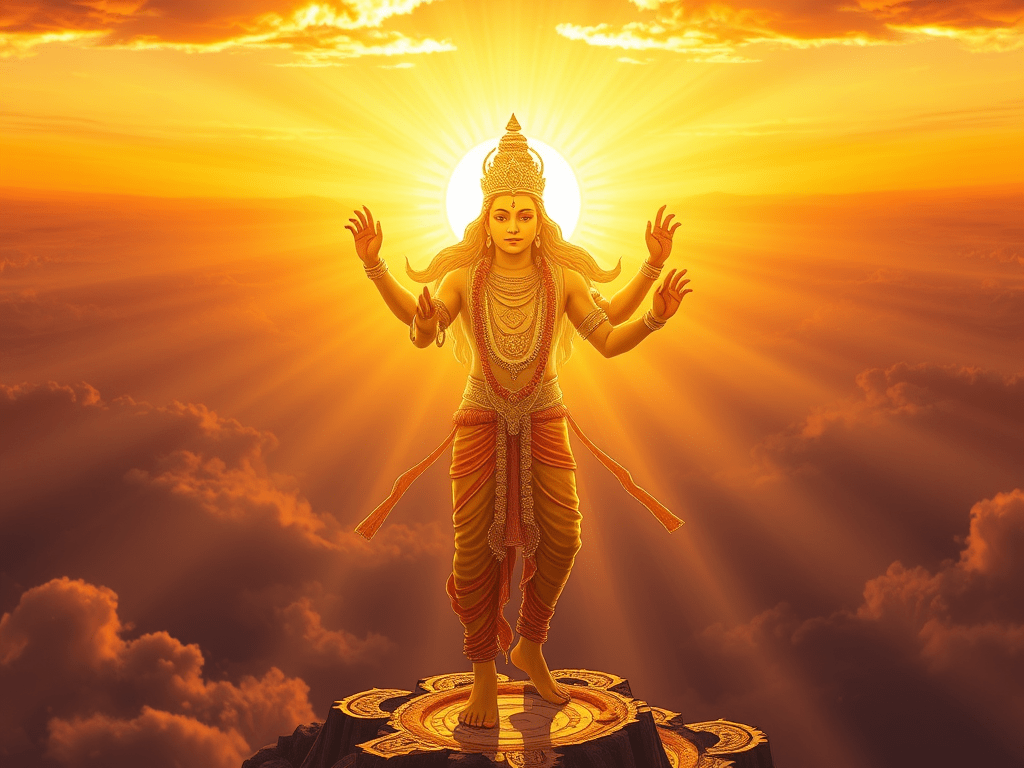
Vivasvān is an important figure in Vedic texts. He represents the sun, not just as a star, but as a luminous, living, and radiant presence. His name comes from the Sanskrit root vi-vas , which means “to shine,” “to diffuse light.”
In the Rig Veda, Vivasvān is an Aditya, that is, one of the sons of Aditi, the great mother goddess. The Adityas are divine forces linked to light, order, and truth. Vivasvān embodies this light that illuminates the world, warms living beings, and makes life grow.
But Vivasvān is not just a physical sun. He is also an inner light. He guides consciousness toward greater clarity, greater truth. In hymns, he is often associated with spiritual awakening. His light drives away darkness, not only that of night, but also that of the mind, illusions, and ignorance.
He is also the father of Manu, the first man, the one with whom humanity begins in the Vedic texts. This reinforces the idea that the sun is not just an object in the sky: it is the source of life, the origin of order, and the father of humanity.
When the Vedic sages invoked Vivasvān, they were asking not only for the light of day, but also for the light of the mind. A light that illuminates the world and transforms the inner being.
 Le Rig Veda
Laisser un commentaire