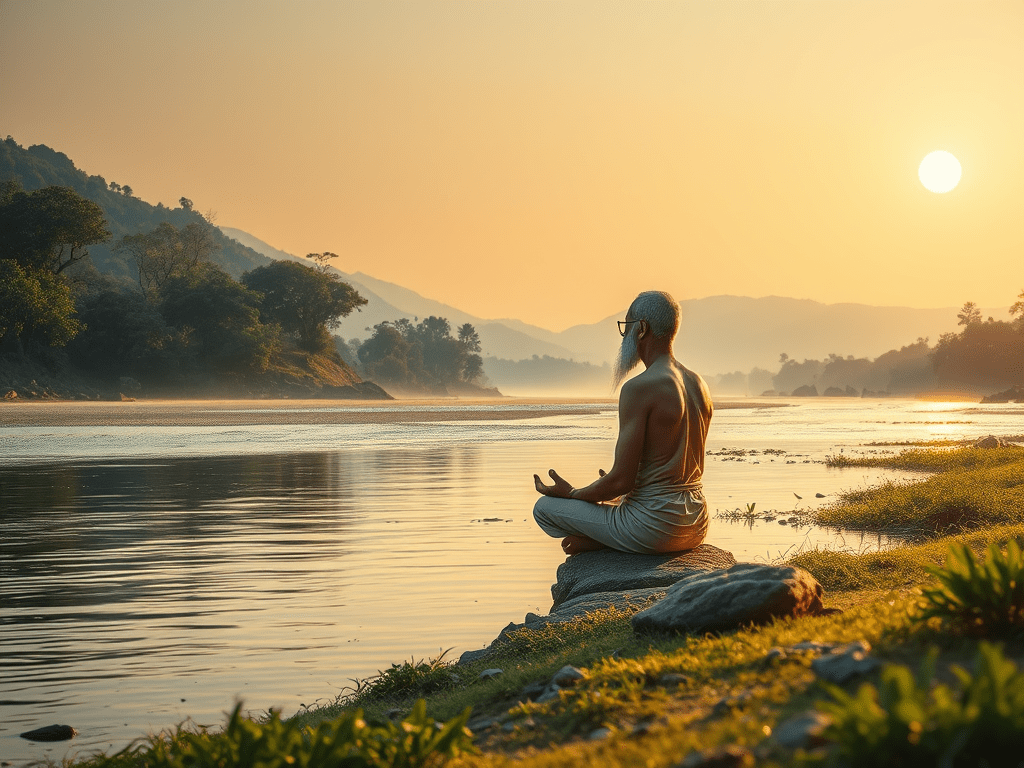
In the Seven Rivers (Sapta Sindhu) civilization, soma played a central role. This sacred beverage, derived from an entheogenic plant, allowed one to achieve a state of profound unity, beyond the mind and ego. But with the drought of 2200 BCE, this plant became rare, even impossible to find. Faced with this shortage, the sages had to seek other paths to reach this state of expanded consciousness.
Conscious breathing (prāṇa)
One of the first methods implemented was breathwork. In the Rig Veda, breath (prāṇa) is seen as a link between the body, mind, and the universe. By controlling breathing, one calms the mind, slows down thoughts, and opens a door to the inner world. This seemingly simple practice allows one to gradually dissolve the ego, without the need for external substances.
The chanting of mantras
The hymns of the Rig Veda are more than just prayers. They are powerful sounds, transmitted orally, with a precise vibration. By reciting them repeatedly, the mind empties. The individual ceases to see himself as a separate person and feels carried by something greater. The chanting of the mantra acts as an inner cleansing. There is nothing to understand, only repetition, with faith and regularity.
The inner fire (Agni)
Fire (Agni) was central to Vedic rituals. But this fire was not just an external flame. It also represented the inner fire, the one that burns away illusions, attachments, and pride. Rituals centered around Agni were designed to bring about inner transformation. Fire consumes all that is useless. The goal was to no longer want anything for oneself. To no longer possess anything. Just to be.
Silence and solitude
The sages of Sapta Sindhu knew that silence is more powerful than many words. Many of them went alone, into the forest or the mountains, to meditate far from the world. Without distraction, without noise, the ego eventually fades away. In these moments of solitude, they sought to listen to what is essential. What remains when we no longer think of ourselves.
Self-giving (yajña)
Yajna, often translated as « sacrifice, » did not mean killing an animal or burning something. It was an act of total giving. Offering one’s thoughts, actions, desires. Giving everything, expecting nothing. In this offering, the ego dissolves. There is no longer any separation between the giver and the given. Yajna was a direct path to the erasure of the self.
Union with nature
In this civilization, man did not consider himself superior to nature. He lived in connection with the rivers, the trees, the stars. He observed the seasons, the rains, the winds. Feeling an integral part of this greater whole, he no longer needed to assert himself. The ego lost its place. The connection with nature helped to rediscover a form of humility and unity.
Conclusion
When soma disappeared, the inhabitants of the Seven Rivers civilization did not abandon their inner quest. They found other paths. Through breath, song, fire, silence, giving, and connection with nature, they continued to seek the essential: to free themselves from the ego and find unity with the whole.
These ancient techniques are still valid today. They remind us that it is possible to live differently, in peace, without chasing after what glitters. Just be.
 Le Rig Veda
Laisser un commentaire